Why this works
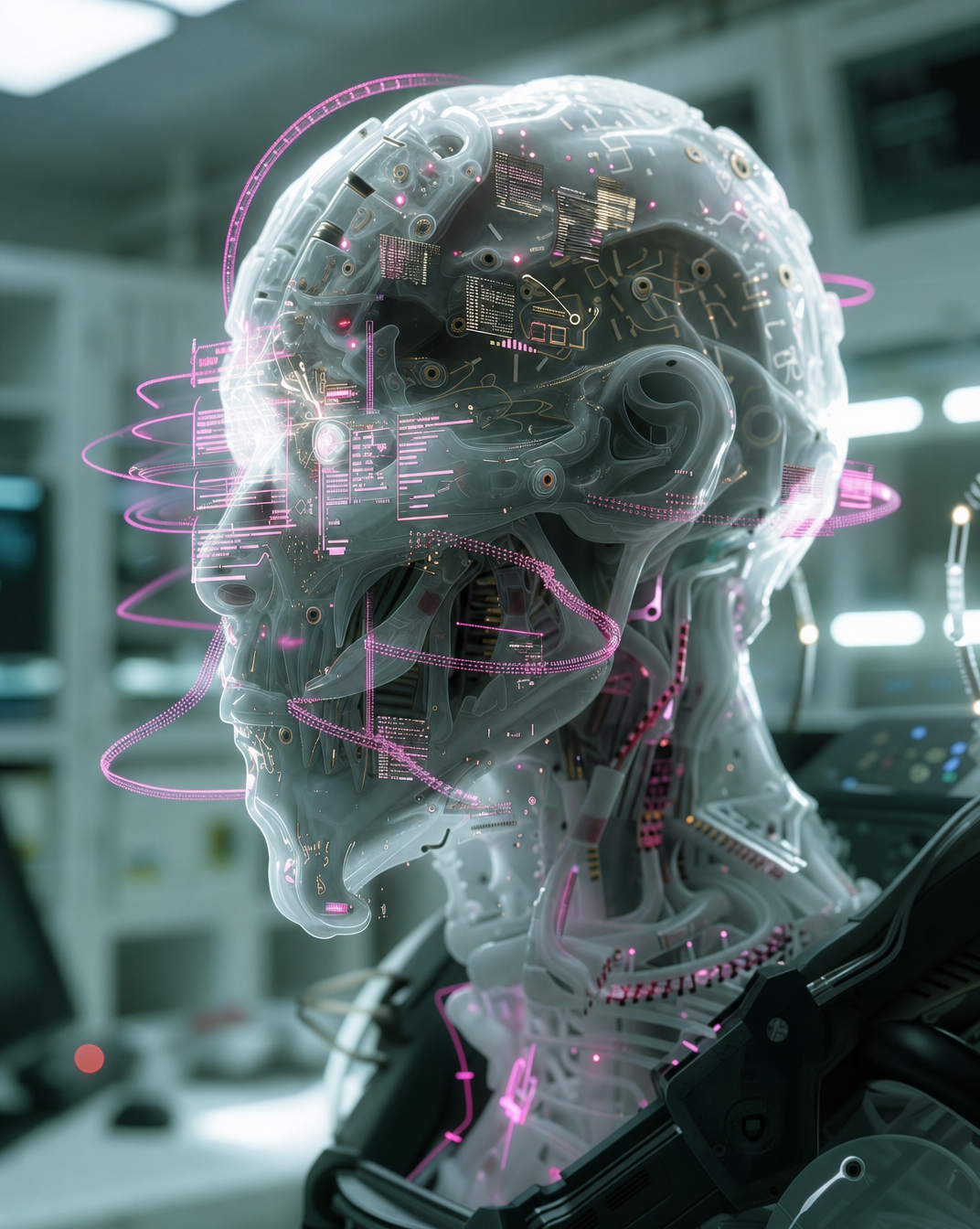
The portrait-closeup composition comes directly from “close-up framing on the head and upper torso,” while “shallow depth of field with sharp focus on the face” isolates the cyborg against the blurred laboratory. “Subtle magenta holographic interface elements” supplies the dominant pink accent against the black-and-white mechanical forms, and “cool rim light” plus “gentle subsurface glow through the translucent materials” separates the skull while revealing its internal circuitry. The mysterious tone is anchored by the explicit phrase “mysterious futuristic mood,” reinforced by the partially concealed “internal mechanical circuitry” and “slightly blurred” high-tech setting.
FAQ
→How do I make the holographic interface the most prominent element?
Replace “subtle magenta holographic interface elements floating around the face” with “large, bright magenta holographic interfaces layered across the face and extending beyond the skull.” Change “sharp focus on the face” to “sharp focus on the holographic symbols and facial interface,” and reduce “gentle subsurface glow” to keep the overlays visually dominant.
→How do I make this cyborg feel darker and more ominous?
Replace “soft cinematic lighting with cool rim light” with “harsh directional lighting with deep shadows and a narrow violet rim light.” Change “clean, high-tech sci-fi laboratory background” to “dark abandoned laboratory with damaged equipment and drifting smoke,” and replace “mysterious futuristic mood” with “ominous dystopian mood.”
→How do I turn this into a consistent series of cyborg portraits?
Keep the fixed identity phrases “translucent synthetic skull,” “fine gold-toned structural components,” and “magenta holographic interface elements,” then swap the subject descriptor for variants such as “aquatic-adapted cyborg,” “avian-inspired cyborg,” or “industrial repair cyborg.” Preserve “close-up framing on the head and upper torso,” “photorealistic sci-fi render,” and “clean composition” so each variation retains the same portrait format and visual language.
Learn the technique behind this
- Why can't AI spell, and how do I get readable text in an image? — Older diffusion models had no character-level representation of text, so they produced letterform-shaped texture instead of words.
- How should a prompt be structured, and does word order matter? — A prompt that behaves predictably names one subject first, then what it is doing, then where, then the light, then the lens or medium, then the style.
- Do negative prompts work, and what should go in one? — Negative prompts work on models that support a separate negative conditioning channel — mainly Stable Diffusion and FLUX-family models.