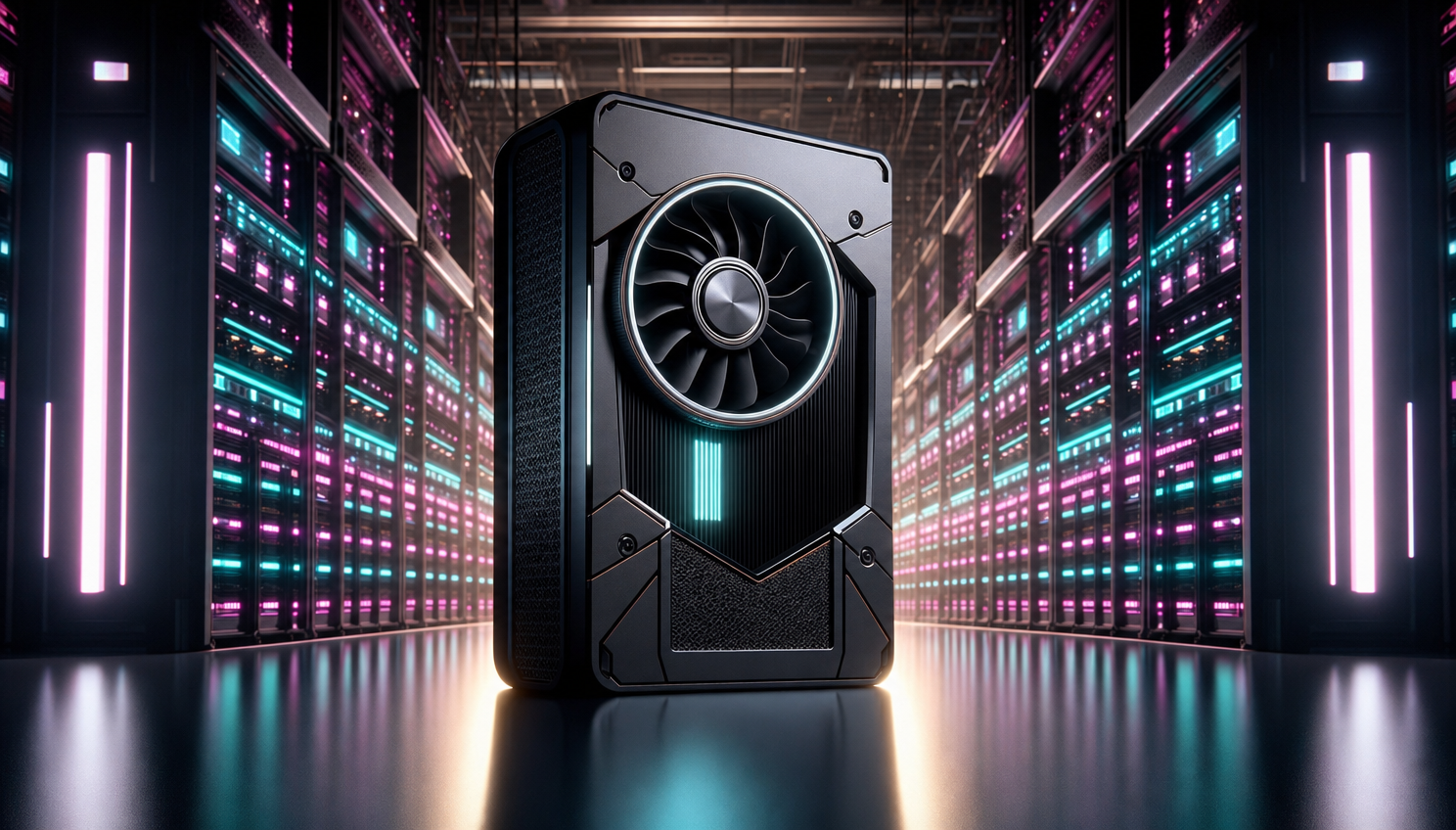
Why this works
The phrase “symmetrical centered product-shot framing” makes the upright graphics card the fixed visual anchor, while “glowing racks on both sides” reinforces its central placement and gives the scene a strong sense of scale. “Gunmetal with subtle copper inlays” supplies the gray metallic base, and “warm magenta and cyan accents” creates the pink-teal color harmony visible across the racks and reflections. The sleek, dramatic mood comes from “dramatic blue–magenta cinematic lighting,” while “ultra-detailed, sharp focus,” “photorealistic materials,” and “high contrast” keep the card’s fan, body, and copper details crisp rather than atmospheric or soft.
FAQ
→How do I make the graphics card feel larger and more dominant in the frame?
Replace “standing upright in the center” with “towering upright in the immediate foreground, filling most of the frame,” and change “symmetrical centered product-shot framing” to “low-angle centered hero shot.” Keep “server racks flanking both sides” to preserve the scale reference while making the card more imposing.
→How do I shift this from a dramatic neon scene to a darker, more premium mood?
Replace “dramatic blue–magenta cinematic lighting” with “low-key charcoal lighting with narrow cool rim lights,” and change “warm magenta and cyan accents” to “restrained amber and deep navy rack accents.” Replacing “high contrast” with “controlled contrast and deep shadow detail” will keep the gunmetal body refined instead of aggressively neon.
→How do I create a matching series with different hardware while keeping this visual identity?
Keep “symmetrical centered product-shot framing,” “modern data center server room,” “reflective floor,” “dramatic blue–magenta cinematic lighting,” and “photorealistic CGI cinematic product shot” unchanged. Replace only “futuristic graphics card” with subjects such as “upright liquid-cooling system with transparent tubing” or “tower workstation motherboard on a display plinth,” then adapt “visible cooling fan” to the new subject’s defining component.
Learn the technique behind this
- Why can't AI spell, and how do I get readable text in an image? — Older diffusion models had no character-level representation of text, so they produced letterform-shaped texture instead of words.
- How should a prompt be structured, and does word order matter? — A prompt that behaves predictably names one subject first, then what it is doing, then where, then the light, then the lens or medium, then the style.
- Do negative prompts work, and what should go in one? — Negative prompts work on models that support a separate negative conditioning channel — mainly Stable Diffusion and FLUX-family models.
Related prompts

DJ in neon haze at low angle

Glowing Fiber-Optic Cables With Purple Data Lines

Cyan Hologram, Sleek Robotic Hand
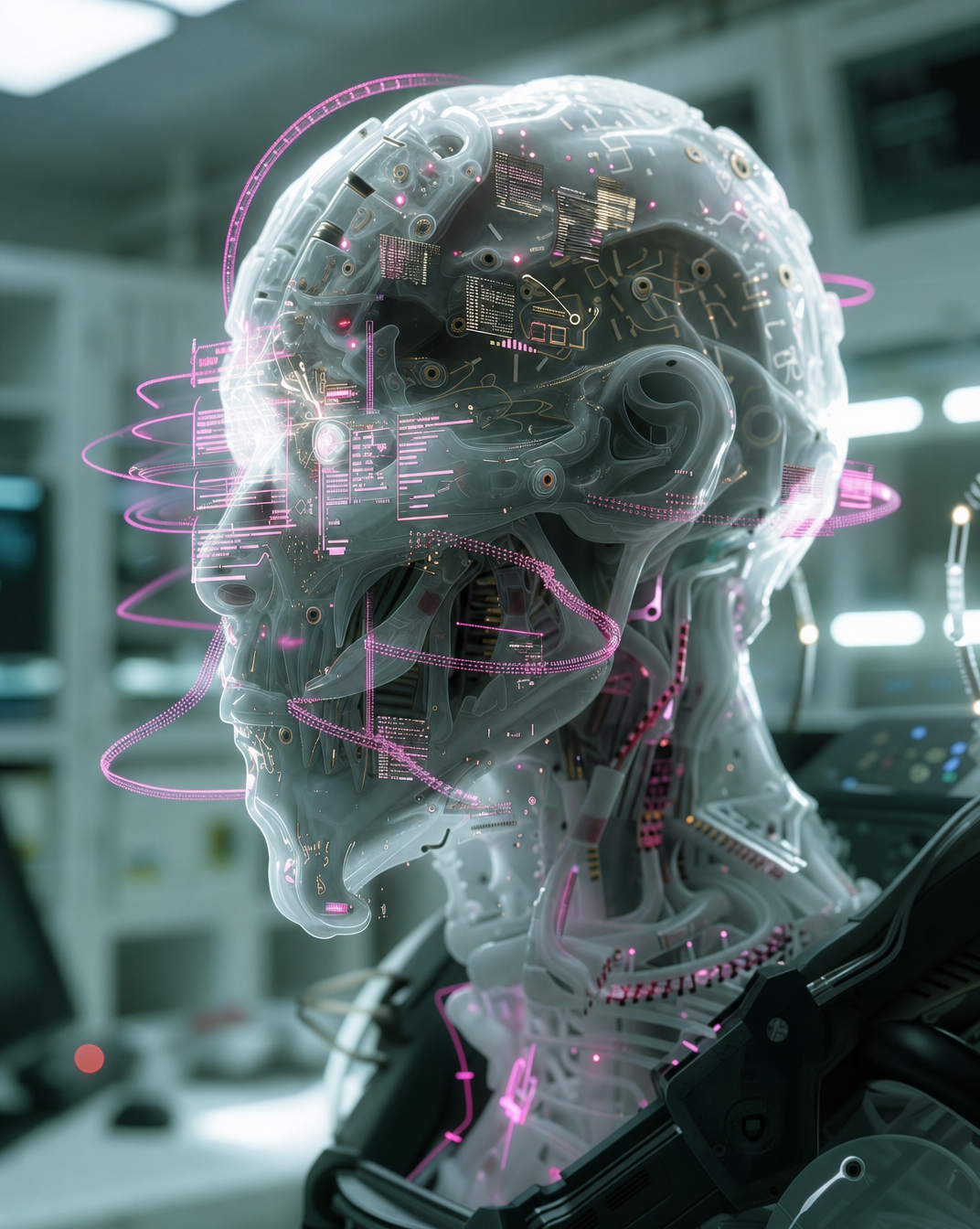
Cyborg head with magenta holograms and translucent skull