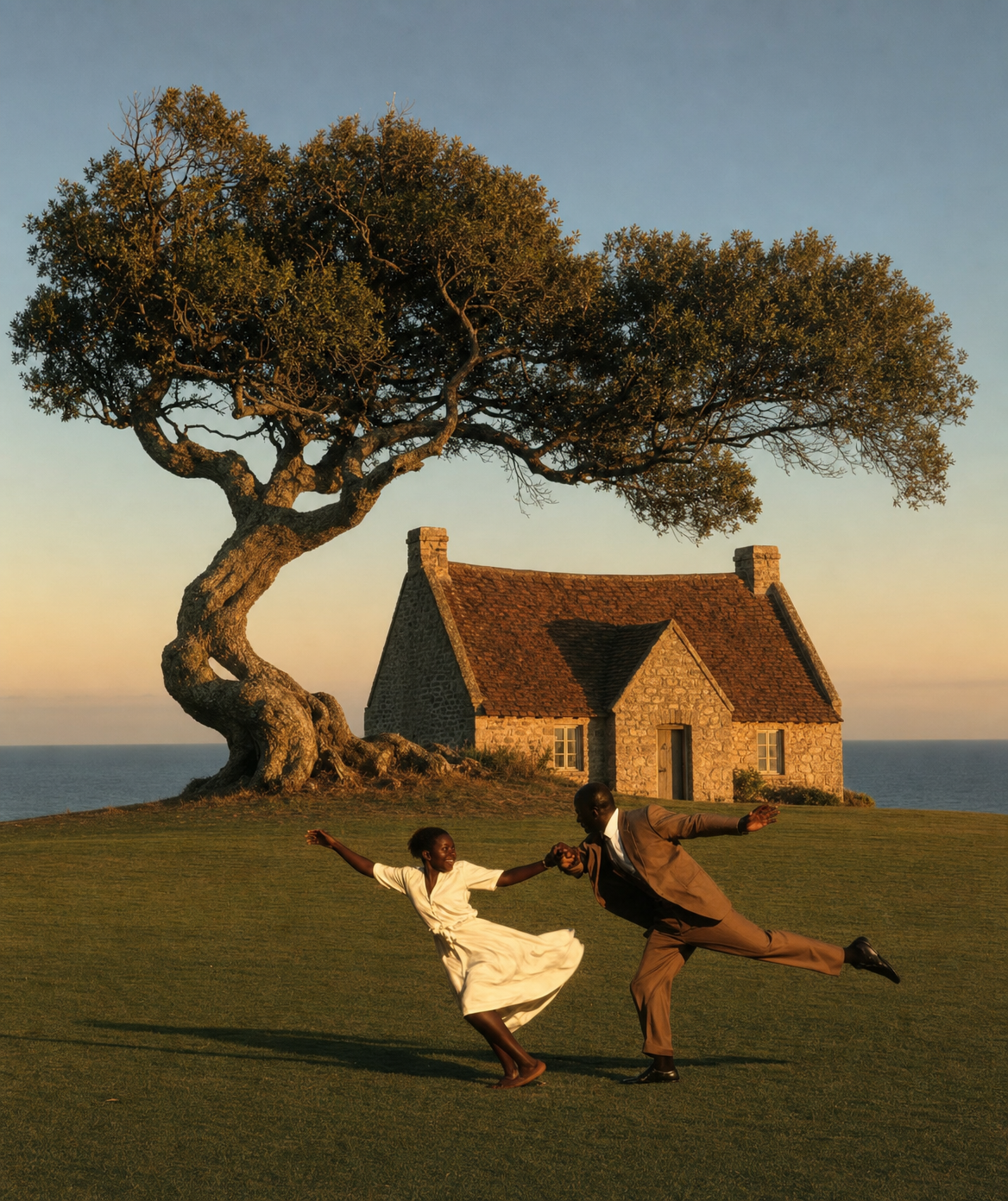
Why this works
The “medium-wide framing” and “dancing couple…in front of a cottage and a massive windswept tree” establish a readable wide-shot hierarchy, while the “more pronounced twisting branches” give the oak a strong frame around the figures. “Warm late-afternoon sunlight (golden hour)” and “long natural shadows” supply the warm, grounded mood, contrasted by the “deeper indigo-to-cerulean sky gradient,” which accounts for the dominant blue above the brown-and-gold land. “Shallow atmospheric depth near the horizon” and “high-detail textures in grass and clothing” balance distant softness with tactile foreground detail, preserving the dreamlike effect without losing photorealism.
FAQ
→How do I make the dancing couple more central and prominent?
Replace “medium-wide framing” with “medium shot centered on the dancing couple,” and change “in front of a cottage and a massive windswept tree” to “the couple fills the central foreground, with the cottage and oak receding into the background.” Keep “high-detail textures in…clothing” to retain detail on their movement and garments.
→How do I make the scene moodier and less warmly whimsical?
Replace “Warm late-afternoon sunlight (golden hour)” with “cool overcast twilight,” change “cinematic warm color grade” to “muted blue-gray color grade,” and replace “whimsical dreamlike atmosphere” with “quiet melancholic atmosphere.” Remove or soften “long natural shadows” by using “diffuse low-contrast light” for a flatter, more subdued field.
→How do I build a variation with a different setting while preserving this composition?
Replace “grassy hill with a small cottage (beige stone facade) and a large twisting oak” with a concrete setting such as “rolling lavender meadow with a weathered stone chapel and a wind-bent cypress.” Retain “dancing couple,” “medium-wide framing,” “golden-hour late-afternoon sunlight,” and “shallow atmospheric depth near the horizon” so the new version keeps the same subject scale, lighting logic, and hazy cinematic depth.
Learn the technique behind this
- Why can't AI spell, and how do I get readable text in an image? — Older diffusion models had no character-level representation of text, so they produced letterform-shaped texture instead of words.
- How should a prompt be structured, and does word order matter? — A prompt that behaves predictably names one subject first, then what it is doing, then where, then the light, then the lens or medium, then the style.
- Do negative prompts work, and what should go in one? — Negative prompts work on models that support a separate negative conditioning channel — mainly Stable Diffusion and FLUX-family models.
Related prompts
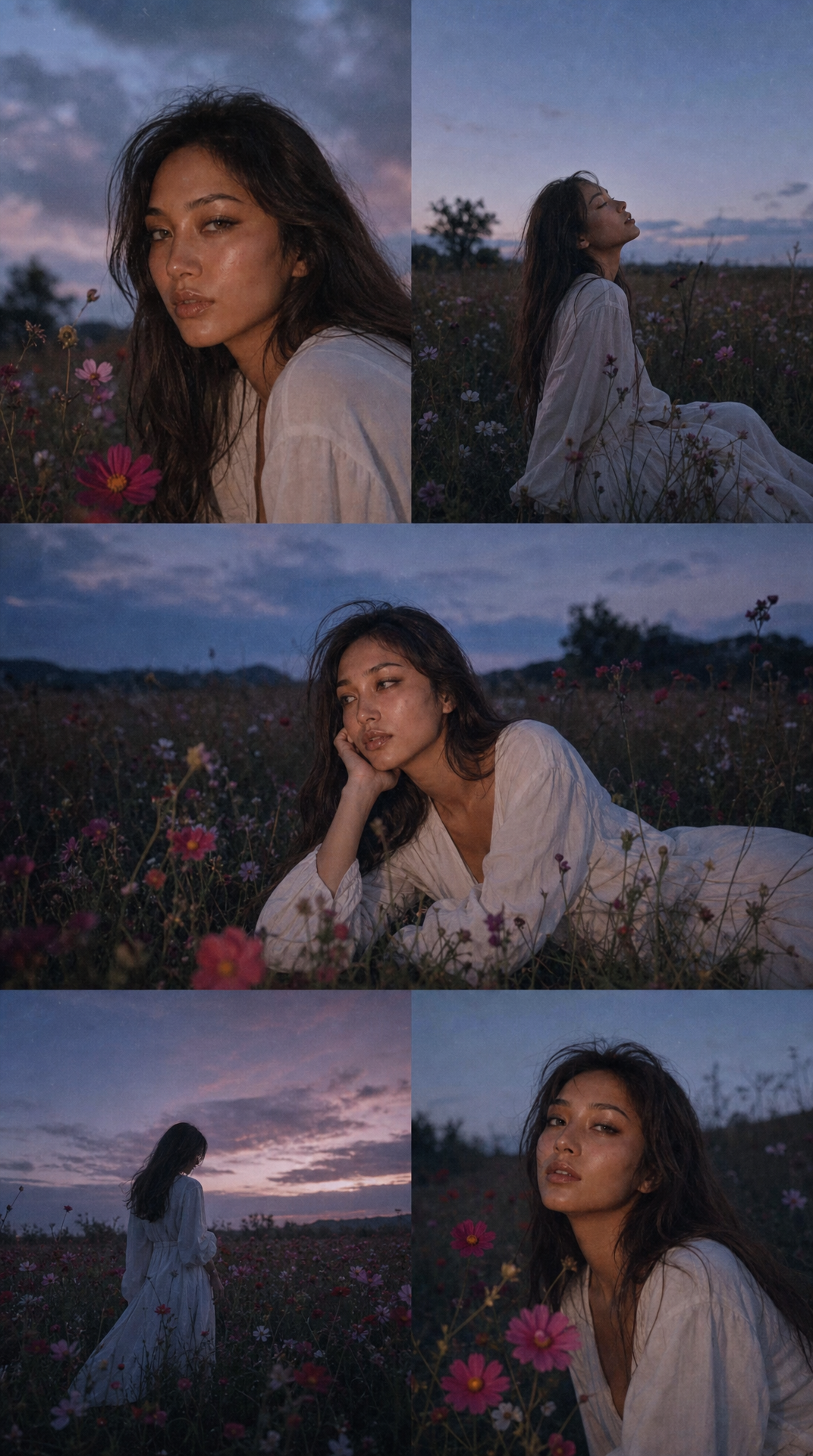
Solitary Woman in Twilight Wildflower Meadow
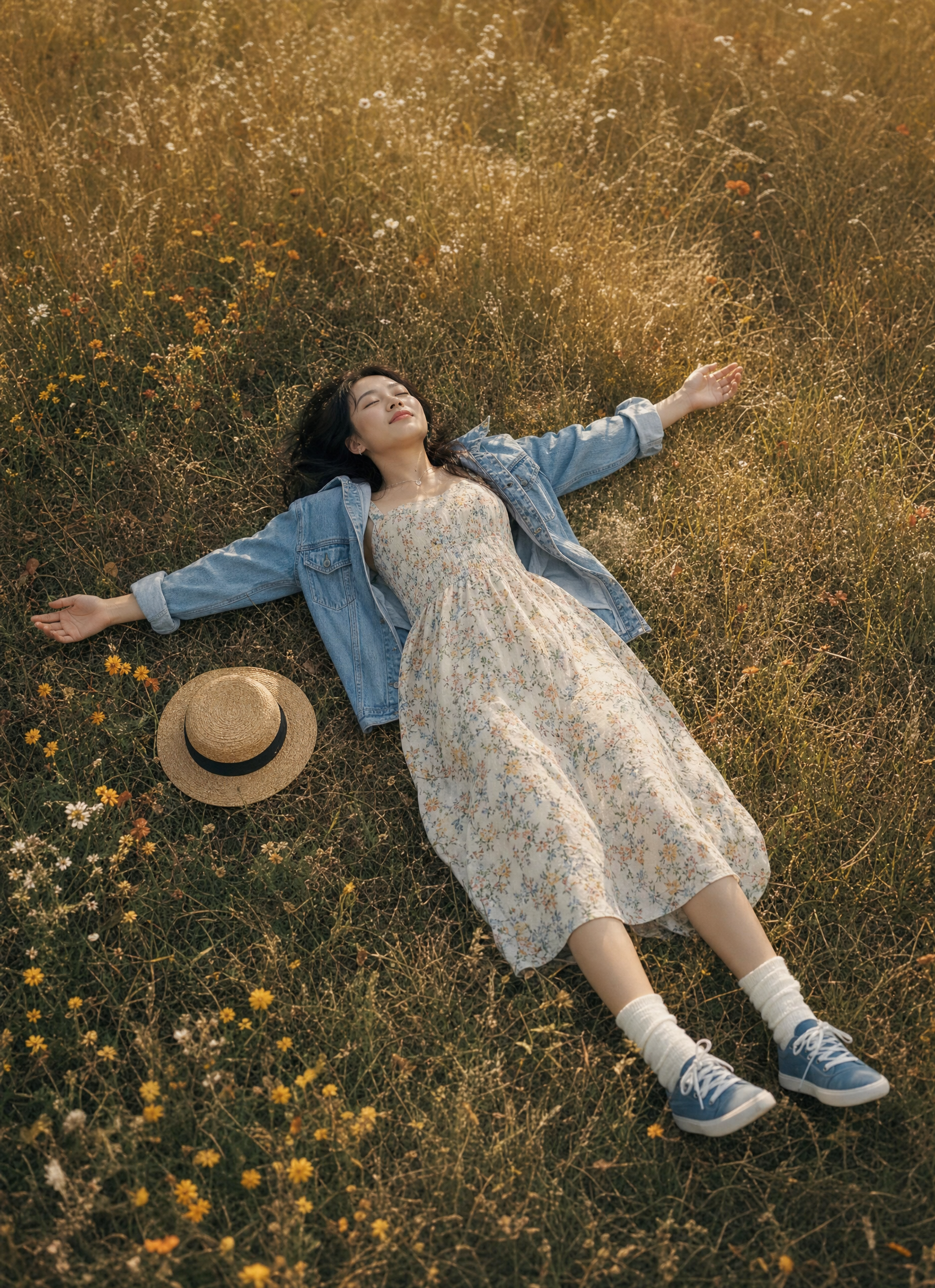
Woman Relaxing in Golden Autumn Field

Man on sand dune in blue hour

Golden-hour surf under dramatic clouds