Same prompt, generated with each model separately — click one to see how it holds up.
Why this works
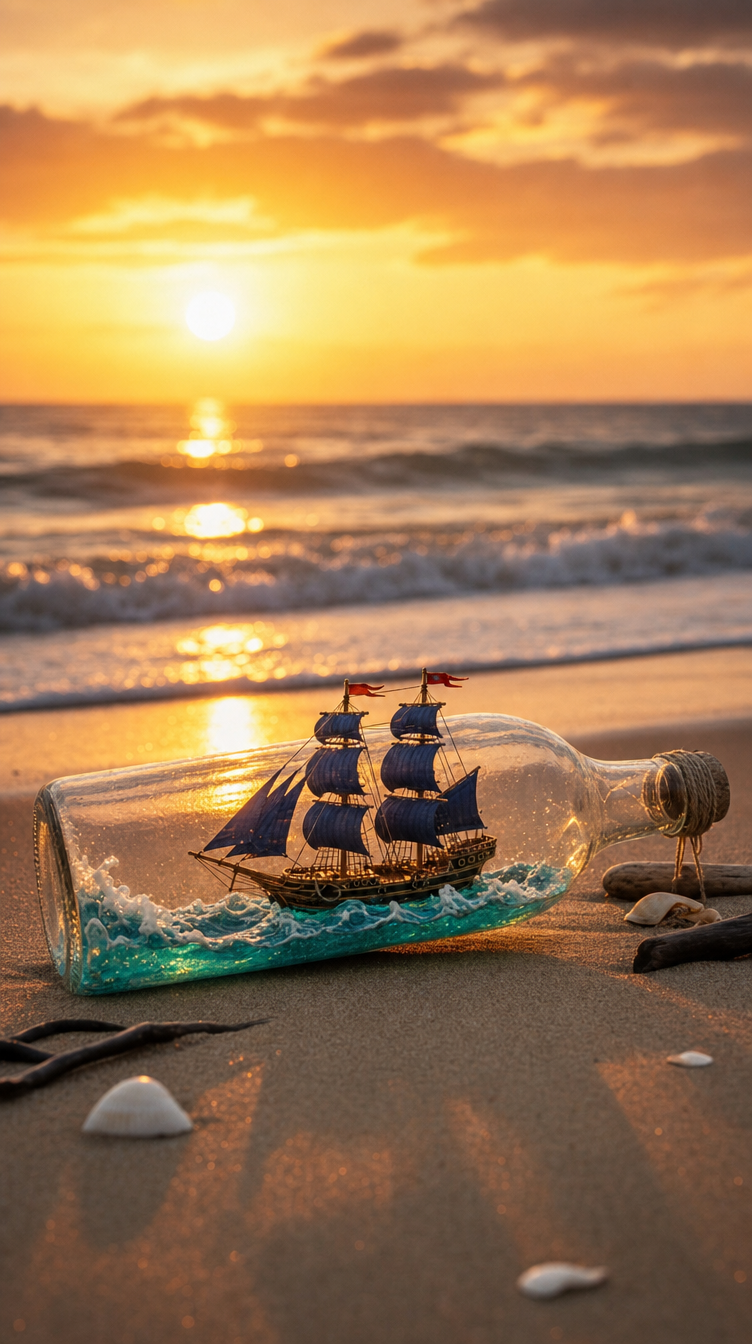
The phrase “clear glass bottle washed up on a sandy beach during late-afternoon golden hour” establishes the warm, dreamy setting, while “miniature wooden pirate ship,” “deep navy sails,” and “small red pennant flag” supply the adventurous narrative focal point. “Turquoise-blue water and tiny white swirls inside the ship’s miniature deck area” adds a concentrated teal-and-white color accent against the dominant brown wet sand and blue-gray horizon. “Shallow depth of field focusing on the bottle and glass” keeps the bottle readable within the wide-shot composition, and “highly detailed glass refractions and reflections” makes the magical miniature feel physically embedded rather than pasted into the scene.
FAQ
→How do I make the pirate ship more prominent than the beach and horizon?
Replace “wide-shot” with “medium close-up centered on the bottle,” and change “ocean horizon softly blurred in the background” to “the beach and horizon reduced to an abstract blurred backdrop.” Add “ship and miniature deck filling most of the bottle’s visible interior” so the navy sails, red pennant, and turquoise water become the visual center.
→How do I shift this from dreamy golden-hour magic to a darker, stormier adventure?
Replace “late-afternoon golden hour” and “dramatic warm lighting” with “overcast storm light with cold blue-gray shadows and sharp flashes of reflected light.” Change “Dreamy, adventurous, magical atmosphere” to “ominous maritime mystery,” and replace “warm sunlit highlights” with “wet glass catching pale lightning-like highlights.”
→How do I create a series of related bottle scenes with different miniature worlds?
Keep “clear glass bottle,” “wet sandy beach,” “shallow depth of field,” and “highly detailed glass refractions and reflections” unchanged as the series framework. Replace “miniature wooden pirate ship with deep navy sails and a small red pennant flag” with variants such as “miniature lighthouse on a rocky island,” “tiny coral reef with a submerged diver,” or “miniature fishing village with glowing windows,” while retaining “turquoise-blue water and tiny white swirls” only for ocean-themed versions.
Learn the technique behind this
- Why can't AI spell, and how do I get readable text in an image? — Older diffusion models had no character-level representation of text, so they produced letterform-shaped texture instead of words.
- How should a prompt be structured, and does word order matter? — A prompt that behaves predictably names one subject first, then what it is doing, then where, then the light, then the lens or medium, then the style.
- Do negative prompts work, and what should go in one? — Negative prompts work on models that support a separate negative conditioning channel — mainly Stable Diffusion and FLUX-family models.
Related prompts
Solitary Woman in Twilight Wildflower Meadow
Woman Relaxing in Golden Autumn Field
Man on sand dune in blue hour
Golden-hour surf under dramatic clouds