Why this works
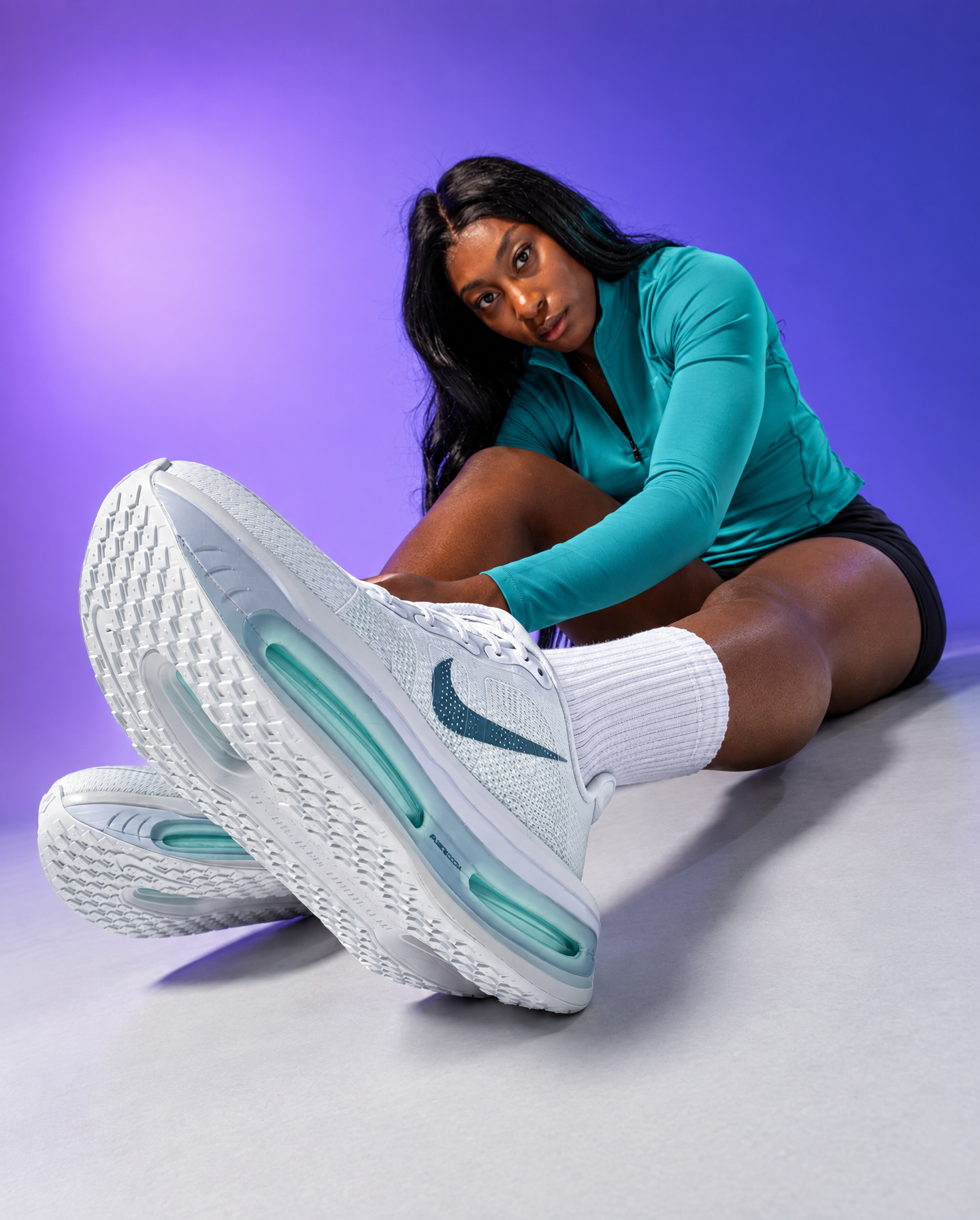
“Low-angle close perspective” and “one sneaker still dominates the foreground” create the image’s forceful framing, making the shoe a visual anchor while keeping the seated figure readable in a full-body portrait. The “smooth purple-to-indigo gradient studio background” separates the black, teal, and white outfit into a controlled blue-toned palette, while “crisp, dramatic studio lighting” and “sharp skin and fabric texture detail” support the confident, editorial mood through defined surfaces rather than soft glamour. “Bold modern pose” and “fit Black woman seated on the floor in sporty fashion” give the composition its athletic fashion identity.
FAQ
→How do I make the woman more central and reduce the sneaker’s dominance?
Replace “one sneaker still dominates the foreground from a close, low perspective” with “both sneakers remain proportional to the body in a medium low-angle perspective,” and change “strong foreground sneaker emphasis” to “subject-centered framing with balanced full-body proportions.” Keep “bold modern pose” to preserve the editorial energy.
→How do I shift this from bold and dramatic to a softer, more minimal mood?
Replace “dramatic perspective” and “crisp, dramatic studio lighting” with “gentle eye-level perspective” and “large softbox lighting with subtle shadows.” Change “smooth purple-to-indigo gradient studio background” to “warm off-white seamless studio background” for a quieter palette while retaining the “clean light-gray floor.”
→How do I create a coordinated series with different outfits and background colors?
Keep the structural phrases “low-angle close perspective,” “one sneaker dominates the foreground,” “seated on the floor,” and “sharp skin and fabric texture detail” unchanged. Swap “teal athletic zip-up top,” “black bike shorts,” and “white with subtle teal accents” for each colorway, then replace “purple-to-indigo gradient” with matched gradients such as “orange-to-coral,” “lime-to-deep green,” or “red-to-plum.”
Learn the technique behind this
- Why can't AI spell, and how do I get readable text in an image? — Older diffusion models had no character-level representation of text, so they produced letterform-shaped texture instead of words.
- How should a prompt be structured, and does word order matter? — A prompt that behaves predictably names one subject first, then what it is doing, then where, then the light, then the lens or medium, then the style.
- Why does AI get hands and faces wrong, and how do I fix it? — Hands fail because they're small in frame, extremely variable in pose, and self-occluding — the model has less usable signal per pixel than for any other body part.
Related prompts
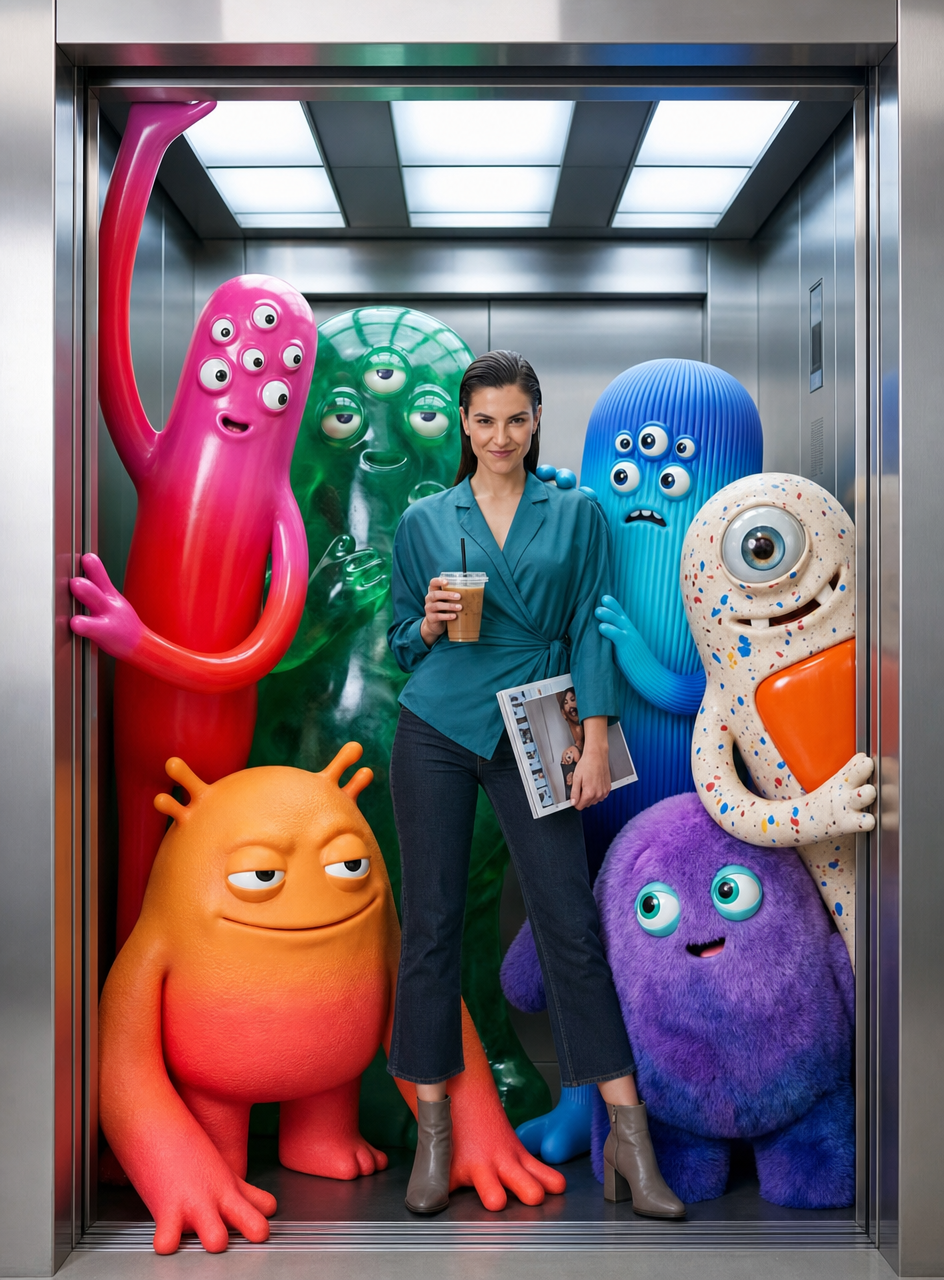
Teal fashion editorial in monster-filled lift
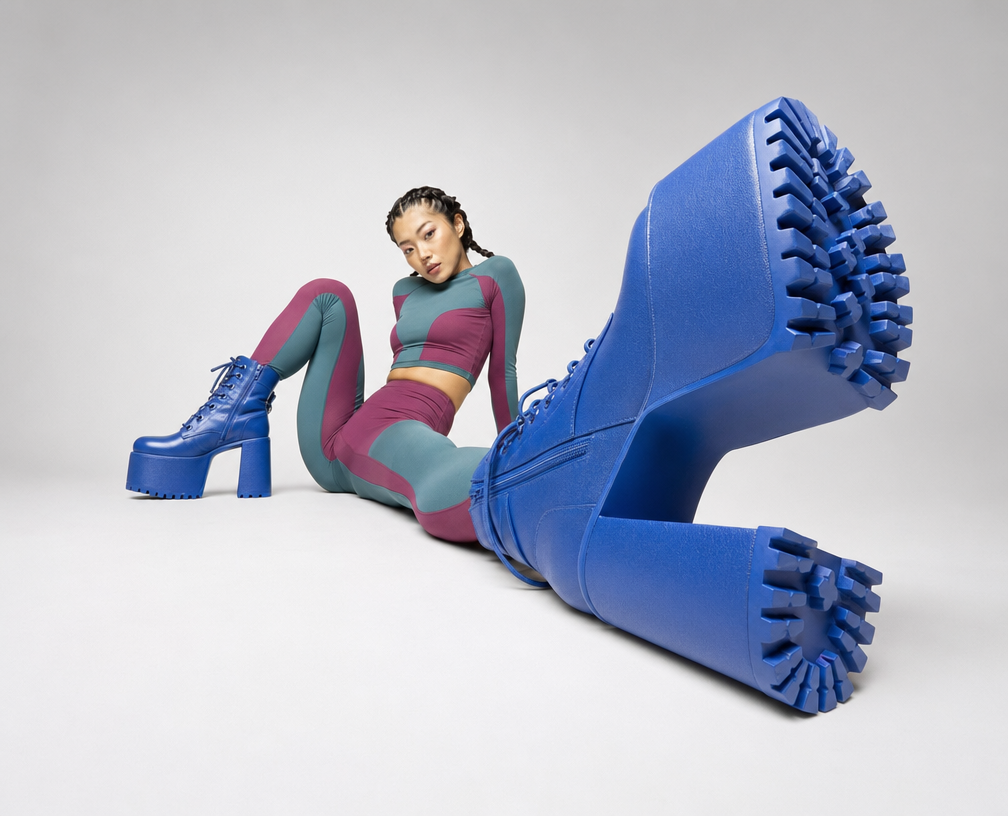
Cobalt Boots in Sleek Studio Edit
Silhouette Influencer by Sunlit Window
Sunlit editorial on striped beach towel