Why this works
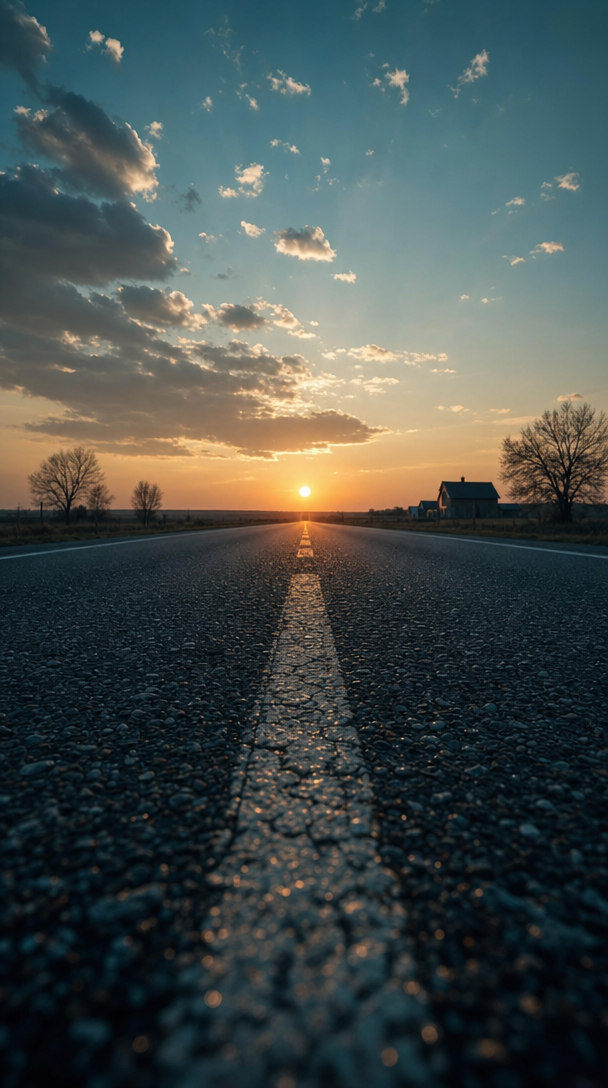
“Low-angle photorealistic view from the center of an empty asphalt road” makes the road the dominant subject, while “stronger leading lines and subtle road curvature” pull the wide composition directly toward the radiant horizon. The serene, contemplative mood comes from “quiet farmhouse silhouette,” “sparse roadside trees,” and “thin high clouds lightly diffusing the glow,” while “teal shadows and warm amber highlights” create the cool-gray, gold, and orange color contrast visible across the pavement and sunset. “Shallow depth of field” softens the distant farmhouse and trees, preserving the road’s graphic foreground without losing the sense of rural scale.
FAQ
→How do I make the farmhouse more prominent instead of keeping the road as the main focus?
Replace “quiet farmhouse silhouette in the distance” with “a clearly defined farmhouse as the central focal point, medium distance, visible windows and roof details,” and change “shallow depth of field” to “moderate depth of field with the farmhouse sharply resolved.” Keep “road center” and “leading lines” to have the pavement guide the eye toward the building.
→How do I turn this serene sunset scene into a moodier, stormier image?
Replace “radiant sunset horizon” with “a dim storm-lit horizon beneath heavy slate clouds,” change “warm amber highlights” to “muted copper highlights,” and replace “thin high clouds lightly diffusing the glow” with “thick layered storm clouds with narrow breaks of light.” Retain “teal shadows” and “dark pavement” to reinforce the colder, brooding tonal range.
→How do I create a series of variations while preserving the same road composition?
Keep “low-angle view from the road center,” “stronger leading lines,” “subtle road curvature,” and “faded white center line” unchanged, then swap only the setting and light phrases. For example, replace “sparse roadside trees and a quiet farmhouse silhouette” with “tall cypress trees and a distant coastal watchtower,” and replace “warm amber highlights” with “soft rose and violet highlights” for a dawn variation.
Learn the technique behind this
- Why can't AI spell, and how do I get readable text in an image? — Older diffusion models had no character-level representation of text, so they produced letterform-shaped texture instead of words.
- How do I keep one consistent style across a whole set of images? — Style consistency is more achievable than character consistency because style lives in describable attributes.
- How should a prompt be structured, and does word order matter? — A prompt that behaves predictably names one subject first, then what it is doing, then where, then the light, then the lens or medium, then the style.
Related prompts
Solitary Woman in Twilight Wildflower Meadow
Woman Relaxing in Golden Autumn Field
Man on sand dune in blue hour

Golden-hour surf under dramatic clouds