Why this works
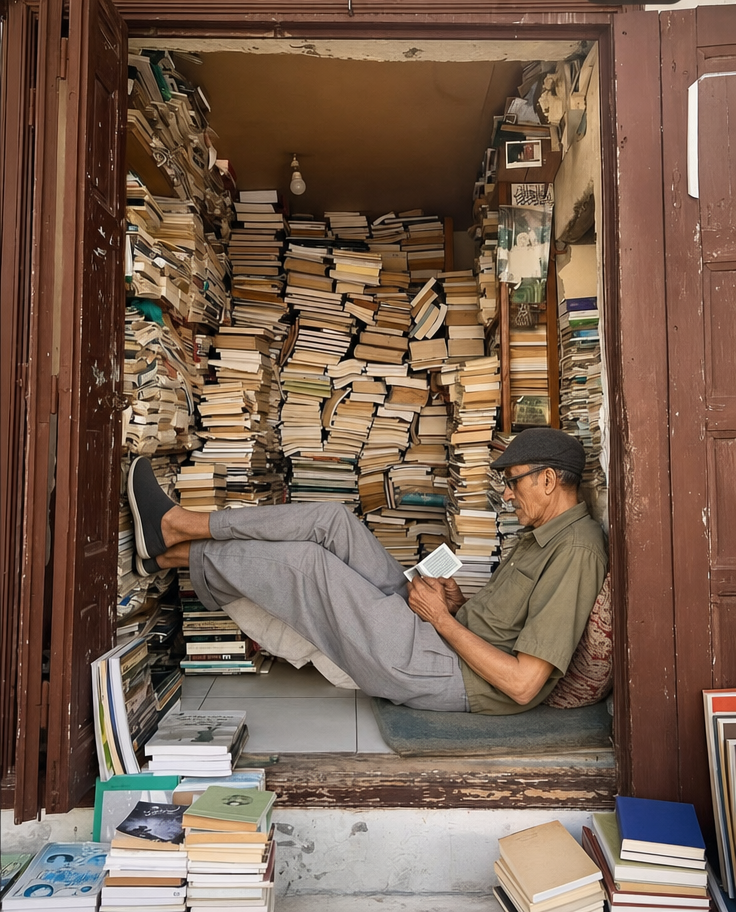
The phrase “elderly man reclining in the doorway” gives the portrait-full-body composition a clear human anchor, while “cluttered piles spilling toward the entrance” creates a layered frame that pulls the eye from the foreground into the floor-to-ceiling shelves. “Natural daylight filters in, creating soft highlights on the book spines and the man’s face” explains the gentle beige-and-gray tonal harmony and keeps the face readable without breaking the quiet mood. The slightly surreal quality comes from the contrast between the documentary language, “candid composition” and “photorealistic,” and the almost impossible density of a shop “completely packed with books from floor to ceiling.”
FAQ
→How do I make the man more visually central and prominent?
Replace “reclining in the doorway” with “seated upright in the center of the doorway, occupying the visual focal point,” and change “cluttered piles spilling toward the entrance” to “lower, orderly book piles framing him without obscuring his body.” Keep “soft highlights on the book spines and the man’s face” so the lighting continues to prioritize both subject and setting.
→How do I shift this from quiet contemplation to a warmer, more hopeful mood?
Replace “quiet intimate contemplative mood” with “warm, gently optimistic mood,” and change “warm earthy tones dominate the scene” to “golden amber, honey, and muted terracotta tones dominate the scene.” You can also replace “natural daylight filters in” with “late-afternoon sunlight pours through the doorway,” producing stronger warmth while retaining the bookshop setting.
→How do I build a series of variations from this bookshop scene?
Keep “tiny secondhand bookshop interior with floor-to-ceiling shelves” as the recurring setting, then swap “elderly man reading” for specific subjects such as “young woman repairing a torn atlas,” “bookseller cataloguing a stack of poetry,” or “child reaching for a brightly colored storybook.” Change the action phrase “casually reading a small paperback” for each variation, and vary “natural daylight” with replacements such as “rain-muted window light,” “cool fluorescent shop light,” or “blue hour light through the doorway.”
Learn the technique behind this
- Why can't AI spell, and how do I get readable text in an image? — Older diffusion models had no character-level representation of text, so they produced letterform-shaped texture instead of words.
- How should a prompt be structured, and does word order matter? — A prompt that behaves predictably names one subject first, then what it is doing, then where, then the light, then the lens or medium, then the style.
- Why does AI get hands and faces wrong, and how do I fix it? — Hands fail because they're small in frame, extremely variable in pose, and self-occluding — the model has less usable signal per pixel than for any other body part.
Related prompts
Grotesque Claymation Gangsters in Gritty Alley
Charcoal coat with tan-handled tote
Woman in Teal Jacket Capturing Twilight Reflection
Stuffed Bear on Winter Dumpster at Dawn