Why this works
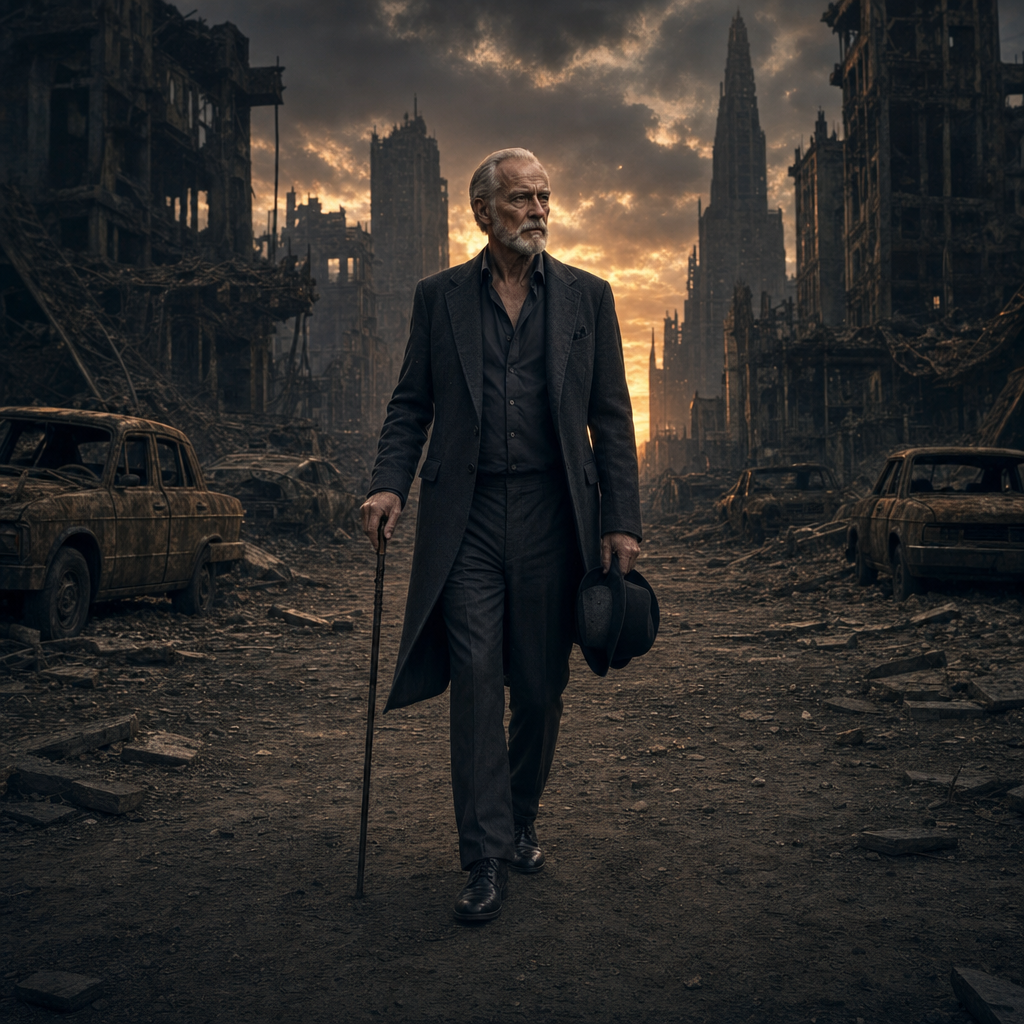
The solemn mood is anchored by “elderly gentleman,” “standing centered,” and “solemn and still,” while “stormy sunset sky” and “warm orange-gray light breaking through clouds” add restrained drama rather than spectacle. “Cinematic, full-body” and “centered composition” give the figure poster-like authority, with the cane and worn brimmed hat supplying readable gestures inside the frame. Muted warm grays, “burnt amber accents,” and “atmospheric haze” create the black-brown-gold harmony, while “shallow depth of field” keeps the collapsed facades and burnt-out vehicles subordinate to the subject.
FAQ
→How do I change this prompt to make the ruined city more prominent than the elderly gentleman?
Replace “cinematic full-body framing” and “centered composition” with “wide establishing shot, elderly gentleman small in the lower third,” and replace “shallow depth of field” with “deep focus across the entire street.” Keep “collapsed facades, abandoned burnt-out vehicles, and scattered debris” so the environment remains visually legible.
→How do I change this prompt for a warmer, more hopeful tone?
Replace “bleak, dramatic, solemn” and “stormy sunset sky with warm orange-gray light” with “quietly hopeful mood, clear sunrise with golden light streaming through thinning clouds.” Change “muted warm grays and burnt amber accents” to “soft gold, pale blue, and fresh green accents,” while retaining the elderly man and cane for continuity.
→How do I build a series of character variations from this image while keeping the poster design consistent?
Leave “cinematic, full-body photorealistic film-poster scene,” “centered composition,” “stormy sunset sky,” and “muted warm grays and burnt amber accents” unchanged. Swap only “elderly gentleman” and his clothing for variants such as “young woman in a weathered flight jacket,” “middle-aged mechanic in stained workwear,” or “child wearing an oversized raincoat,” and replace “holding a cane in one hand while his other hand supports a worn brimmed hat” with a defining prop action for each character.
Learn the technique behind this
- Why can't AI spell, and how do I get readable text in an image? — Older diffusion models had no character-level representation of text, so they produced letterform-shaped texture instead of words.
- How should a prompt be structured, and does word order matter? — A prompt that behaves predictably names one subject first, then what it is doing, then where, then the light, then the lens or medium, then the style.
- How do I keep one consistent style across a whole set of images? — Style consistency is more achievable than character consistency because style lives in describable attributes.
Related prompts
Grotesque Claymation Gangsters in Gritty Alley
Charcoal coat with tan-handled tote
Woman in Teal Jacket Capturing Twilight Reflection
Stuffed Bear on Winter Dumpster at Dawn