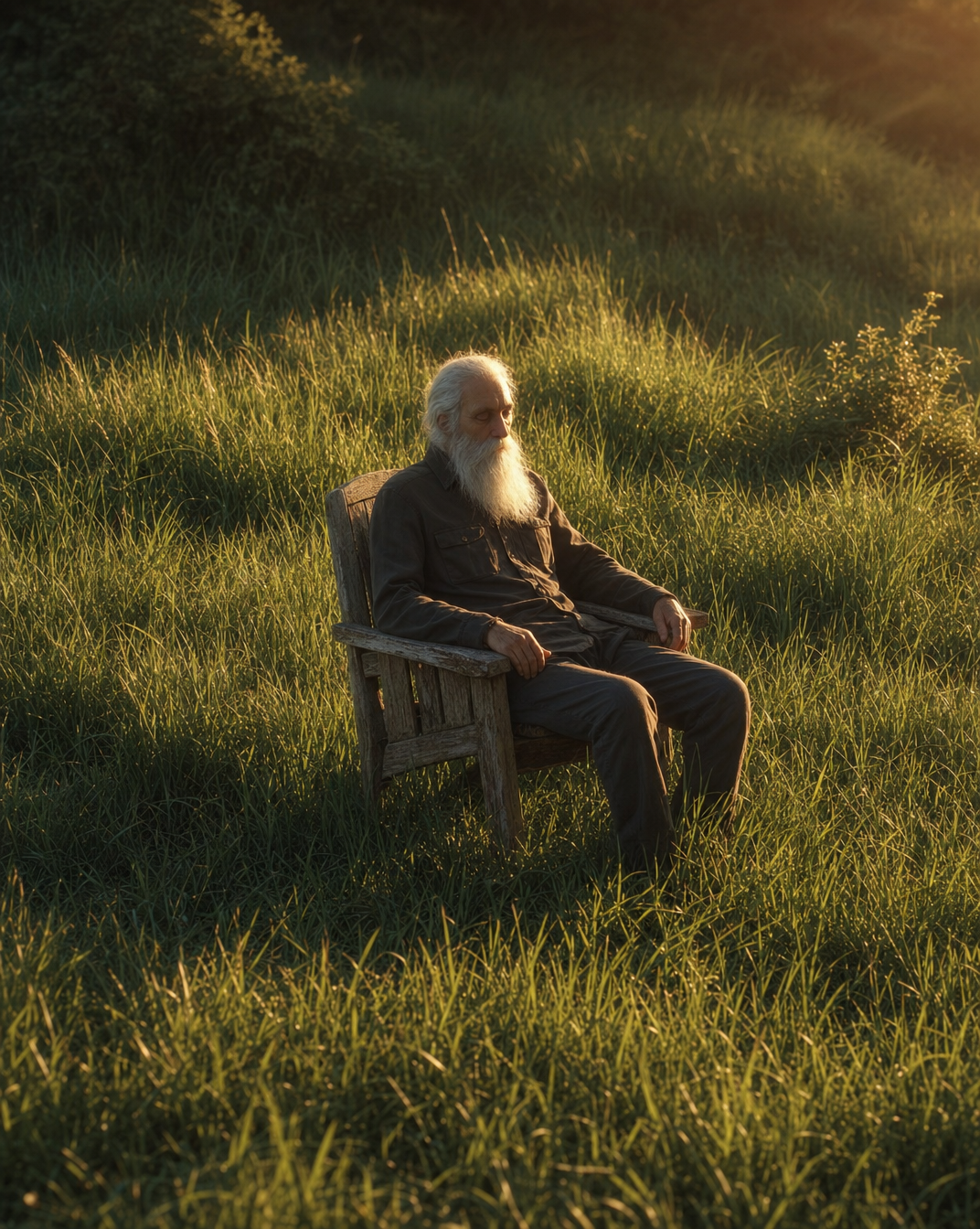
Why this works
The phrase “elderly man with a long white beard sitting alone on a weathered wooden chair” gives the image a clear full-body anchor, while “dense green meadow” and “cinematic composition with shallow depth of field” frame him with layered grass and softened background space. “Golden-hour sunlight with long soft shadows” supplies the gold and brown dominance, and “white beard,” “gray” weathered wood, and “warm natural color palette” keep the palette grounded rather than brightly saturated. The peaceful, contemplative mood comes from the explicit wording “peaceful solitary scene” and “quiet contemplative mood,” while “surreal realism” adds subtle uncanniness without displacing the photorealistic textures.
FAQ
→How do I make the man feel more isolated and emotionally somber?
Replace “peaceful solitary scene” and “quiet contemplative mood” with “somber, emotionally heavy solitude,” and change “warm natural color palette” to “muted desaturated greens, cool gray shadows, and subdued amber highlights.” Keep “sitting alone” but add “large empty meadow surrounding him” to increase visual distance.
→How do I make the chair and the man more visually prominent?
Replace “close-to-mid framing on the subject” with “tight full-body portrait framing, man and chair filling most of the vertical frame,” and add “sharp focus on the man’s face, white beard, hands, and weathered chair.” Change “shallow depth of field” to “moderately shallow depth of field with the chair and foreground grass still readable.”
→How do I build a consistent series of variations from this scene?
Keep the fixed phrases “elderly man with a long white beard,” “weathered wooden chair,” “cinematic composition,” and “surreal realism,” then swap only the setting and light: use “misty blue forest at dawn,” “windswept coastal cliff under overcast light,” or “autumn meadow in late-afternoon amber light.” Preserve “portrait-full-body” and “close-to-mid framing” so each variation retains the same subject scale and composition.
Learn the technique behind this
- Why can't AI spell, and how do I get readable text in an image? — Older diffusion models had no character-level representation of text, so they produced letterform-shaped texture instead of words.
- How should a prompt be structured, and does word order matter? — A prompt that behaves predictably names one subject first, then what it is doing, then where, then the light, then the lens or medium, then the style.
- How do I keep one consistent style across a whole set of images? — Style consistency is more achievable than character consistency because style lives in describable attributes.
Related prompts
Solitary Woman in Twilight Wildflower Meadow
Woman Relaxing in Golden Autumn Field
Man on sand dune in blue hour

Golden-hour surf under dramatic clouds