Why this works
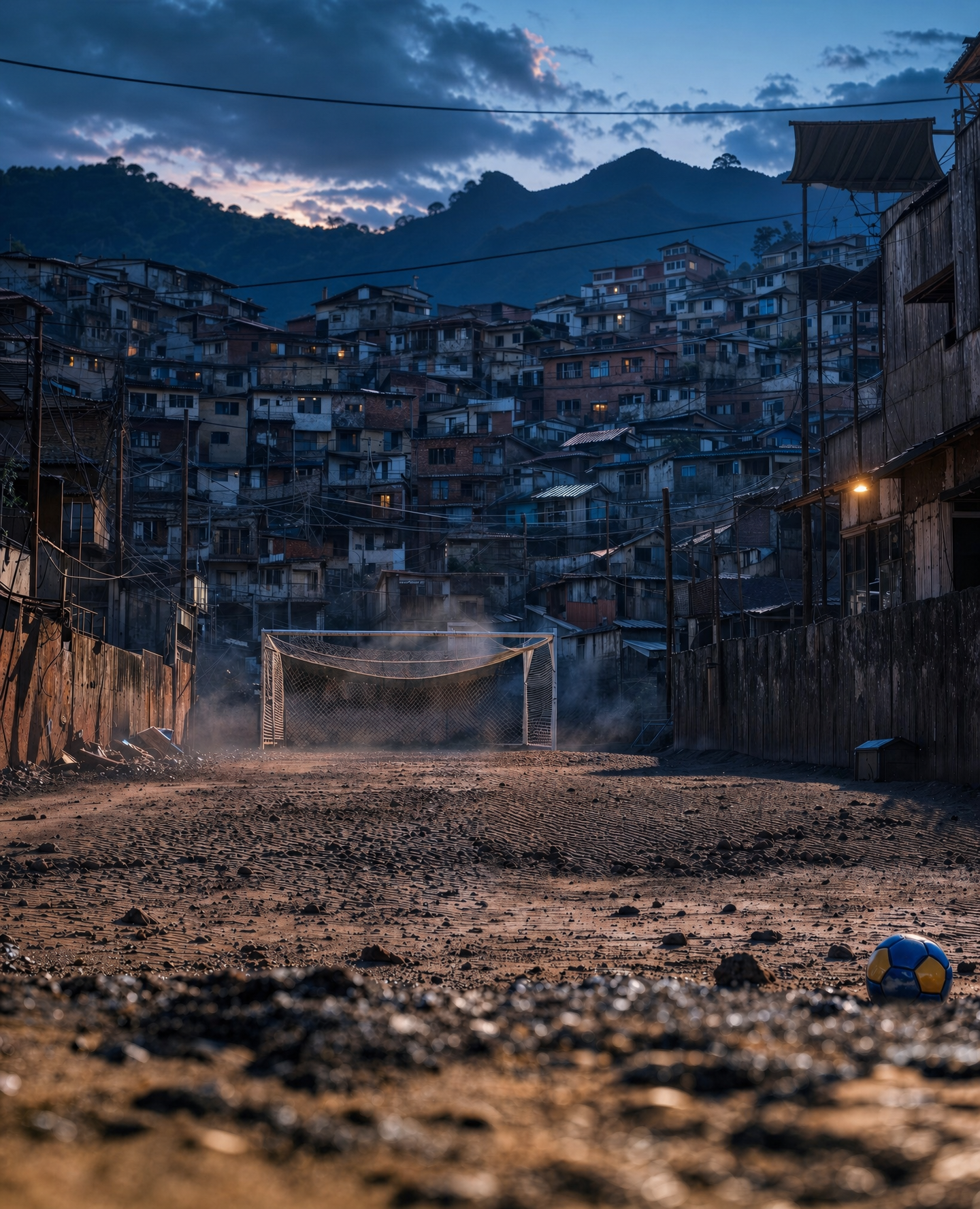
The phrase “low, ground-level viewpoint with the rough, cracked earth dominating the foreground” creates a wide, immersive frame and gives the brown soil visual weight, while “a single soccer goal centered far in the distance” supplies a precise focal anchor. “Blue hour” and “cool ambient tones” establish the gray-black twilight palette, with “cinematic, warm highlights mixed with cool ambient tones” adding the restrained warmth that keeps the scene from feeling flat. “Dust and small debris drift through cool atmospheric haze,” combined with “tightly packed hillside homes” and “distant mountains appear as darker silhouettes,” builds the dramatic scale and documentary atmosphere through layered depth rather than exaggerated effects.
FAQ
→How do I make the soccer goal feel more prominent and central?
Replace “a single soccer goal centered far in the distance” with “a single soccer goal large and sharply defined in the central midground,” and reduce “the rough, cracked earth dominating the foreground” to “a textured foreground receding quickly toward the goal.” Keep “wide-shot” for the surrounding neighborhood context while moving the focal point closer.
→How do I shift this from dramatic twilight to a brighter, hopeful mood?
Replace “at blue hour” and “cool ambient tones” with “early golden morning light” and “soft, warm sunlight,” then change “darker silhouettes against the twilight sky” to “sunlit mountains beneath a pale, clear sky.” Retain “warm highlights” but replace “natural film-like contrast” with “gentle, lifted contrast” to open the shadows.
→How do I create a series of variations while preserving this visual identity?
Keep the fixed structure “low, ground-level viewpoint,” “single ... goal centered,” “highly detailed realistic textures,” and “dust particles drifting through haze.” For each variation, swap only the setting phrase “dense hillside homes rising behind the field” with locations such as “weathered coastal apartment blocks,” “an industrial district beneath elevated rail tracks,” or “a rural valley village,” while changing the background phrase “distant mountains” to a location-specific landmark.
Learn the technique behind this
- Why can't AI spell, and how do I get readable text in an image? — Older diffusion models had no character-level representation of text, so they produced letterform-shaped texture instead of words.
- How should a prompt be structured, and does word order matter? — A prompt that behaves predictably names one subject first, then what it is doing, then where, then the light, then the lens or medium, then the style.
- Do negative prompts work, and what should go in one? — Negative prompts work on models that support a separate negative conditioning channel — mainly Stable Diffusion and FLUX-family models.
Related prompts
Solitary Woman in Twilight Wildflower Meadow
Woman Relaxing in Golden Autumn Field
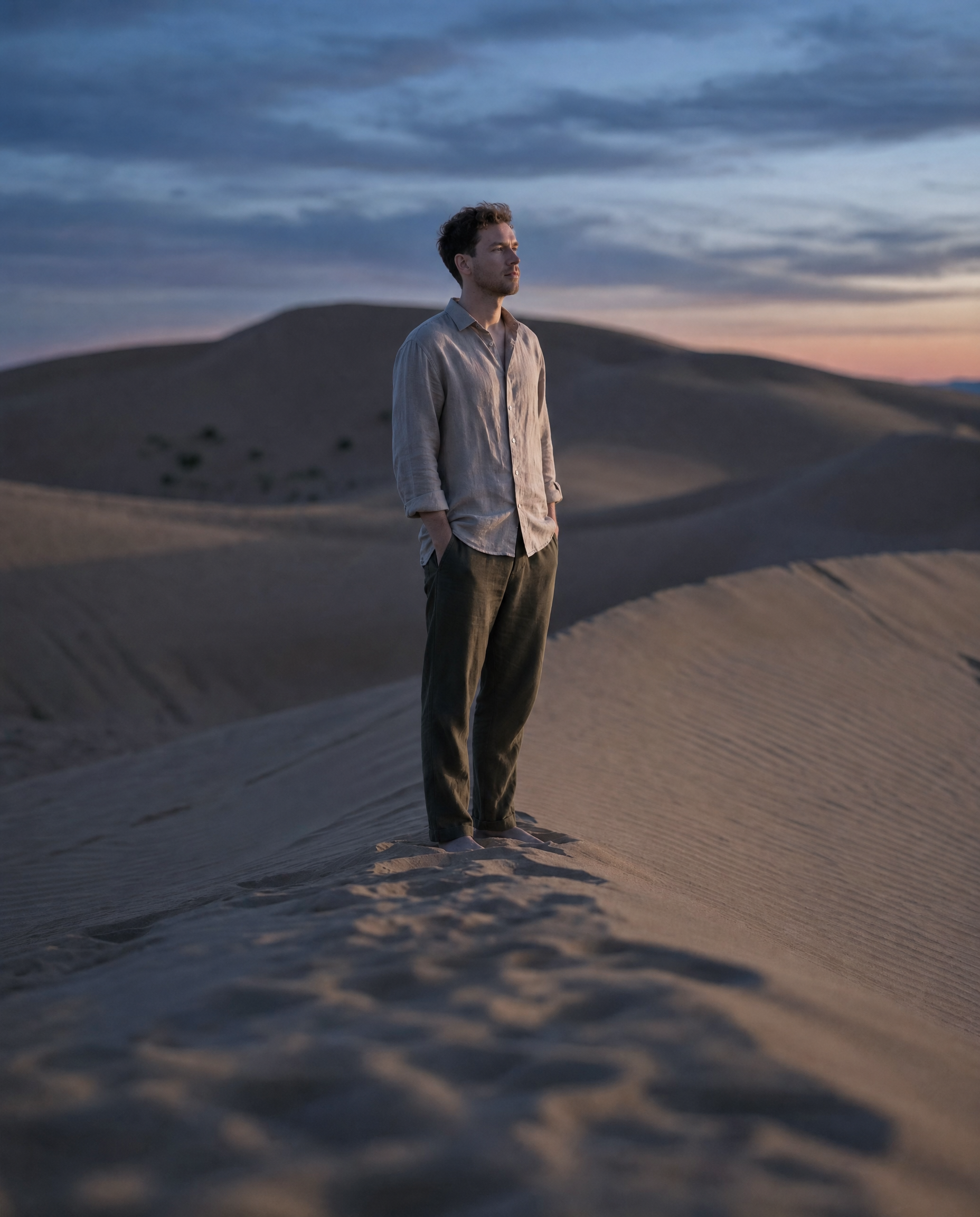
Man on sand dune in blue hour

Golden-hour surf under dramatic clouds