Why this works
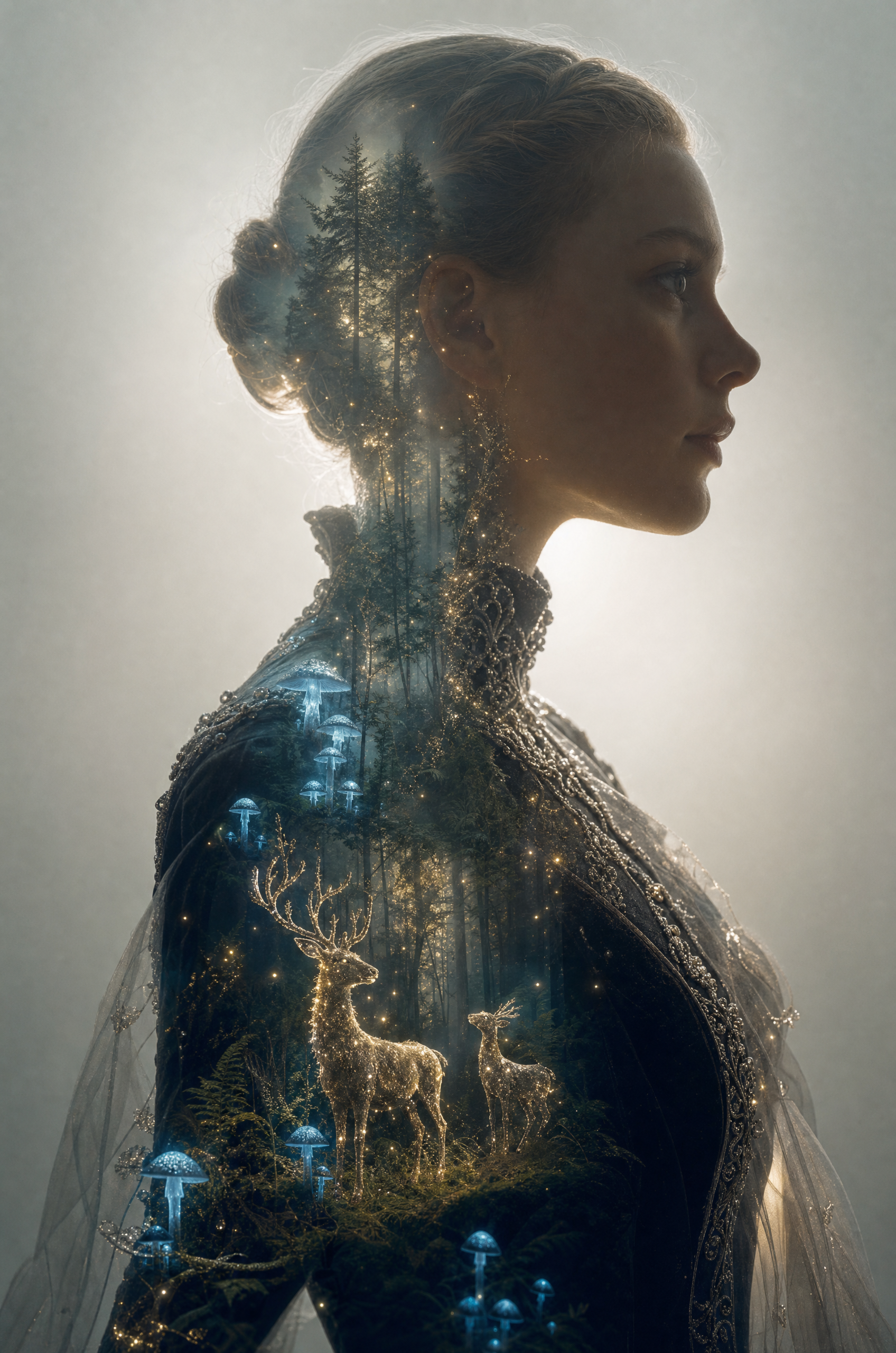
The full-body editorial portrait framing makes the woman’s couture silhouette the structural anchor, while “her silhouette is filled with golden reindeer moving through a dim cedar forest” turns the figure into a self-contained narrative landscape. “Thick mist,” “faint light rays,” and “cinematic backlighting” soften the black, blue, and gold palette into a dreamy, ethereal mood; the strongest color harmony comes from the contrast between the “black velvet bodice,” “bioluminescent blue mushrooms,” and “golden reindeer.” “High micro-detail” and “porcelain skin with a subtle pearly shimmer” keep the composite tactile and photorealistic instead of purely illustrative.
FAQ
→How do I make the golden reindeer and forest more prominent than the couture clothing?
Replace “editorial portrait framing with high detail” with “medium-wide environmental portrait framing with the forest extending beyond her silhouette,” and change “her silhouette is filled with golden reindeer” to “large, clearly visible golden reindeer surround and overlap her figure, with branching forest paths visible inside the double exposure.” Keep “black velvet bodice” and “sheer organza overskirt” but reduce their description so they support, rather than dominate, the scene.
→How do I shift this from dreamy mystical wonder to a darker, ominous tone?
Replace “dreamlike vulnerability and mystical wonder” with “quiet dread and ancient forest menace,” and change “soft, luminous atmosphere with delicate whimsical fantasy illumination” to “cold, low-key illumination with deep shadows and sparse blue bioluminescent highlights.” Replace “thick mist” with “dense creeping fog obscuring the distant trees” and “golden reindeer” with “shadowed reindeer with faint amber eyes” for a more threatening silhouette.
→How do I create a coordinated series of variations from this prompt?
Keep the fixed anchors “photorealistic fantasy couture editorial,” “cinematic double-exposure composite,” “porcelain skin,” and “editorial portrait framing,” then swap the environment and fauna as matched pairs. For example, replace “dim cedar forest” with “wind-carved alpine glacier,” “golden reindeer” with “white mountain cranes,” and “bioluminescent blue mushrooms” with “floating turquoise ice shards”; for another image, use “moonlit desert of black dunes,” “silver foxes,” and “violet desert flowers,” while preserving the same black, blue, and gold color logic.
Learn the technique behind this
- Why can't AI spell, and how do I get readable text in an image? — Older diffusion models had no character-level representation of text, so they produced letterform-shaped texture instead of words.
- How should a prompt be structured, and does word order matter? — A prompt that behaves predictably names one subject first, then what it is doing, then where, then the light, then the lens or medium, then the style.
- Why does AI get hands and faces wrong, and how do I fix it? — Hands fail because they're small in frame, extremely variable in pose, and self-occluding — the model has less usable signal per pixel than for any other body part.
Related prompts

Teal fashion editorial in monster-filled lift
Cobalt Boots in Sleek Studio Edit
Silhouette Influencer by Sunlit Window

Sunlit editorial on striped beach towel