Why this works
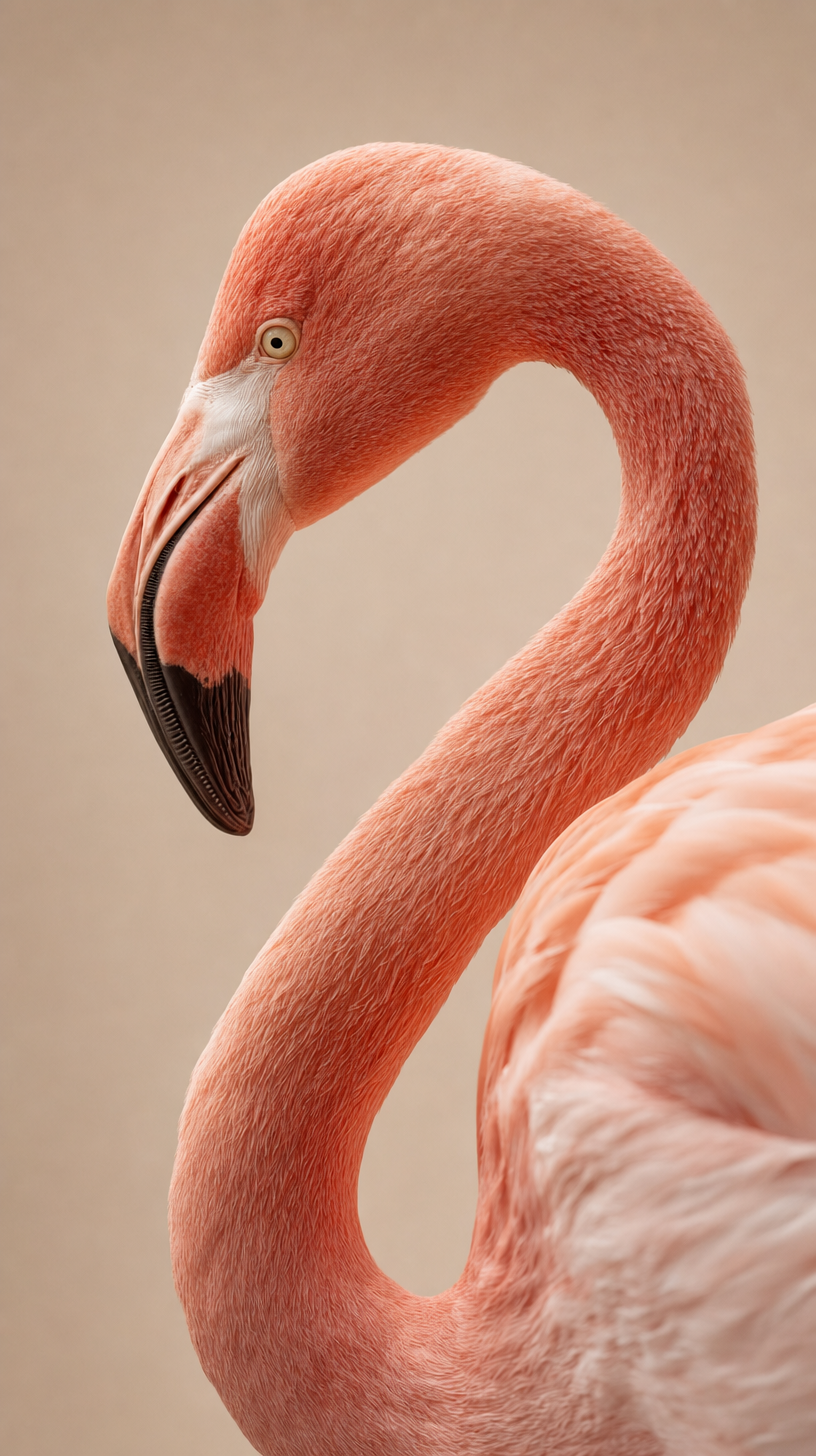
“Close-up framing” and “sharp focus on the head and neck” make the S-curve neck the dominant portrait structure, while “minimal composition” and the “clean warm beige background” leave deliberate negative space around it. The serene tone comes from the exact pairing of “soft diffused studio lighting” and “serene elegant mood,” which avoids harsh contrast; “ultra-high detail in feather micro-texture” keeps the matte coral-pink plumage tactile even though the generated image is visually led by beige, white, and black. The “pale” beak with its “darker brown tip” supplies the small dark accent that anchors the otherwise restrained palette.
FAQ
→How do I make the flamingo’s eye and beak more prominent?
Replace “sharp focus on the head and neck” with “sharp focus on the eye and beak, with the neck gently receding,” and add “tight head crop, eye positioned near the upper third.” Keep “close-up framing,” but change “minimal composition” to “head-dominant composition” so the facial details carry more visual weight.
→How do I turn this serene studio portrait into a dramatic editorial image?
Replace “soft diffused studio lighting, even illumination” with “strong directional side-lighting with deep shadows and a controlled rim light,” and change “serene elegant mood” to “dramatic fashion-editorial mood.” Swap “clean warm beige background” for “deep charcoal-gray studio background” to increase contrast against the coral-pink feathers.
→How do I create a coordinated series using different birds or colors?
Keep the structural phrases “photorealistic studio close-up,” “close-up framing,” “sharp focus on the head and neck,” and “minimal composition” unchanged. Replace “pink flamingo with an elegant S-curve neck” with a specific new subject such as “white swan with a graceful curved neck,” then change “slightly deeper coral-pink feather tone” to a matching color phrase such as “cool ivory-white feather tone,” while retaining “warm beige background” and “soft diffused studio lighting” for visual consistency.
Learn the technique behind this
- Why can't AI spell, and how do I get readable text in an image? — Older diffusion models had no character-level representation of text, so they produced letterform-shaped texture instead of words.
- How should a prompt be structured, and does word order matter? — A prompt that behaves predictably names one subject first, then what it is doing, then where, then the light, then the lens or medium, then the style.
- Which aspect ratio should I use, and how does it change the image? — Aspect ratio determines what the model composes, not how it's cropped afterwards.
Related prompts
Cream Longhaired Cat in Warm Dusty-Rose Light
Warm Studio Laughter With Brown Puppy
Long-haired gray tabby cat with green eyes
Cream, Smoky Gray, and Ginger Tabby Stacked Cats