Why this works
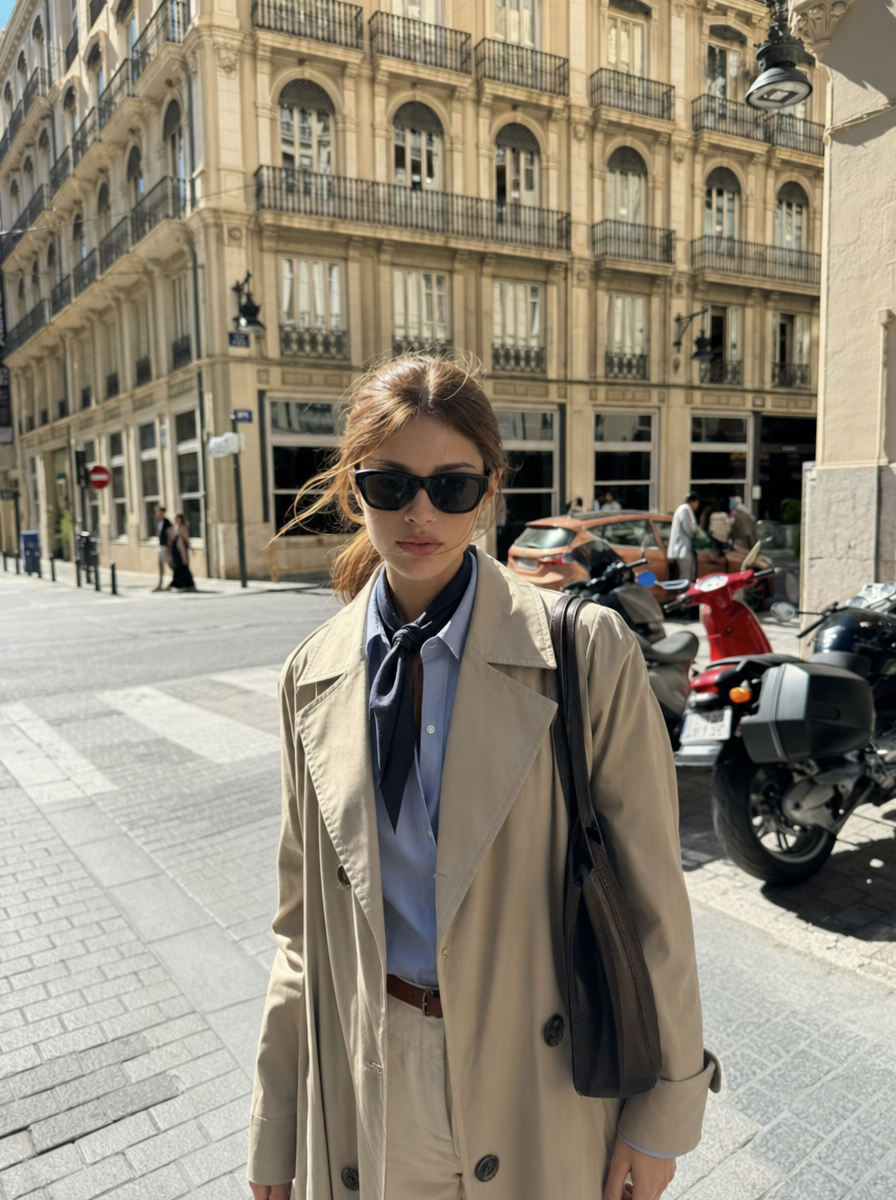
The full-body portrait framing keeps the model’s relaxed stance and complete outfit readable, while “hands relaxed at her sides” gives the pose an unforced editorial confidence. “Bright midday light with crisp shadows” supplies the sunny, graphic mood, and the “light beige trench coat,” “light-blue button-down shirt,” “matte black sunglasses,” and historic stone buildings organize the image around a restrained gray, brown, blue, and black palette. “Elegant historic stone buildings with wrought-iron balconies” adds European depth behind the subject without competing with the fashion styling.
FAQ
→How do I make the model feel more dramatic and powerful?
Replace “hands relaxed at her sides” with “one hand gripping the trench-coat lapel, the other resting on her hip,” and change “bright midday light with crisp shadows” to “hard low-angle sunlight with deep directional shadows.” Keep “portrait-full-body framing” so the stronger pose remains visible from head to toe.
→How do I make the outfit more central than the street background?
Replace “portrait-full-body framing” with “three-quarter fashion portrait framing” and add “shallow depth of field, sharply focused clothing textures, softly blurred buildings and pedestrians.” Keep “light beige trench coat over a crisp light-blue button-down shirt” unchanged so the coat and shirt remain the visual anchors.
→How do I create a dusk variation while preserving the same editorial style?
Replace “sunlit European city street” and “bright midday sunlight with crisp shadows” with “blue-hour European city street with warm storefront reflections and soft ambient light.” Change “natural color palette” to “muted blue-and-amber color palette,” while retaining “photorealistic editorial street photography” and the historic stone buildings for continuity.
Learn the technique behind this
- Why can't AI spell, and how do I get readable text in an image? — Older diffusion models had no character-level representation of text, so they produced letterform-shaped texture instead of words.
- Why does the model ignore parts of my prompt? — Ignored instructions are almost always conflicts, counts, or spatial relationships — three things current models handle badly — rather than the model failing to read you.
- Why does AI get hands and faces wrong, and how do I fix it? — Hands fail because they're small in frame, extremely variable in pose, and self-occluding — the model has less usable signal per pixel than for any other body part.
Related prompts

Teal fashion editorial in monster-filled lift
Cobalt Boots in Sleek Studio Edit

Silhouette Influencer by Sunlit Window
Sunlit editorial on striped beach towel