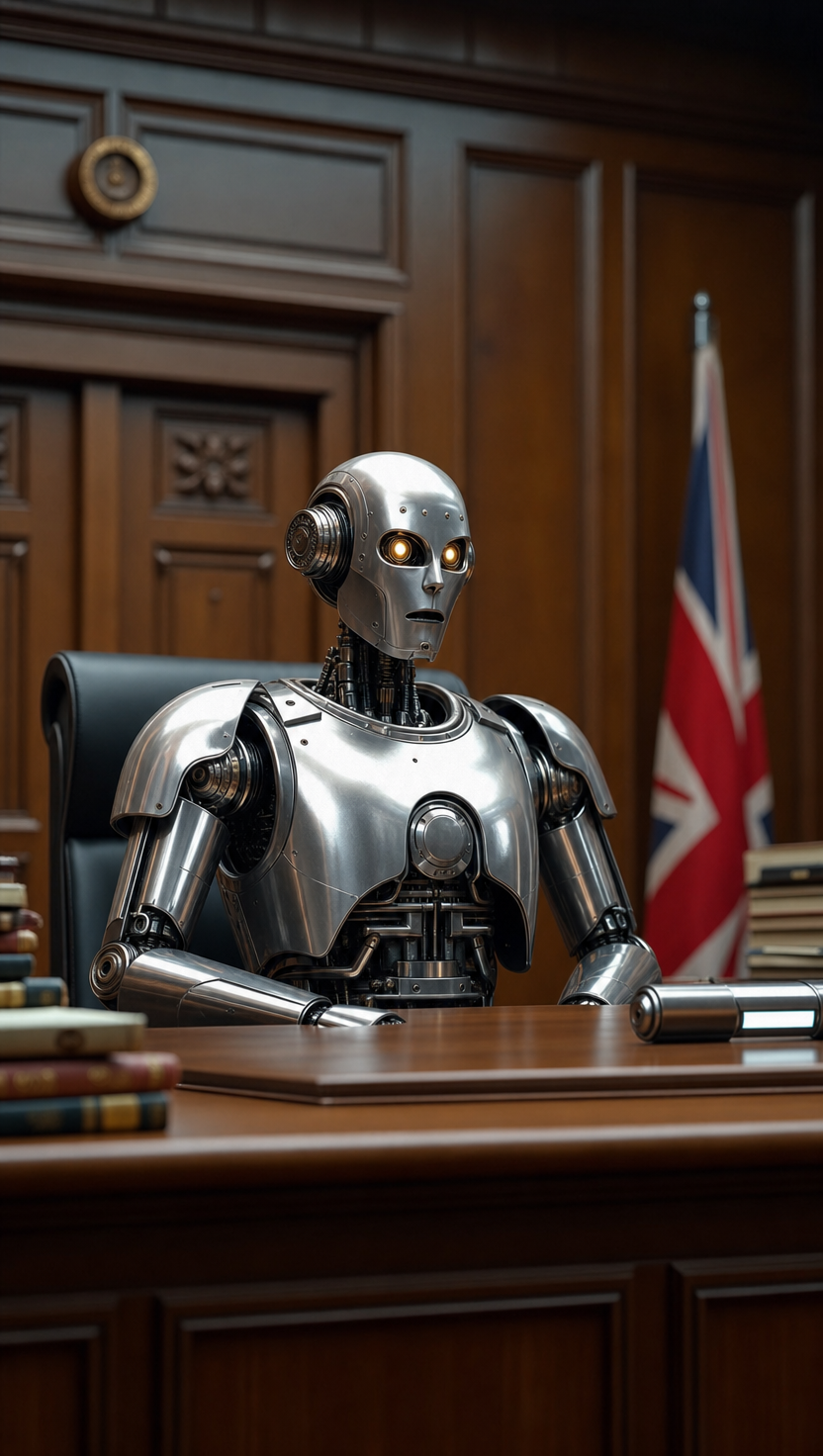
Same prompt, generated with each model separately — click one to see how it holds up.
Why this works
The phrase “dramatic low-angle composition” gives the seated robot judge visual authority, while “portrait-full-body” keeps the streamlined chrome-and-steel body and control baton readable within the frame. “Cinematic side lighting with cool rim highlights” separates the gray metallic figure from the darker wood-paneled hall, and the “amber glowing eyes” provide a warm focal contrast against the dominant gray, black, white, and blue palette. “British Union Jack” supplies a crisp background color structure, while “ultra-detailed photorealistic sci-fi realism” makes the polished surfaces, mechanical joints, and baton feel physically convincing.
FAQ
→How do I make the robot judge feel more intimidating and imposing?
Keep “dramatic low-angle composition,” but replace “seated at a courtroom bench” with “towering behind a massive elevated courtroom bench, shoulders squared toward the viewer.” Change “cinematic side lighting with cool rim highlights” to “hard overhead spotlight with deep underlighting and sharp black shadows,” and replace “amber glowing eyes” with “intense red glowing eyes.”
→How do I make the control baton the central visual element?
Replace “a sleek futuristic control baton resting on the desk” with “a sleek futuristic control baton held upright in the robot’s foreground hand, prominently centered and sharply focused.” Add “shallow depth of field with the baton as the primary focal point,” while changing “portrait-full-body” to “portrait three-quarter view” so the baton can occupy more of the frame without shrinking the judge excessively.
→How do I create a series of alternate courtroom settings with the same robot design?
Preserve “futuristic humanoid robot judge,” “polished chrome-and-steel body featuring more streamlined mechanical joints,” “amber glowing eyes,” and “realistic metallic materials” as fixed elements. Swap “wood-paneled courtroom bench,” “British Union Jack,” and “cinematic side lighting with cool rim highlights” for variations such as “glass-and-carbon-fiber tribunal chamber with a holographic planetary seal and cold blue overhead lighting,” or “ancient stone courtroom with illuminated legal glyphs and warm torch-like side lighting.”
Learn the technique behind this
- Why can't AI spell, and how do I get readable text in an image? — Older diffusion models had no character-level representation of text, so they produced letterform-shaped texture instead of words.
- How should a prompt be structured, and does word order matter? — A prompt that behaves predictably names one subject first, then what it is doing, then where, then the light, then the lens or medium, then the style.
- Do negative prompts work, and what should go in one? — Negative prompts work on models that support a separate negative conditioning channel — mainly Stable Diffusion and FLUX-family models.
Related prompts

DJ in neon haze at low angle

Glowing Fiber-Optic Cables With Purple Data Lines

Cyan Hologram, Sleek Robotic Hand
Cyborg head with magenta holograms and translucent skull