Same prompt, generated with each model separately — click one to see how it holds up.
Why this works
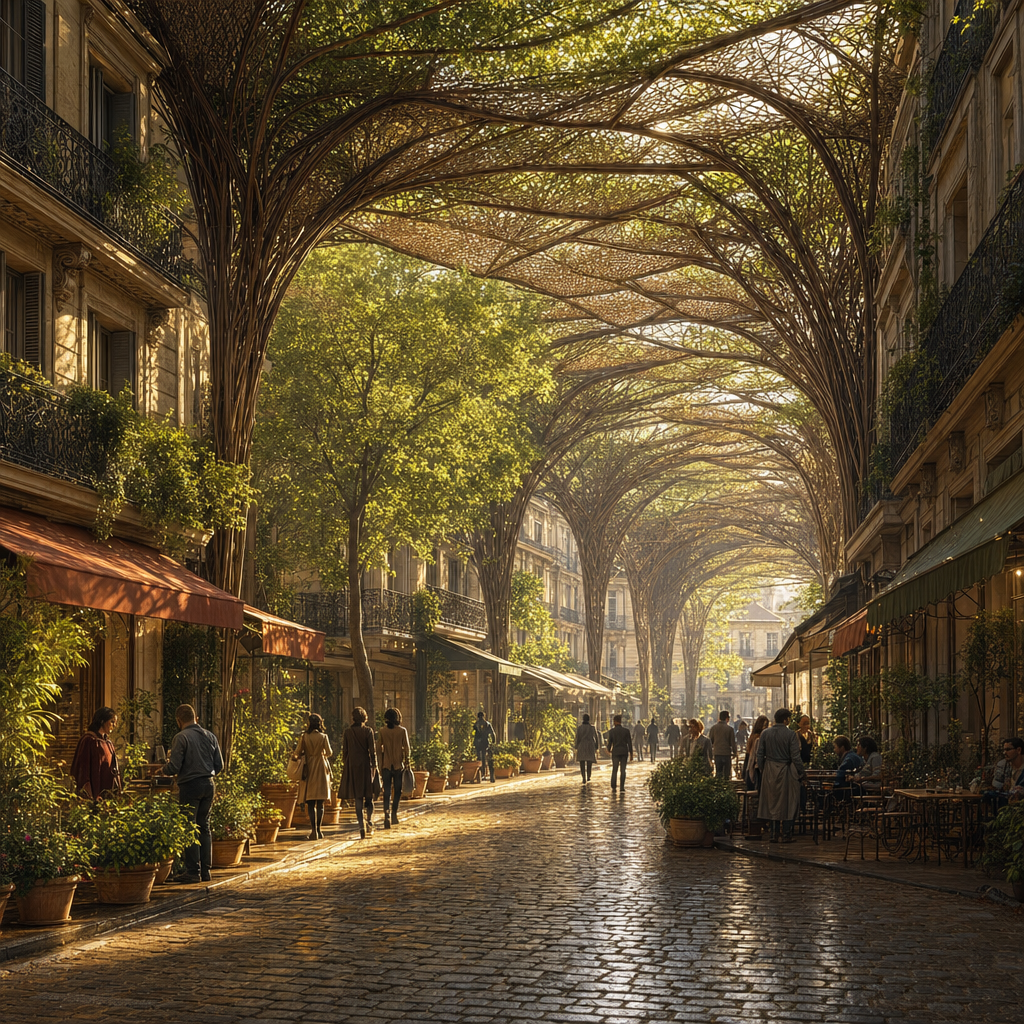
The phrase “wide cinematic framing” establishes the broad street-level composition, allowing the “sculptural woven canopy bridging older apartment buildings” to read as the main architectural gesture rather than an isolated object. “Cooler and more golden” morning light, “longer shadows,” and “slightly damp” cobblestones create the serene gold-and-beige atmosphere, while “lush greenery climbing along balconies” supplies the dominant green accents. “Slimmer, branching tree-like supports” and “organic and architectural” make the futuristic structure feel integrated with the older European setting instead of visually detached.
FAQ
→How do I make the woven canopy more prominent in the image?
Replace “Wide cinematic framing” with “wide low-angle framing centered beneath the canopy,” and change “a sculptural woven canopy bridging older apartment buildings” to “a monumental sculptural woven canopy dominating the upper frame and spanning the entire street.” Add “strong leading lines from the cobblestones toward the canopy’s central span” to direct attention upward.
→How do I shift this from a serene morning scene to a more dramatic evening mood?
Replace “Cooler and more golden morning sunlight with longer shadows” with “deep blue-hour light with warm amber cafe illumination and pronounced architectural uplighting.” Change “warm yet futuristic and inviting” to “dramatic, atmospheric, and quietly futuristic,” while keeping “slightly damp” cobblestones so the pavement reflects the cafe lights.
→How do I create a series of variations using a different urban setting?
Keep “sculptural woven canopy,” “slimmer, branching tree-like supports,” and “organic and architectural,” but replace “European narrow street between older apartment buildings with balconies and storefronts” with options such as “seaside Mediterranean market lane with stucco arcades,” “dense East Asian pedestrian alley with layered signage,” or “repurposed industrial courtyard with brick warehouses.” Retain “lush greenery” and “muted terracotta and olive tones” to preserve a recognizable visual thread across the series.
Learn the technique behind this
- Why can't AI spell, and how do I get readable text in an image? — Older diffusion models had no character-level representation of text, so they produced letterform-shaped texture instead of words.
- How should a prompt be structured, and does word order matter? — A prompt that behaves predictably names one subject first, then what it is doing, then where, then the light, then the lens or medium, then the style.
- Do negative prompts work, and what should go in one? — Negative prompts work on models that support a separate negative conditioning channel — mainly Stable Diffusion and FLUX-family models.
Related prompts
Grotesque Claymation Gangsters in Gritty Alley
Woman in Teal Jacket Capturing Twilight Reflection
Charcoal coat with tan-handled tote
Neon Night Portrait by Red Signal