Why this works
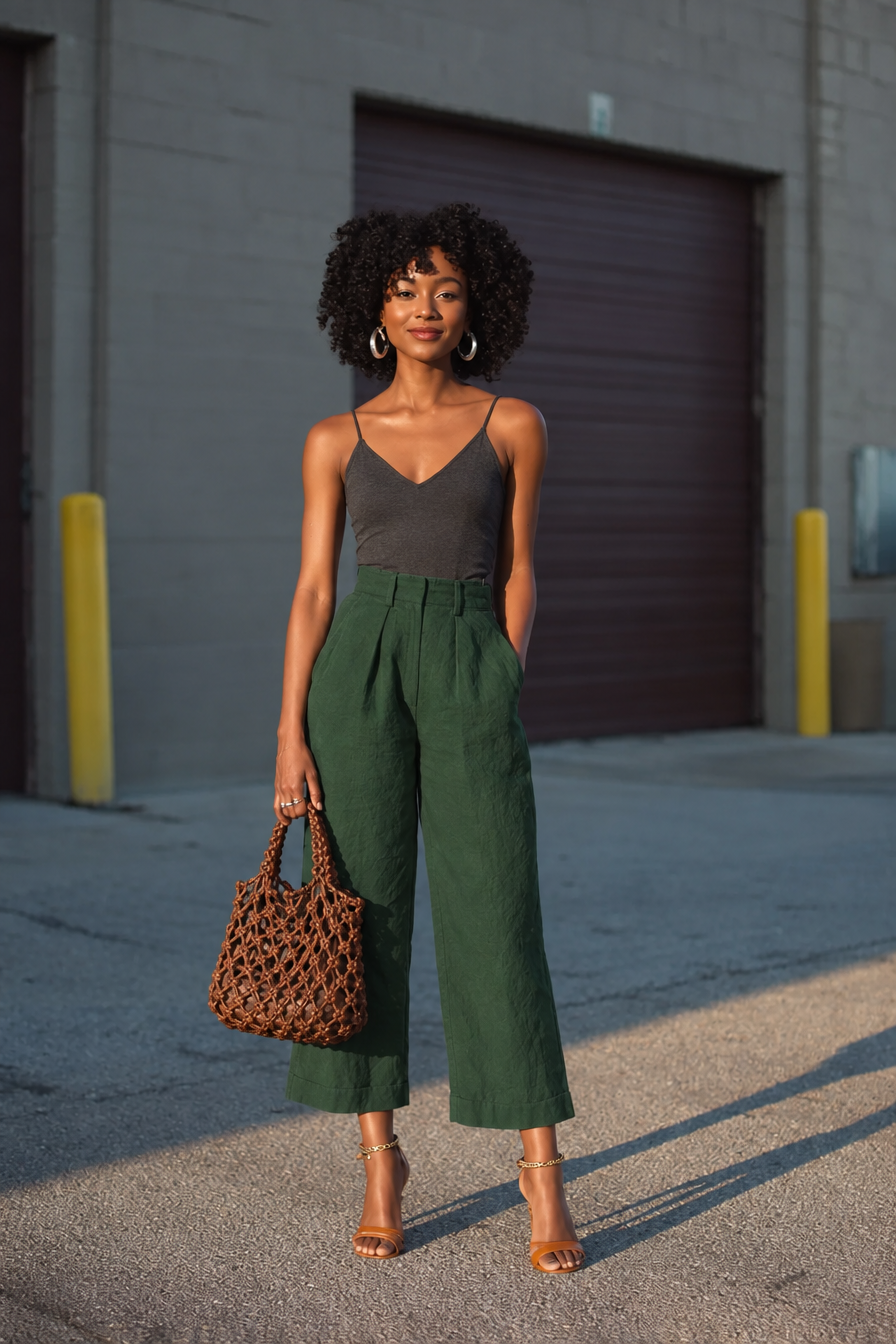
“Full-body street-style fashion editorial portrait” establishes the vertical composition and keeps the complete outfit readable, while “relaxed editorial stance” gives the confident subject a natural rather than rigid pose. The palette is anchored by “forest-green trousers,” “charcoal” fabric, and the “tan” tote and sandals, creating the green, black, and brown harmony visible in the image. “Golden early-evening sunlight with long soft shadows” supplies the warm polished mood, and “industrial urban street background” plus “shallow depth of field” separates the sharply detailed figure from the garage door and concrete wall.
FAQ
→How do I make the trousers and tote more visually central?
Replace “charcoal spaghetti-strap cami” with “minimal cream cropped blouse” to reduce competition with the trousers, and change “holding a woven leather-look tote bag with macramé texture” to “prominently displaying a large sculptural woven tote in the foreground.” Add “fashion-forward low-angle framing with the trousers and tote emphasized” after “full-body framing.”
→How do I shift this from warm polished street style to a moodier editorial image?
Replace “golden early-evening sunlight with long soft shadows” with “cool overcast directional light with deep architectural shadows,” and change “warm natural skin tones, cinematic color grading” to “muted cool skin tones and high-contrast desaturated cinematic grading.” Keep “painted metal garage door and concrete wall” so the industrial setting supports the darker tone.
→How do I create a coordinated series of variations from this prompt?
Keep “photorealistic fashion editorial portrait,” “full-body framing,” “relaxed editorial stance,” and the subject’s accessories fixed, then swap the setting and lighting as paired variables. For example, replace “painted metal garage door and concrete wall” with “sunlit concrete stairwell” and “golden early-evening sunlight” with “bright midday light,” or use “rain-darkened brick alley” with “soft blue-hour ambient light” for a second variation.
Learn the technique behind this
- Why can't AI spell, and how do I get readable text in an image? — Older diffusion models had no character-level representation of text, so they produced letterform-shaped texture instead of words.
- How should a prompt be structured, and does word order matter? — A prompt that behaves predictably names one subject first, then what it is doing, then where, then the light, then the lens or medium, then the style.
- Which aspect ratio should I use, and how does it change the image? — Aspect ratio determines what the model composes, not how it's cropped afterwards.
Related prompts
Teal fashion editorial in monster-filled lift
Cobalt Boots in Sleek Studio Edit
Silhouette Influencer by Sunlit Window
Sunlit editorial on striped beach towel