Why this works
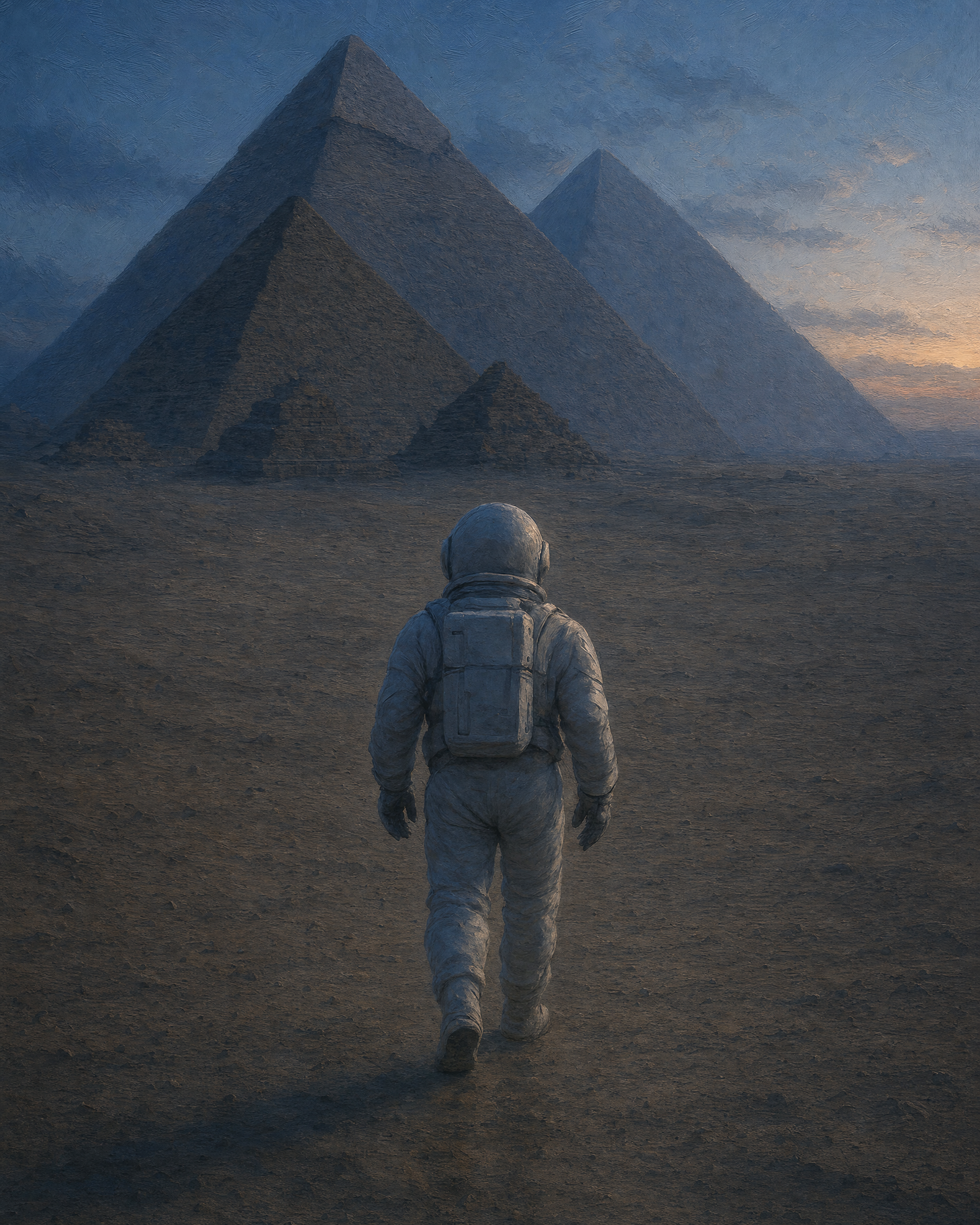
The lonely, exploratory mood comes from the specific pairing of “a lone astronaut” and “walks away from the camera,” while “vast ochre desert” and “towering stone pyramids” create a strong sense of scale around the small figure. “Cool blue dusk sky,” “dim rim light,” and “subtle color contrast from the twilight” establish the restrained blue-gray and black-dominant palette, with the astronaut’s matte white suit providing the clearest contrast. “Wide-angle framing,” “fine drifting dust,” and “mild haze” push the pyramids and horizon into atmospheric depth, while “high detail textures on the suit fabric and desert ground” keeps the foreground tactile despite the soft shadows.
FAQ
→How do I make the astronaut more prominent and central in the frame?
Replace “walks away from the camera across a vast ochre desert” with “stands centered in the foreground, occupying the central third of the frame, facing the camera,” and change “wide-angle framing” to “medium-wide framing with the astronaut as the primary subject.” Keep “towering stone pyramids” in the distant background so they remain a scale cue rather than competing focal points.
→How do I make the scene warmer and more ominous instead of cool and lonely?
Replace “under a cool blue dusk sky” and “dim rim light and subtle color contrast from the twilight” with “under a burnt orange storm sky, lit by harsh crimson rim light and deep directional shadows.” Change “mild haze” to “thick amber dust storm haze” to shift the atmosphere from quiet isolation toward danger while preserving the desert setting.
→How do I create a series of variations without losing the core composition?
Keep “a lone astronaut,” “walks away from the camera,” “wide-angle framing,” and “atmospheric depth,” then swap only the setting phrase “vast ochre desert with towering stone pyramids” for controlled alternatives such as “black volcanic plain with a collapsed space elevator,” “salt flats surrounding a half-buried orbital station,” or “pale ice desert beneath a fractured moon.” Match each variation with a corresponding palette and light phrase, such as “cold cyan moonlight” for the ice desert or “rust-red sunset” for the volcanic plain.
Learn the technique behind this
- Why can't AI spell, and how do I get readable text in an image? — Older diffusion models had no character-level representation of text, so they produced letterform-shaped texture instead of words.
- Which aspect ratio should I use, and how does it change the image? — Aspect ratio determines what the model composes, not how it's cropped afterwards.
- How should a prompt be structured, and does word order matter? — A prompt that behaves predictably names one subject first, then what it is doing, then where, then the light, then the lens or medium, then the style.
Related prompts
Solitary Woman in Twilight Wildflower Meadow
Woman Relaxing in Golden Autumn Field
Man on sand dune in blue hour
Golden-hour surf under dramatic clouds