There is no secret phrasing. What there is, is an ordering that survives contact with every model we publish on, and a fairly narrow vocabulary that actually changes pixels. Both of those claims are testable against this library, so this article uses it as the evidence rather than asserting them.
The five-part order
| Position | Part | What belongs here | What does not |
|---|---|---|---|
| 1 | Subject | Who or what, plus the one thing they are doing or wearing that matters | Adjective piles: 'beautiful', 'stunning', 'masterpiece' |
| 2 | Setting | Where, and how much of it should be visible | A second subject you have not committed to |
| 3 | Lighting | Direction, hardness, colour temperature, what falls into shadow | 'Good lighting', 'perfect lighting' |
| 4 | Camera | Framing distance, angle, depth of field, where focus lands | Lens model numbers the model has never seen labelled |
| 5 | Style | Genre and finish: editorial, product, claymation, film stock | '8K', 'ultra HD' — resolution comes from the request, not the words |
The order matters because attention is not uniform across a prompt. Words near the front influence the composition that gets laid down early; words near the end tend to act as finish and grading. Putting your lighting instruction after 200 words of style modifiers is how it gets treated as a suggestion. This is also why the fix for an ignored detail is usually to move it forward, not to repeat it louder.
The vocabulary that actually moves the image
We counted term frequency across the 168 portrait prompts in the library — the largest single category here, and the one where lighting language matters most. These are the terms that survived editing, in order of how often they appear:
| Lighting terms (168 portrait prompts) | Count |
|---|---|
| soft | 82 |
| warm | 52 |
| shadows | 49 |
| contrast | 48 |
| highlights | 41 |
| dramatic | 41 |
| cool | 39 |
| studio | 30 |
| cinematic | 25 |
| diffused | 24 |
| side (light) | 23 |
| golden hour | 21 |
| Camera terms (168 portrait prompts) | Count |
|---|---|
| framing | 99 |
| shallow depth of field | 86 |
| close-up | 75 |
| cinematic | 48 |
| photorealistic | 38 |
| sharp detail | 37 |
| editorial | 31 |
| focus (on a named feature) | 25 |
Two things stand out. First, the working vocabulary is small — roughly a dozen lighting words and eight camera words cover almost the entire library. You do not need a glossary of photographic jargon; you need to use these consistently. Second, the highest-count camera term is 'framing', which is not a piece of jargon at all: it is a decision about how much of the subject is in the frame. That decision does more than any lens name.
Terms that appear almost nowhere in the published set, despite being all over prompt-tip lists: specific lens focal lengths, named camera bodies, f-stop numbers, and 'award-winning'. They were tried and did not survive, because their effect was not distinguishable from the plain-language version.
Write the negative prompt once, then leave it alone
All 782 published prompts carry a negative prompt, and all 782 contain the same seven terms: text, watermark, signature, logo, letters, words, caption. That is not laziness — it is the one negative that reliably pays off on these models, because generative models have absorbed enormous quantities of images with captions, credits and watermarks baked in, and they will helpfully add some to yours.
Beyond that, negatives are situational and rare here: blurry (37 prompts), low quality (28), extra limbs (10), deformed hands (6), extra fingers (6). Add them when you are seeing that specific failure repeatedly on that specific prompt. Adding them pre-emptively is cargo cult.
A worked rewrite
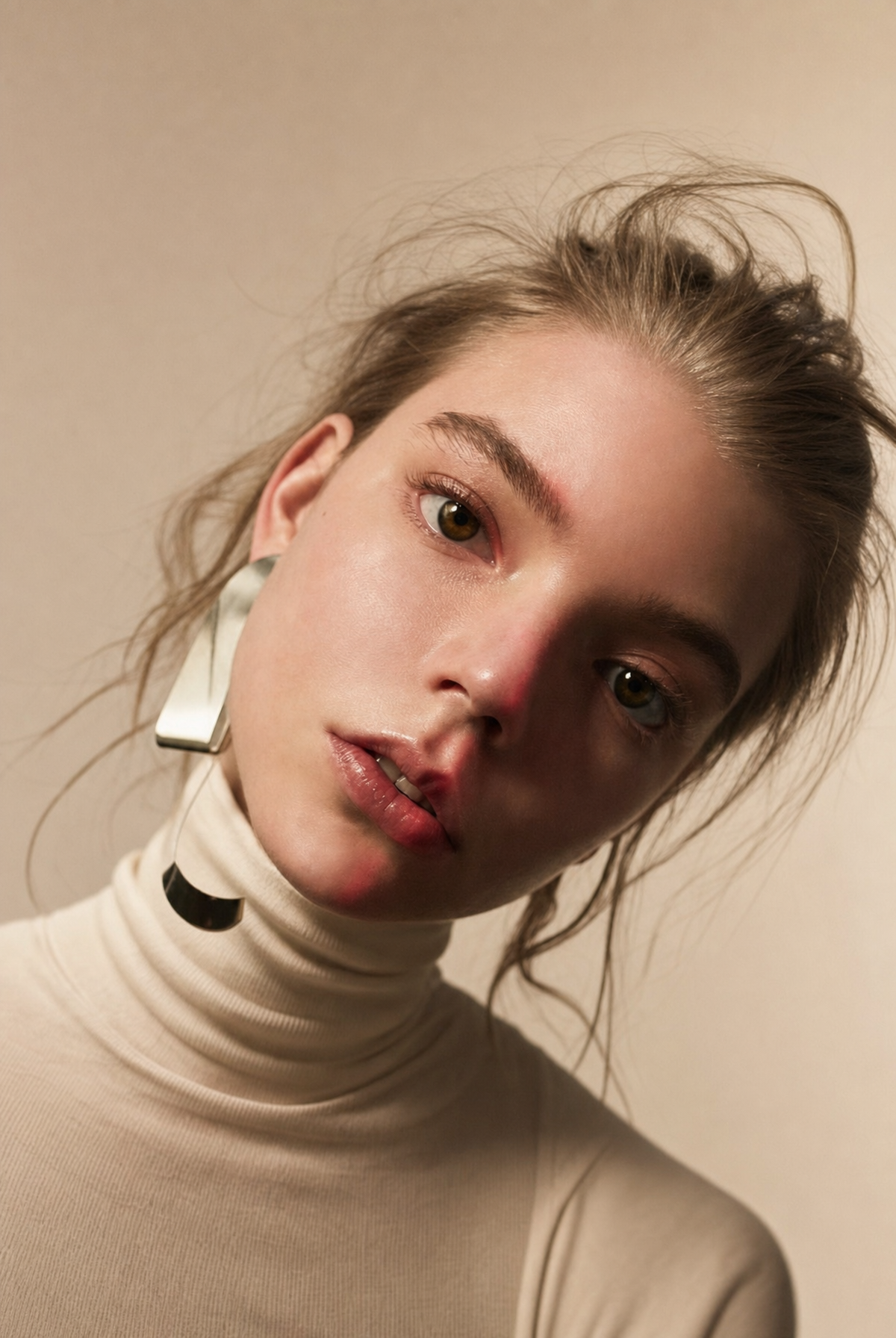
Take a beginner prompt: 'beautiful woman, amazing lighting, 8k, ultra detailed, masterpiece, professional photo'. Six clauses, and not one of them is a decision. Now the same intent written in five parts, which is roughly how the studio portrait in the library is phrased:
Close-up studio portrait of a young woman with tousled ash-blonde hair, minimal makeup, head tilted slightly to the side / plain warm-beige background / soft directional key light creating sculptural shadows, moody cinematic contrast / close framing, shallow depth of field, crisp focus on the eyes and cheekbones / modern editorial fashion photography, natural skin texture and realistic pores.
Same length as the adjective version, entirely different in kind. Every clause is something a photographer would have had to choose on set, which is exactly the information the model is missing. 'Masterpiece' is not information.
- Real prompt examples, taken apart — What 782 published prompts have in common
- Why order changes the output
- Negative prompts: what they still do
- Camera and lighting terms that move the image