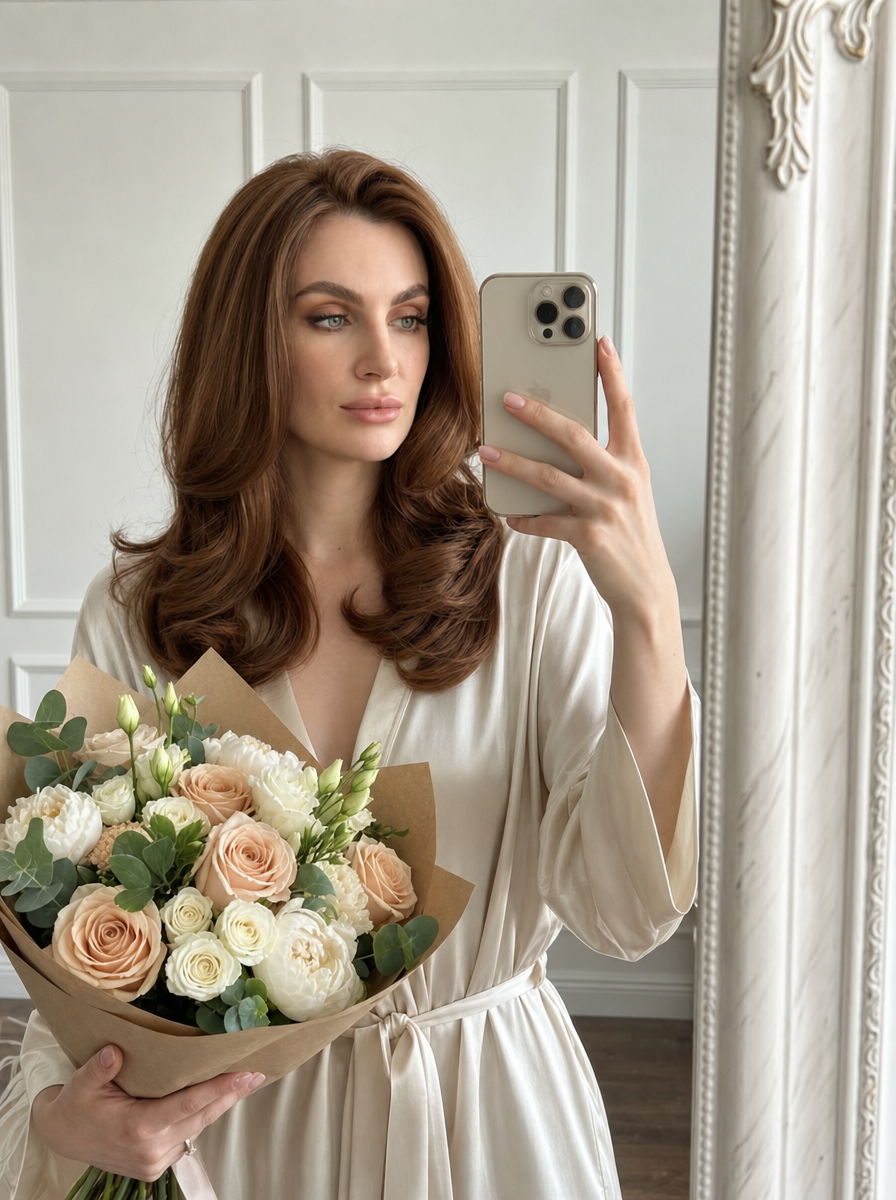
Why this works
The calm, elegant mood comes from the specific combination of “light cream satin robe,” “soft late-afternoon window light,” and “gentle highlights and shadows,” while “natural realistic skin tones” keeps the portrait grounded rather than overly polished. “Mirror selfie framing” establishes the full-body portrait composition, and the “large bouquet of pale peach and white roses with greenery” creates a strong foreground anchor against the “pale gray paneled wall.” The brown auburn hair, white robe and roses, and green foliage form the image’s dominant earthy-neutral palette, while “shallow depth of field” separates the woman and bouquet from the subtle molding behind them.
FAQ
→How do I make the bouquet more central and visually prominent?
Replace “holding a large bouquet” with “holding an oversized bouquet that fills the lower center of the frame, partially covering her torso,” and add “the bouquet is the primary foreground subject, with sharply detailed roses and greenery.” Keep “mirror selfie framing” so the woman remains visible behind it.
→How do I turn the calm luxury portrait into a moodier, more dramatic image?
Replace “soft late-afternoon window light creates gentle highlights and shadows” with “low, directional evening window light creates deep shadows and narrow golden highlights across her face, hair, and robe.” You can also replace “soft elegant calm mood” with “quiet romantic editorial mood” and change the pale gray wall to “a darker warm-gray paneled wall.”
→How do I create a matching series with different flowers and interiors?
Keep the fixed structure, including “mirror selfie framing,” “light cream satin robe,” “natural realistic skin tones,” and “shallow depth of field,” then swap “pale peach and white roses with greenery” for options such as “deep burgundy dahlias with eucalyptus” or “white tulips with trailing olive branches.” Replace “pale gray paneled wall” with coordinated settings such as “warm ivory plaster beside a carved antique mirror” or “cream marble walls beside a modern brass mirror,” while preserving “soft late-afternoon window light” for visual continuity.
Learn the technique behind this
- Why can't AI spell, and how do I get readable text in an image? — Older diffusion models had no character-level representation of text, so they produced letterform-shaped texture instead of words.
- Why does AI get hands and faces wrong, and how do I fix it? — Hands fail because they're small in frame, extremely variable in pose, and self-occluding — the model has less usable signal per pixel than for any other body part.
- How do I keep the same character across multiple images? — Text prompts alone won't hold a face across images — a description defines a type, not a person.
Related prompts

Woman's Selfie with Crimson-Powered Anime Guardian

Blue Tracksuits on Glass Bridge Selfie

Golden-hour café selfie with iced coffee

Warm indoor flashless couple selfie