Why this works
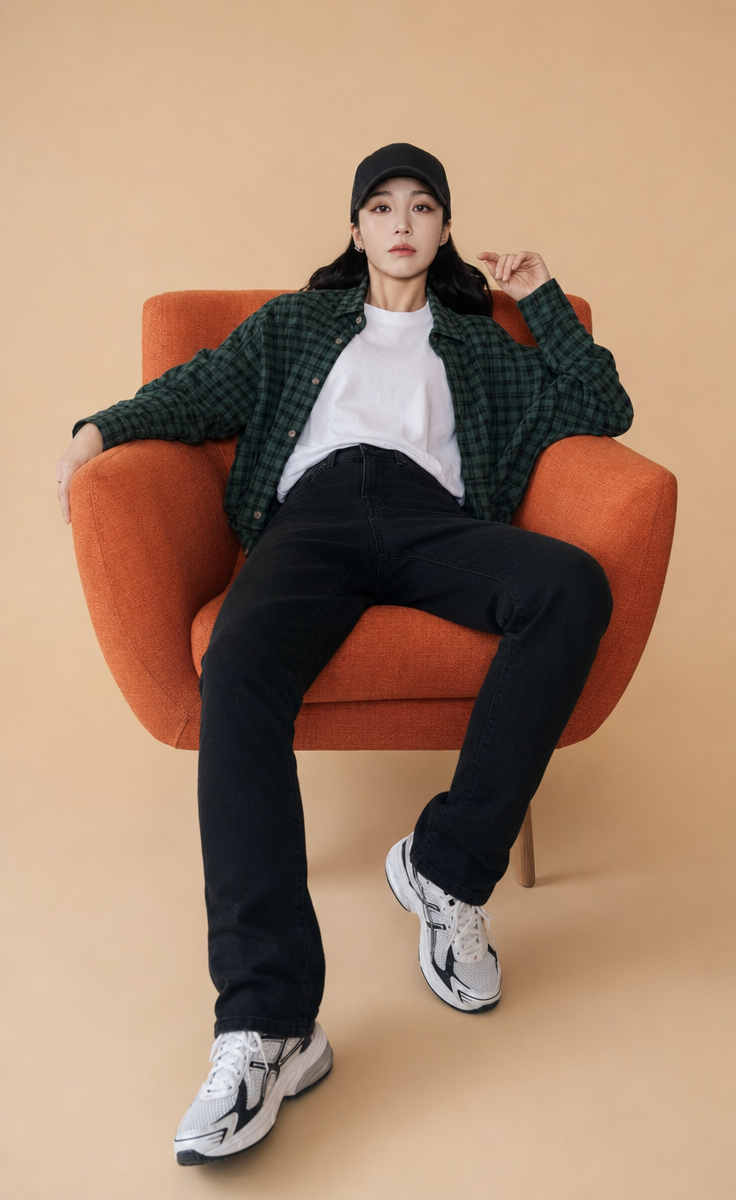
The relaxed, confident mood comes from the load-bearing phrases “lounging casually,” “relaxed editorial pose,” and the contrasting streetwear wardrobe of a “black baseball cap,” “dark green overshirt,” and “black skinny jeans.” The portrait-full-body framing is explicitly anchored by “full-body composition,” while the “modern orange upholstered armchair” creates a strong orange focal block against the “warm beige seamless background.” “Clean soft lighting” preserves the fabric and upholstery detail without adding drama, and “crisp realistic textures and sharp detail” keeps the cap, denim, sneakers, and chair visually legible.
FAQ
→How do I make the woman feel more dominant and fashion-forward in the composition?
Replace “lounging casually in a modern orange upholstered armchair” with “standing confidently beside a sculptural orange armchair, one hand on the chair, commanding editorial posture,” and change “full-body composition with a relaxed editorial pose” to “full-body fashion portrait with a strong contrapposto stance.” Keep “sharp detail” to retain clear wardrobe definition.
→How do I shift this from relaxed studio streetwear to a moodier, more dramatic editorial?
Replace “clean soft lighting” with “dramatic directional side-lighting with deep shadows and controlled highlights,” and change “warm beige seamless background” to “charcoal gray seamless studio background.” Retain the “black baseball cap” and “black skinny jeans,” since those phrases reinforce the darker tonal palette.
→How do I create a series of variations while keeping the same visual identity?
Keep “photorealistic studio fashion editorial,” “full-body composition,” “crisp realistic textures,” and “sharp detail” unchanged, then swap only the chair, background, and accent color: use “cobalt blue velvet armchair with a cool gray seamless background” or “mustard yellow leather chair with an ivory seamless background.” Preserve the black cap and white low-top sneakers as recurring styling anchors.
Learn the technique behind this
- Why can't AI spell, and how do I get readable text in an image? — Older diffusion models had no character-level representation of text, so they produced letterform-shaped texture instead of words.
- How should a prompt be structured, and does word order matter? — A prompt that behaves predictably names one subject first, then what it is doing, then where, then the light, then the lens or medium, then the style.
- Which aspect ratio should I use, and how does it change the image? — Aspect ratio determines what the model composes, not how it's cropped afterwards.
Related prompts
Teal fashion editorial in monster-filled lift
Cobalt Boots in Sleek Studio Edit
Silhouette Influencer by Sunlit Window
Sunlit editorial on striped beach towel