Why this works
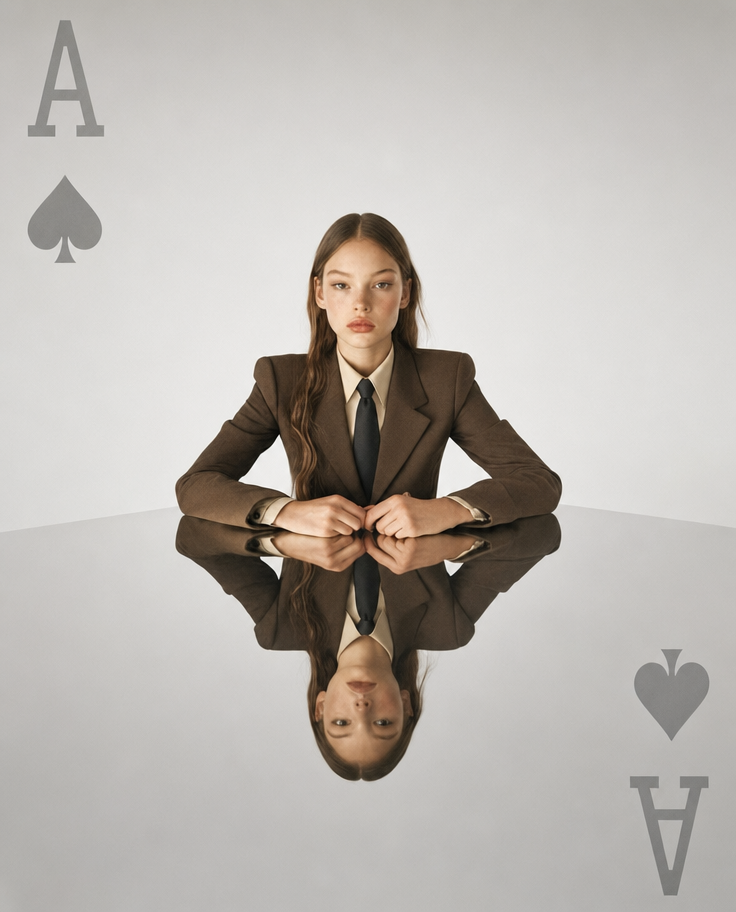
The phrase “centered, symmetrical composition” makes the woman and her reflection the visual anchor, while the “glossy reflective table with mirror-like reflections” adds a controlled, slightly surreal doubling effect. “Soft diffused lighting,” “minimal pale gray background,” and the brown suit with dark tie produce a restrained brown, white, and black palette that supports the calm, composed mood without competing detail. “Shallow depth of field” keeps attention on the subject, while “subtle playing card suit symbols arranged in the corners” creates balanced peripheral framing rather than a busy background.
FAQ
→How do I make the portrait feel darker and more dramatic?
Replace “soft diffused studio lighting” with “hard directional chiaroscuro lighting with deep shadows,” and change “minimal pale gray background” to “deep charcoal background.” Keep the brown suit and dark tie, or replace “brown suit” with “near-black tailored suit” for stronger tonal contrast.
→How do I make the playing-card motif more central and prominent?
Replace “subtle playing card suit symbols arranged in the corners” with “large crisp heart, diamond, club, and spade symbols framing the subject at mid-background,” and change “minimalist conceptual composition” to “graphic editorial composition with bold geometric motifs.” Keep “centered, symmetrical composition” so the symbols remain evenly balanced around her.
→How do I build a related series with different subjects and settings?
Keep the structural phrases “centered, symmetrical composition,” “soft diffused studio lighting,” “glossy reflective table,” and “shallow depth of field,” then replace “young woman in a tailored brown suit and dark tie” with a specific alternative such as “older man in a white tuxedo and black gloves.” For a setting variation, replace “seated at a glossy reflective table” with “standing before a mirrored geometric wall,” while retaining “subtle playing card suit symbols” as the recurring visual motif.
Learn the technique behind this
- Why can't AI spell, and how do I get readable text in an image? — Older diffusion models had no character-level representation of text, so they produced letterform-shaped texture instead of words.
- How should a prompt be structured, and does word order matter? — A prompt that behaves predictably names one subject first, then what it is doing, then where, then the light, then the lens or medium, then the style.
- Which aspect ratio should I use, and how does it change the image? — Aspect ratio determines what the model composes, not how it's cropped afterwards.
Related prompts
Teal fashion editorial in monster-filled lift
Cobalt Boots in Sleek Studio Edit
Silhouette Influencer by Sunlit Window

Sunlit editorial on striped beach towel