Why this works
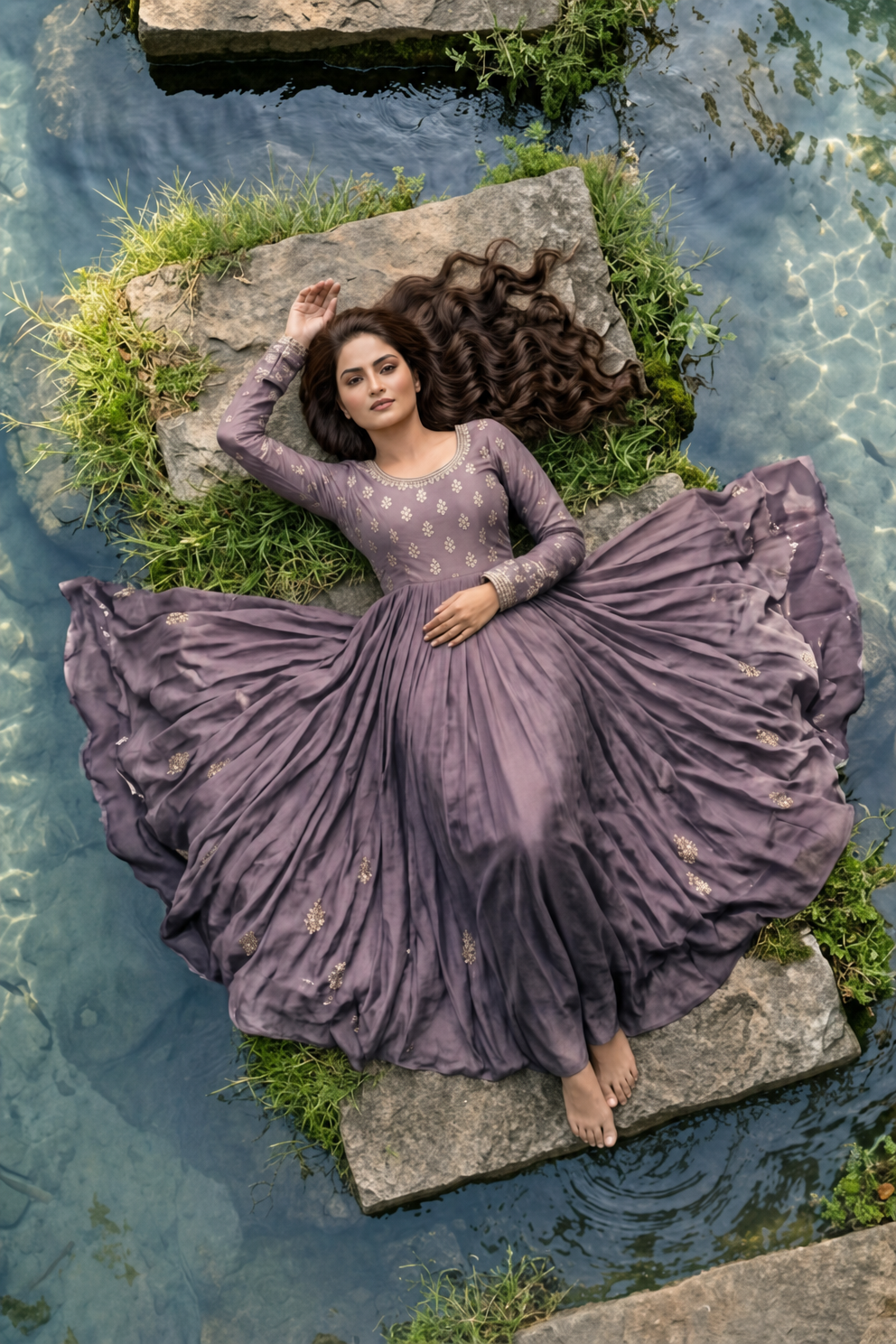
The top-down view makes the woman and the “dramatic, airy spread” of her muted plum-violet dress read as a full-body editorial composition, while the large stone slabs establish a gray, geometric ground plane. “Soft overcast natural daylight” supports the serene, dreamy mood by keeping shadows gentle, and “clear shallow water,” “lush green grass,” and “subtle gentle ripples” add restrained green and reflective detail around the purple-and-gray palette. “Crisp fabric texture” and “realistic skin” keep the image photorealistic despite the stylized pose and flowing silhouette.
FAQ
→How do I make the dress more visually dominant?
Replace “delicate silver embroidery” with “bold reflective silver embroidery” and expand “the fabric fans out across the frame in a dramatic, airy spread” to “the muted plum-violet fabric occupies most of the frame in a sweeping radial spread.” Keep “top-down view” so the enlarged silhouette remains clearly readable.
→How do I shift the mood from serene to dramatic?
Replace “soft overcast natural daylight” with “low directional sunset light with long shadows and warm highlights,” and change “serene and elegant atmosphere” to “cinematic, tense editorial atmosphere.” You can also replace “subtle gentle ripples” with “strong concentric ripples and disturbed reflections” to make the water more active.
→How do I build a series with different subjects while preserving this composition?
Keep “top-down view, editorial fashion framing,” “large natural stone slabs,” “clear shallow water,” and “lush green grass around the edges,” then replace “a woman” and “traditional dress” with a consistent subject-template such as “a dancer in a flowing ivory costume” or “a man in a tailored charcoal suit.” Retain “the fabric fans out across the frame” only for garments with enough volume to create the same full-body radial shape.
Learn the technique behind this
- Why can't AI spell, and how do I get readable text in an image? — Older diffusion models had no character-level representation of text, so they produced letterform-shaped texture instead of words.
- Why does AI get hands and faces wrong, and how do I fix it? — Hands fail because they're small in frame, extremely variable in pose, and self-occluding — the model has less usable signal per pixel than for any other body part.
- How do I keep the same character across multiple images? — Text prompts alone won't hold a face across images — a description defines a type, not a person.
Related prompts
Teal fashion editorial in monster-filled lift
Cobalt Boots in Sleek Studio Edit

Silhouette Influencer by Sunlit Window
Sunlit editorial on striped beach towel