Why this works
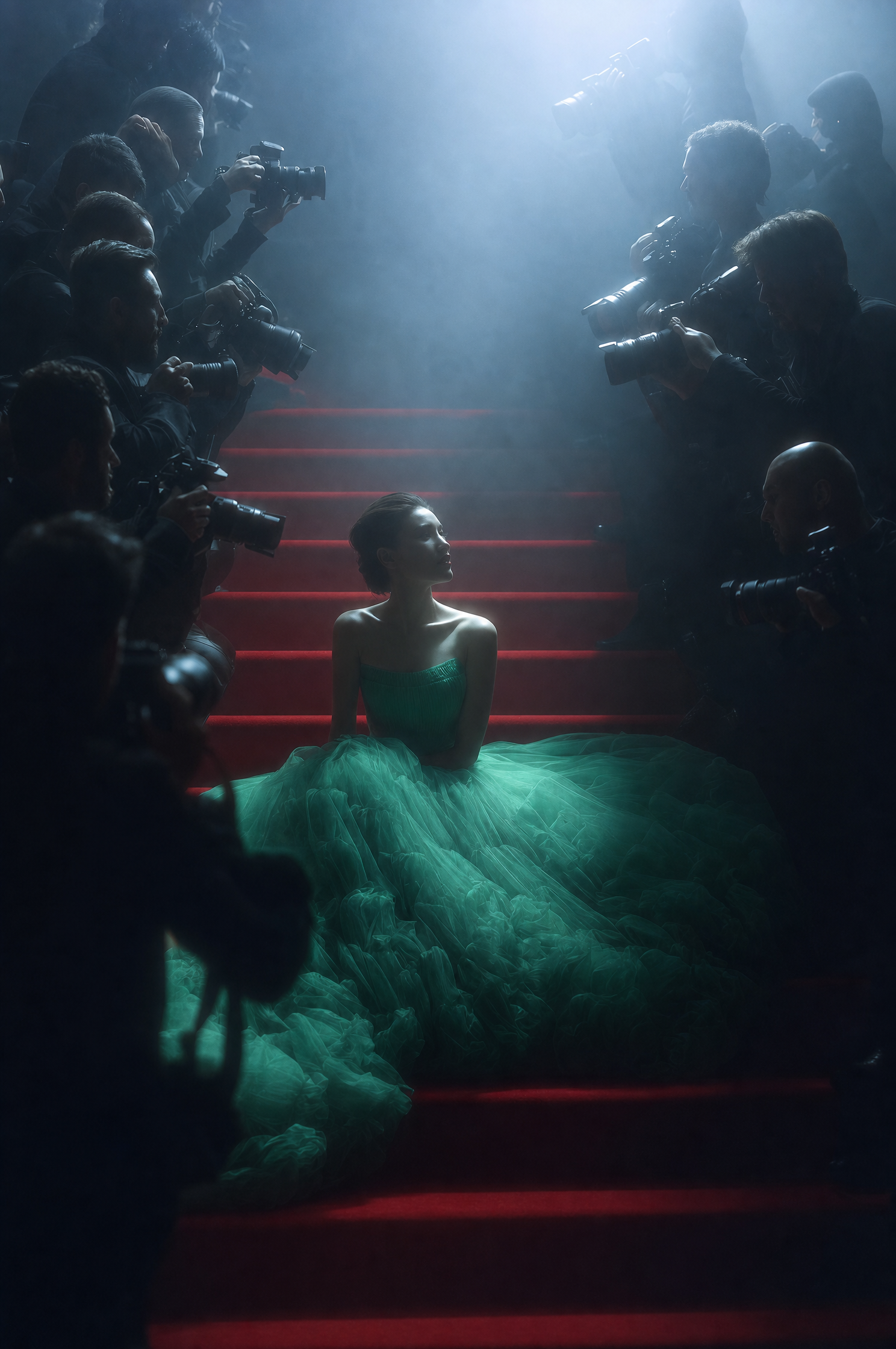
The phrase “glamorous woman in an emerald green couture gown sits dramatically” gives the portrait-full-body composition a clear central pose, while “photographers with cameras lining both sides” creates a corridor of framing lines up the grand red-carpet stairs. “Dark, moody atmosphere,” “soft cool-toned overhead haze,” and “dramatic rim lighting” explain the gray-teal shadows and separated silhouette; the red carpet supplies the dominant warm counterpoint. “Realistic motion blur from camera flashes” adds paparazzi energy without sacrificing the “crisp” details and “highly detailed photorealism” requested for the gown and surrounding cameras.
FAQ
→How do I change this prompt to make the seated woman feel more powerful and central?
Replace “sits dramatically” with “stands at the top of the stairs in a commanding full-body pose, looking directly into the camera,” and change “photographers with cameras lining both sides” to “photographers receding into the background, leaving clear space around her.” Keep “dramatic rim lighting” so her silhouette remains the visual anchor.
→How do I change the prompt for a warmer, celebratory red-carpet mood?
Replace “Dark, moody atmosphere with a soft cool-toned overhead haze” with “warm golden evening light with amber haze,” and change “strong contrast” to “soft luminous contrast.” Retain “red-carpet stairs” and “emerald green couture gown,” while replacing “subtle crowd energy” with “cheering guests and raised phones” for a more openly festive scene.
→How do I build a series of variations from this paparazzi scene without losing its identity?
Keep the fixed elements “emerald green couture gown,” “grand red-carpet stairs,” “photographers lining both sides,” and “fashion-event photography style.” For each variation, swap only the action and camera phrase: use “ascending the stairs, low-angle three-quarter view,” “pausing mid-staircase, centered frontal view,” or “turning toward the photographers, close low-angle crop,” while preserving “cool-toned overhead haze” and “realistic motion blur from camera flashes.”
Learn the technique behind this
- Why can't AI spell, and how do I get readable text in an image? — Older diffusion models had no character-level representation of text, so they produced letterform-shaped texture instead of words.
- How should a prompt be structured, and does word order matter? — A prompt that behaves predictably names one subject first, then what it is doing, then where, then the light, then the lens or medium, then the style.
- Do negative prompts work, and what should go in one? — Negative prompts work on models that support a separate negative conditioning channel — mainly Stable Diffusion and FLUX-family models.
Related prompts
Teal fashion editorial in monster-filled lift
Cobalt Boots in Sleek Studio Edit
Silhouette Influencer by Sunlit Window
Sunlit editorial on striped beach towel