Why this works
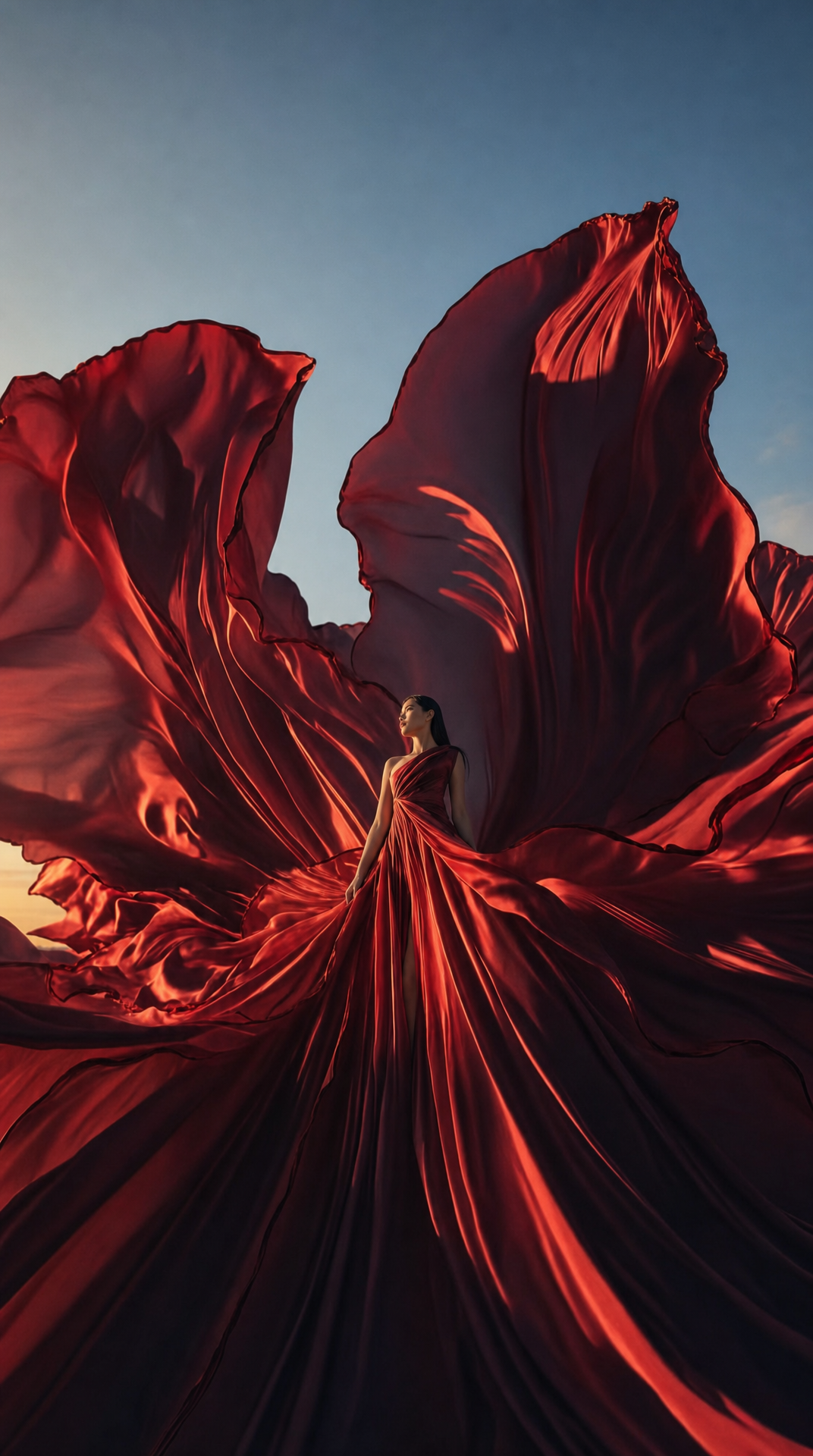
The phrase “low-angle full-body editorial framing” gives the woman and winglike fabric a commanding vertical presence, while “enormous flowing silk fabric billowing outward like wings” supplies the image’s main radial motion. “Warm directional late-afternoon sunlight” and “strong contrast between the deep red silk and the light sky” establish the intended luxurious drama, although the generated image’s dominant blue and black indicate the sky and shadow structure overtook the specified red palette. “Ultra-detailed realistic silk texture and realistic fabric folds” is the load-bearing language for tactile fabric detail rather than the broader “ethereal” style label.
FAQ
→How do I make the gown’s red color dominate instead of getting a blue-and-black image?
Replace “pale late-afternoon sky” with “muted warm ivory sky” and change “strong contrast between the deep red silk and the light sky” to “deep crimson silk occupying most of the frame, with warm ivory highlights and no dominant blue or black.” Add “brightly exposed gown, restrained shadows” to prevent black from overtaking the fabric.
→How do I make the winglike fabric more central and visually expansive?
Replace “full-body editorial framing” with “full-body centered composition with the fabric spanning nearly the entire horizontal frame,” and change “billowing outward like wings” to “vast symmetrical silk wings extending far beyond both shoulders and occupying the left and right thirds.” Keep “low-angle viewpoint” so the expanded fabric still supports the woman’s imposing stance.
→How do I turn this into a darker, more theatrical variation?
Replace “pale late-afternoon sky” and “warm directional late-afternoon sunlight” with “storm-dark twilight sky” and “single hard crimson rim light from the side.” Change “luxurious ethereal fashion photography feel” to “noir couture editorial with ominous theatrical tension,” while retaining “ultra-detailed realistic silk texture” for sharply readable folds.
Learn the technique behind this
- Why can't AI spell, and how do I get readable text in an image? — Older diffusion models had no character-level representation of text, so they produced letterform-shaped texture instead of words.
- How should a prompt be structured, and does word order matter? — A prompt that behaves predictably names one subject first, then what it is doing, then where, then the light, then the lens or medium, then the style.
- Do negative prompts work, and what should go in one? — Negative prompts work on models that support a separate negative conditioning channel — mainly Stable Diffusion and FLUX-family models.
Related prompts
Teal fashion editorial in monster-filled lift
Cobalt Boots in Sleek Studio Edit
Silhouette Influencer by Sunlit Window

Sunlit editorial on striped beach towel