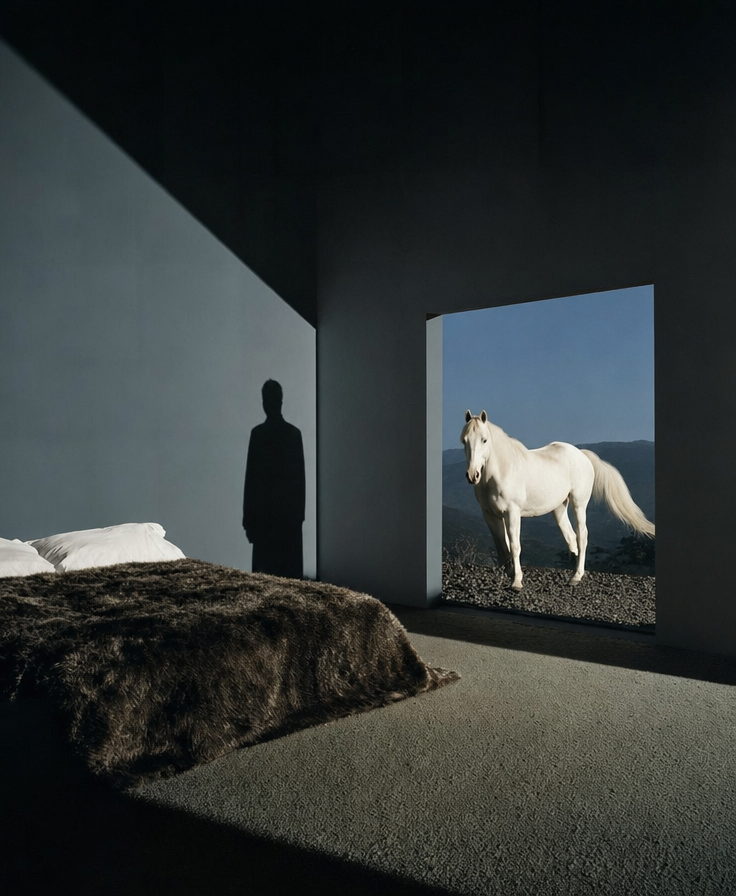
Why this works
The wide, eye-level composition makes the “large open doorway” the structural anchor, turning the white horse, gray pebbled ground, and distant mountains into a framed scene within the cool slate-blue interior. “Dramatic natural light” and “crisp strong shadows” separate the partially silhouetted adult figure from the doorway while giving the brown shaggy bed and white horse distinct tonal weight. The quiet surreal mood comes from the specific collision of a “shaggy fur-covered bed” with a photorealistic modern interior and an outdoor horse, while “elegant modern architectural lines” keeps the unusual arrangement controlled rather than chaotic.
FAQ
→How do I make the white horse the dominant focal point?
Replace “a wide composition emphasizing the doorway framing” with “a medium-wide composition centered on the white horse,” and change “a white horse outside standing on gray pebbled ground” to “a large white horse occupying the central third of the frame, sharply detailed.” Reduce “a shaggy fur-covered bed in the foreground” to “a narrow blurred bed edge in the lower corner” so it no longer competes with the horse.
→How do I make the scene warmer and less austere?
Replace “cool slate-blue walls” with “warm ivory plaster walls,” and change “dramatic natural daylight with crisp strong shadows” to “late-afternoon golden sunlight with soft elongated shadows.” Keep the “white horse” and “gray pebbled ground,” but add “muted amber highlights on the floor and fur” to shift the palette without losing the surreal contrast.
→How do I build a series of variations while keeping the same visual structure?
Keep “cinematic, wide composition emphasizing the doorway framing; eye-level perspective,” “elegant modern architectural lines,” and “quiet contemplative surreal atmosphere” unchanged. Create variations by replacing only “a white horse” with subjects such as “a red deer,” “a lone camel,” or “a vintage red car,” and swap “distant mountains under a pale blue sky” for “a foggy forest,” “a salt flat,” or “a storm-dark coastline.”
Learn the technique behind this
- Why can't AI spell, and how do I get readable text in an image? — Older diffusion models had no character-level representation of text, so they produced letterform-shaped texture instead of words.
- How should a prompt be structured, and does word order matter? — A prompt that behaves predictably names one subject first, then what it is doing, then where, then the light, then the lens or medium, then the style.
- Do negative prompts work, and what should go in one? — Negative prompts work on models that support a separate negative conditioning channel — mainly Stable Diffusion and FLUX-family models.
Related prompts
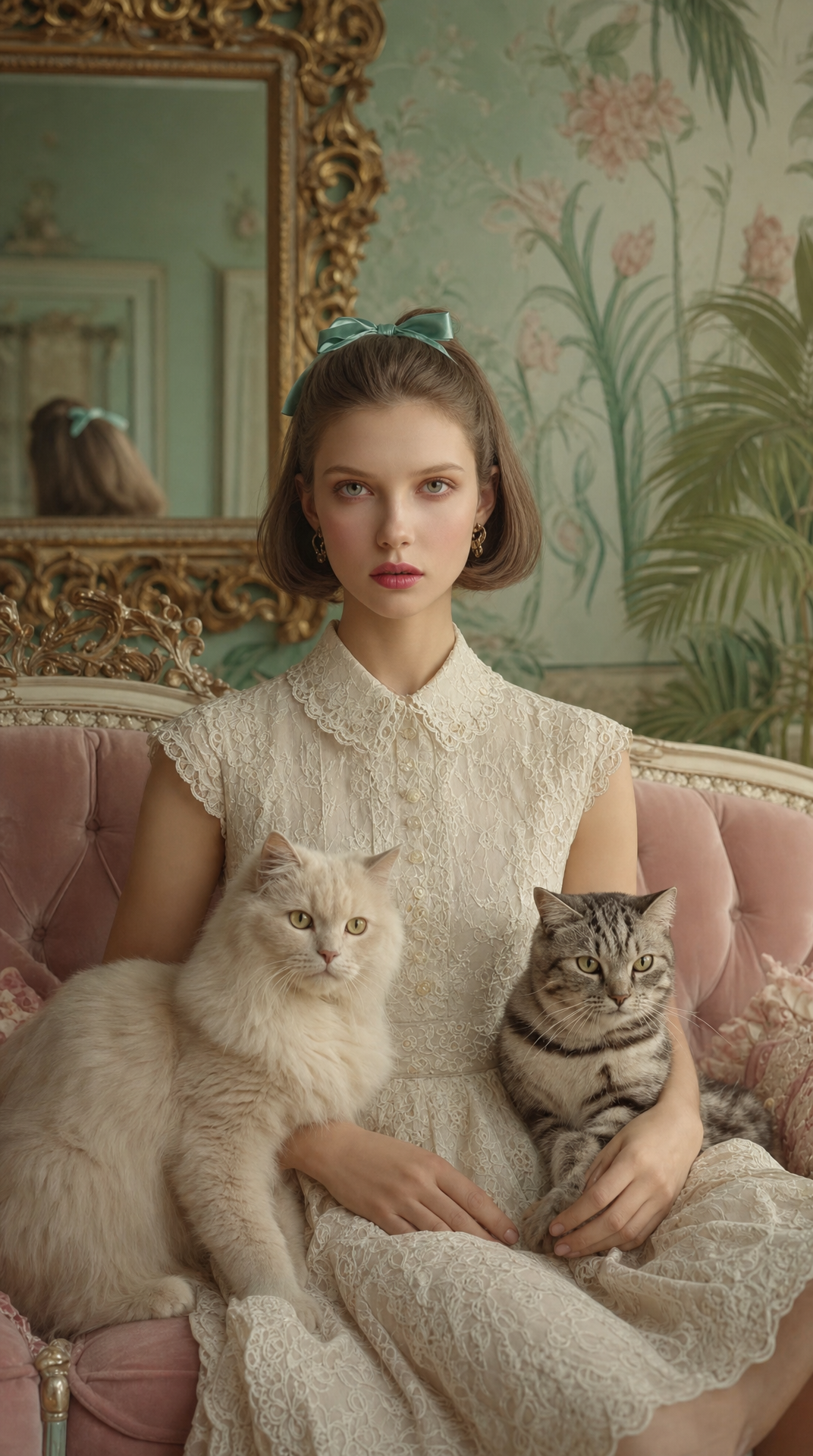
Young woman with two cats
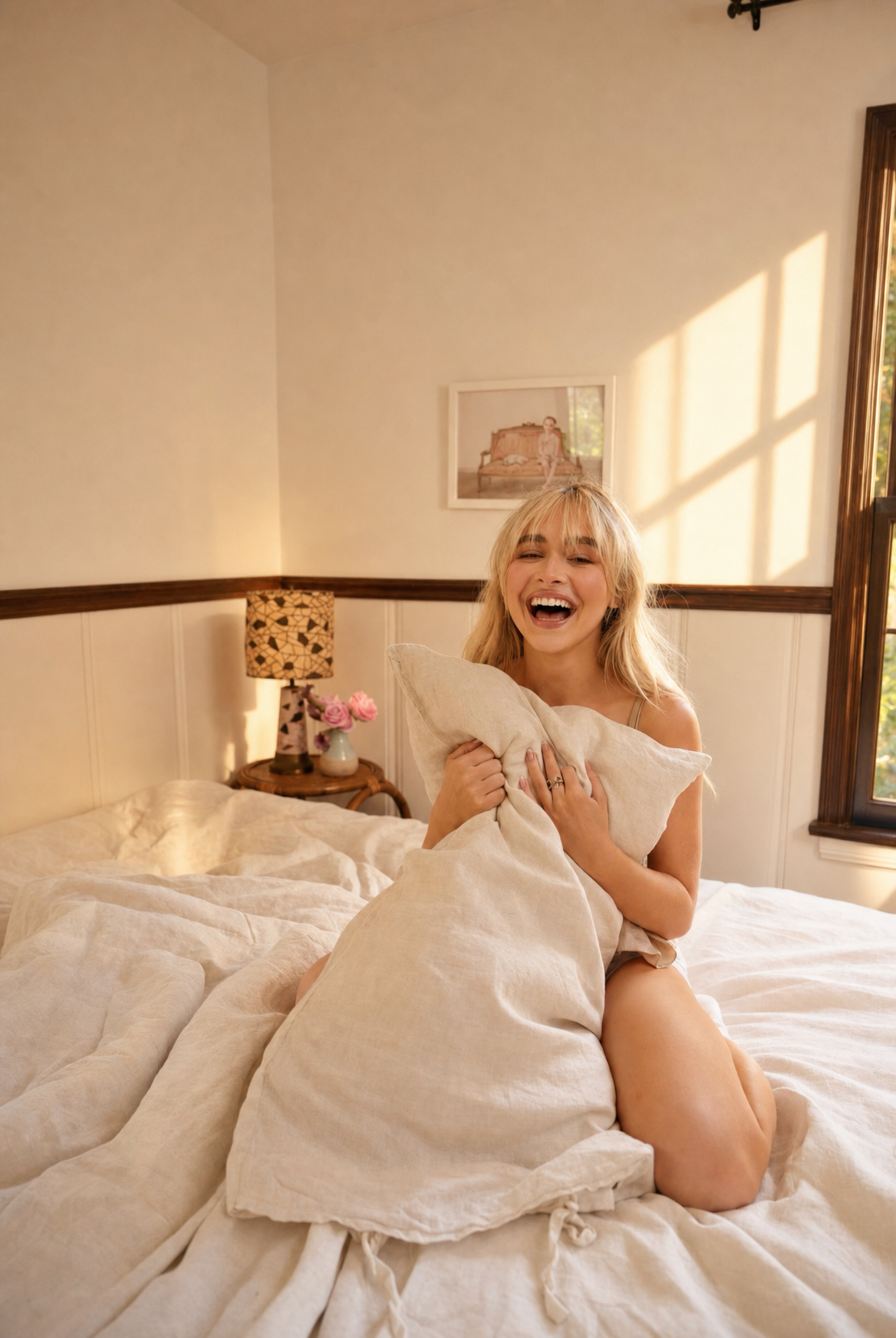
Blonde woman hugging beige pillow on off-white bed

Black tower fan on gray rug by window
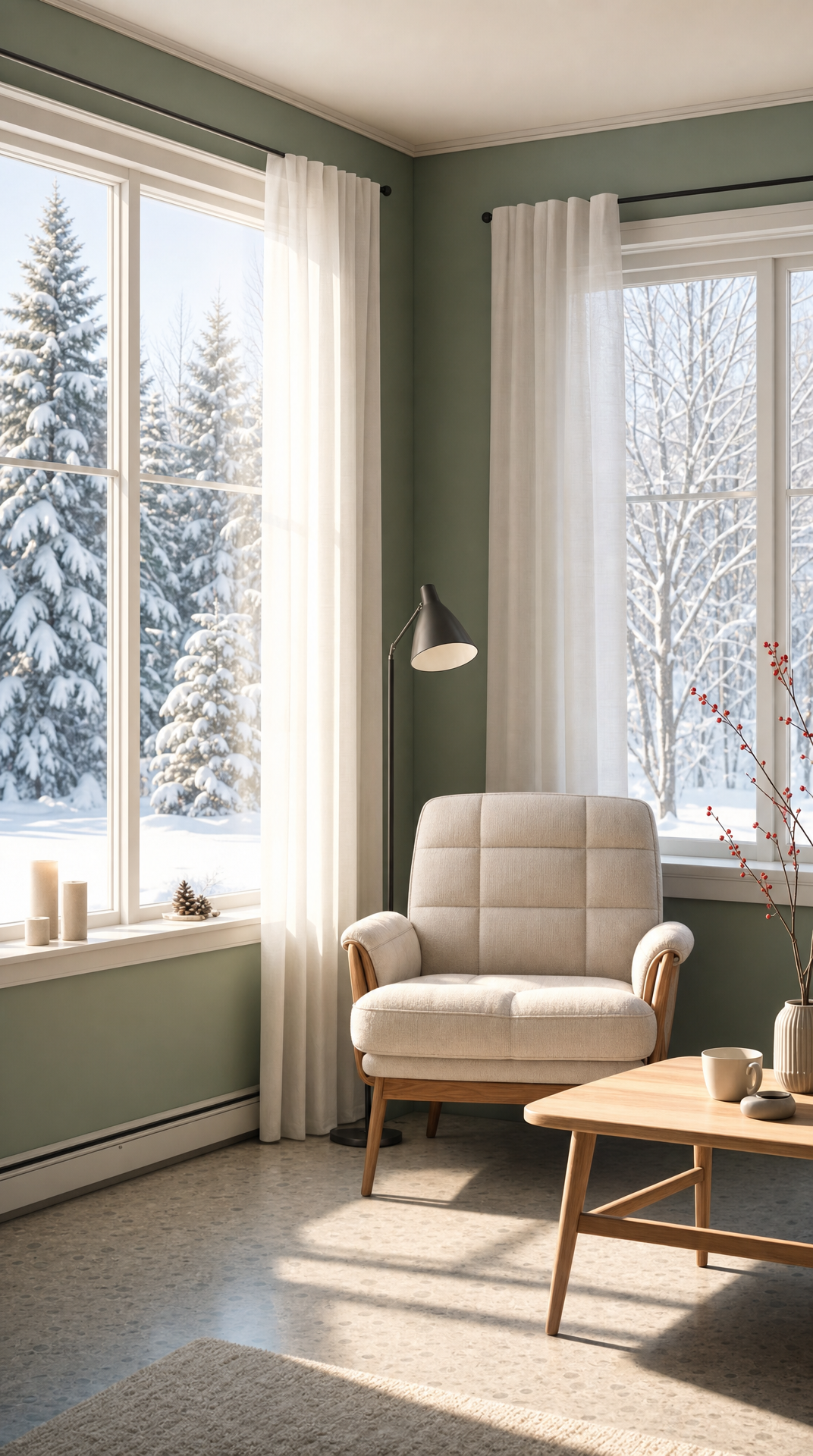
Cozy Winter Living Room in Sage