Why this works
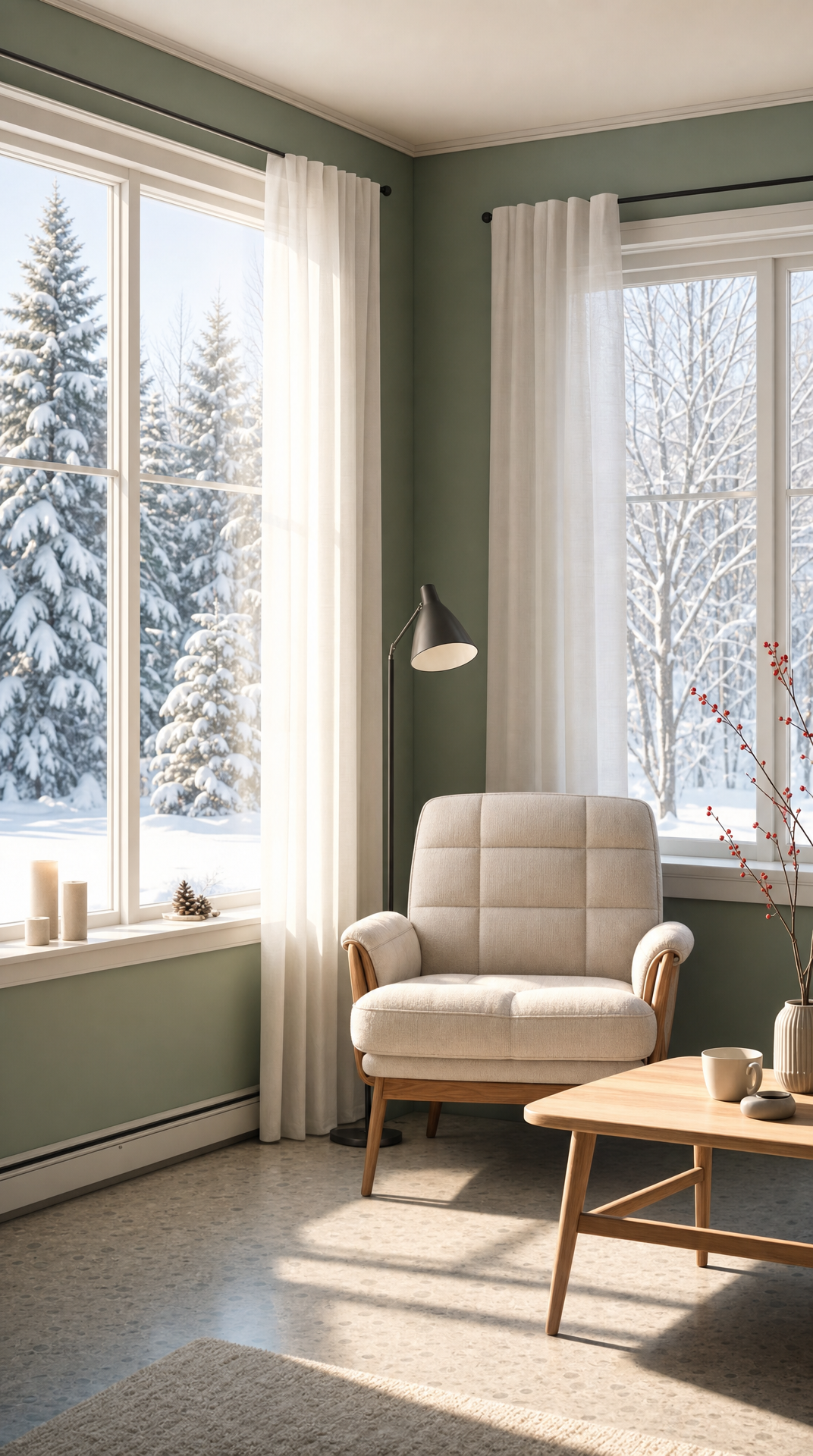
The calm winter mood comes from the specific combination of “muted sage-green walls,” “bright morning winter daylight,” and “snow-covered evergreen trees outside,” while “soft, natural shadows” keeps the brightness gentle rather than stark. “Eye-level perspective” and “wide framing emphasizing the windows and seating area” establish a balanced room-scale composition, with the cream armchair and pale oak table providing a warm focal cluster against the green, white, gray, and brown palette. Material realism is anchored by “fabric weave, wood grain, and smooth plaster,” giving the photorealistic treatment concrete surfaces to describe.
FAQ
→How do I make the armchair the unmistakable focal point?
Replace “wide framing emphasizing the windows and seating area” with “medium-wide framing centered on the armchair,” and change “positioned beside a small modern coffee table” to “the armchair placed prominently in the foreground, angled toward the camera.” Keep “light-cream upholstered” but add “strongest local contrast and crisp fabric detail on the armchair.”
→How do I make the room feel warmer and more evening-oriented?
Replace “bright morning winter daylight” with “low golden-hour light entering through the windows,” and replace “soft, natural floor shadows” with “long warm shadows across the floor.” Change “slim black floor lamp” to “slim black floor lamp switched on with a warm 2700K glow,” while retaining “muted sage-green walls” for the Scandinavian color structure.
→How do I create a series of seasonal variations from this prompt?
Keep the fixed structure, including “eye-level perspective,” “wide framing,” and “realistic materials and textures,” then replace “winter” and “snow-covered evergreen trees outside” with paired seasonal phrases such as “autumn” and “amber birch trees outside,” or “early spring” and “misty green trees outside.” For a summer version, replace “bright morning winter daylight” with “clear soft summer daylight” and “sheer white curtains” with “light linen curtains moving gently in a warm breeze.”
Learn the technique behind this
- Why can't AI spell, and how do I get readable text in an image? — Older diffusion models had no character-level representation of text, so they produced letterform-shaped texture instead of words.
- Do negative prompts work, and what should go in one? — Negative prompts work on models that support a separate negative conditioning channel — mainly Stable Diffusion and FLUX-family models.
- Which aspect ratio should I use, and how does it change the image? — Aspect ratio determines what the model composes, not how it's cropped afterwards.
Related prompts
Young woman with two cats
Blonde woman hugging beige pillow on off-white bed

Morning Tea at the Writing Desk
Modern bedroom with indigo abstract mural wall