Why this works
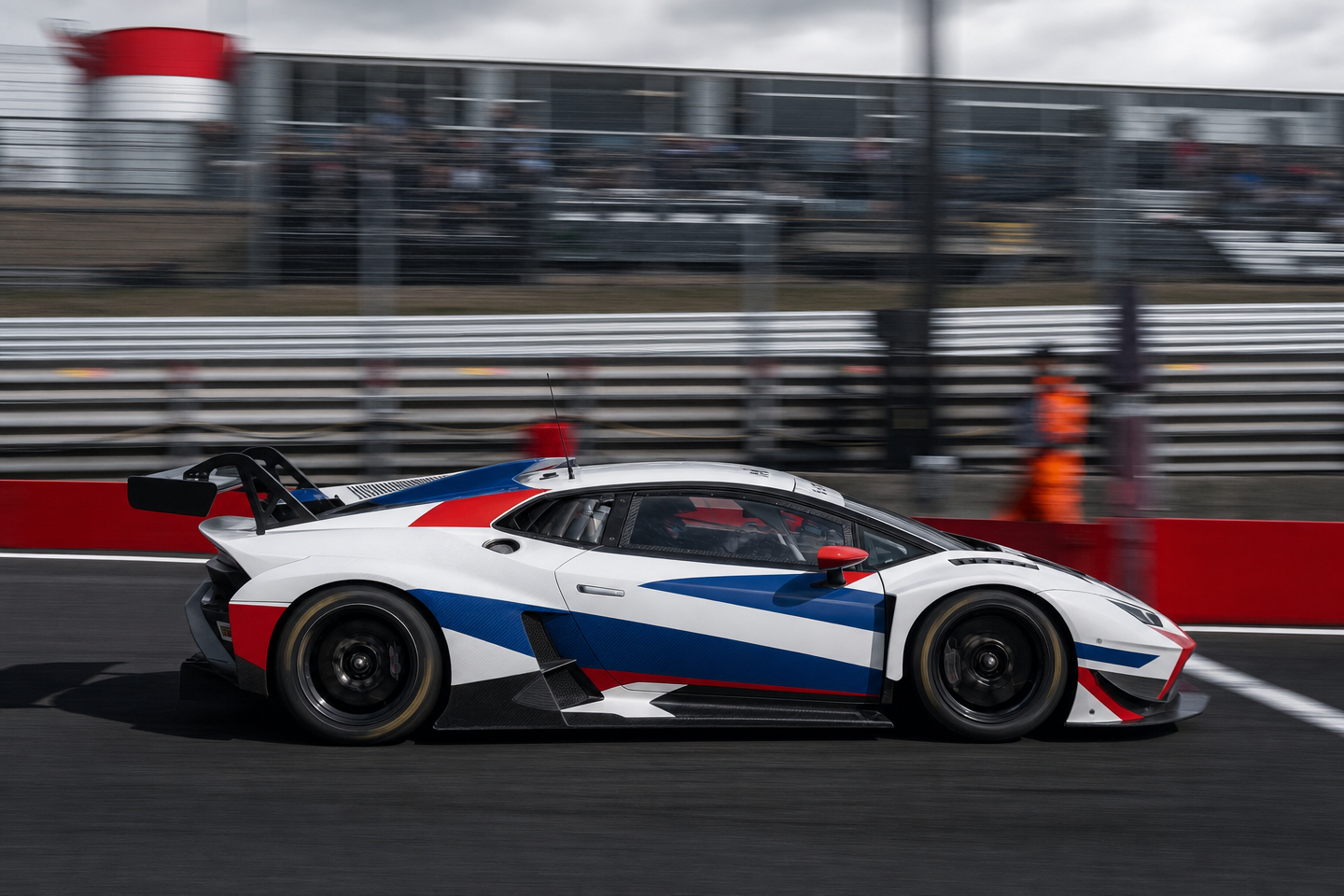
The phrase “low camera angle, side-profile view” gives the GT3 car visual dominance, while “sharp focus on the vehicle” keeps the tire and bodywork textures readable against the rush of “motion blur streaking across the background pit lane and barriers.” “Overcast natural daylight” produces the even gray backdrop seen in the barriers and grandstand, allowing the car’s white body with “blue and red accents” to carry the strongest color contrast. The “pit lane,” “track barriers,” and “grandstand rise behind the car” establish layered depth and scale, while “speeding through” and “dynamic high-speed atmosphere” supply the energetic candid-action feel.
FAQ
→How do I make the car more prominent and imposing in the frame?
Replace “low camera angle” with “extreme low-angle, near-ground camera position” and add “car fills most of the horizontal frame.” Change “side-profile view” to “tight side-tracking shot focused on the front half of the car,” while keeping “sharp focus on the vehicle” to preserve crisp bodywork.
→How do I make the scene feel more dramatic and less evenly lit?
Replace “overcast natural daylight (diffuse)” with “dramatic late-afternoon sunlight cutting between storm clouds” and add “hard highlights on the white bodywork with deep shadows beneath the car.” Keep “motion blur streaking across the background” so the stronger lighting does not reduce the sense of speed.
→How do I create a matching series with different race cars and track locations?
Keep the structure “photorealistic motorsport action scene,” “low camera angle,” “sharp focus on the vehicle,” and “motion blur streaking across the background,” then replace “GT3 race car” with a specific subject such as “LMP2 prototype” or “Formula racing car.” Replace “pit lane with track barriers and grandstand behind” with settings such as “wet street circuit lined with concrete walls” or “sunlit desert circuit with distant grandstands,” and assign each car a new phrase in place of “white with blue and red accents.”
Learn the technique behind this
- Why can't AI spell, and how do I get readable text in an image? — Older diffusion models had no character-level representation of text, so they produced letterform-shaped texture instead of words.
- How should a prompt be structured, and does word order matter? — A prompt that behaves predictably names one subject first, then what it is doing, then where, then the light, then the lens or medium, then the style.
- Why does the model ignore parts of my prompt? — Ignored instructions are almost always conflicts, counts, or spatial relationships — three things current models handle badly — rather than the model failing to read you.
Related prompts
Shirtless Man, Vintage Car, Coastline Light
Golden-hour couple rides a classic bike
Deep-blue Audi concept in brutalist garage
Red endurance race car with blue silver accents