Why this works
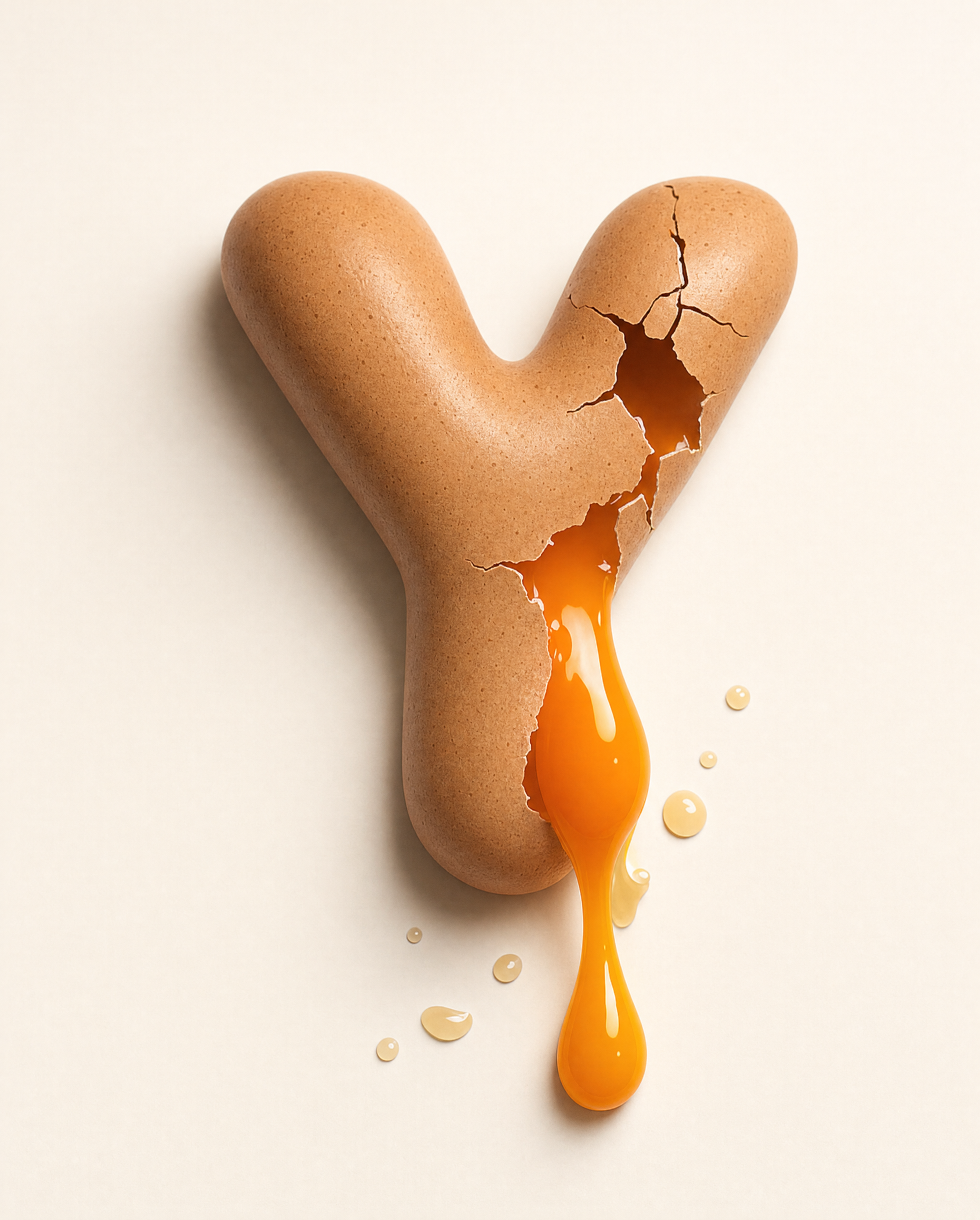
The phrase “eggshell shaped like the letter Y” supplies the unmistakable graphic subject, while “centered” and “minimal, modern product-photography composition” keep the image readable like a logo or catalog object. “Rich orange yolk,” “thicker glossy stream,” and “crisp highlights” create the orange-versus-off-white contrast and tactile shine, while “smooth studio lighting” and “soft natural shadow” anchor the object without introducing a dramatic mood. “More fractured edges” and “a few rounded droplets mid-fall” add playful motion and imperfection to an otherwise controlled, clean setup.
FAQ
→How do I make the yolk and falling droplets more visually dominant?
Replace “a thicker glossy stream with a few rounded droplets mid-fall” with “a large, wide ribbon of yolk cascading from the Y-shaped shell, with many suspended droplets at different heights.” Change “centered” to “slightly upper-centered” so the longer spill has room to occupy the lower frame.
→How do I shift this from clean and playful to moody and dramatic?
Replace “clean off-white background” with “deep charcoal studio background” and “smooth studio lighting” with “single hard side light from the upper left, strong falloff, and deep cast shadows.” Keep “crisp highlights” on the yolk, but replace “soft, natural shadow” with “sharp elongated shadow” to reinforce the darker tone.
→How do I build a matching series with different letter-shaped shells?
Replace only “shaped like the letter Y” with variants such as “shaped like the letter A,” “shaped like the letter S,” or “shaped like the number 8,” while preserving “slightly darker warm-tan shell texture,” “rich orange yolk,” “clean off-white studio background,” and “minimal centered composition.” For consistent variation, change “a few rounded droplets mid-fall” to a fixed quantity such as “three rounded droplets mid-fall” in every prompt.
Learn the technique behind this
- Why can't AI spell, and how do I get readable text in an image? — Older diffusion models had no character-level representation of text, so they produced letterform-shaped texture instead of words.
- How should a prompt be structured, and does word order matter? — A prompt that behaves predictably names one subject first, then what it is doing, then where, then the light, then the lens or medium, then the style.
- Do negative prompts work, and what should go in one? — Negative prompts work on models that support a separate negative conditioning channel — mainly Stable Diffusion and FLUX-family models.
Related prompts
Blueberries Bursting Into Vanilla Cream
Chocolate Filled Cookie Splitting Midair With Dark Drip
Partially Peeled Banana on Blue
Banana slices in cool milk splash background