Why this works
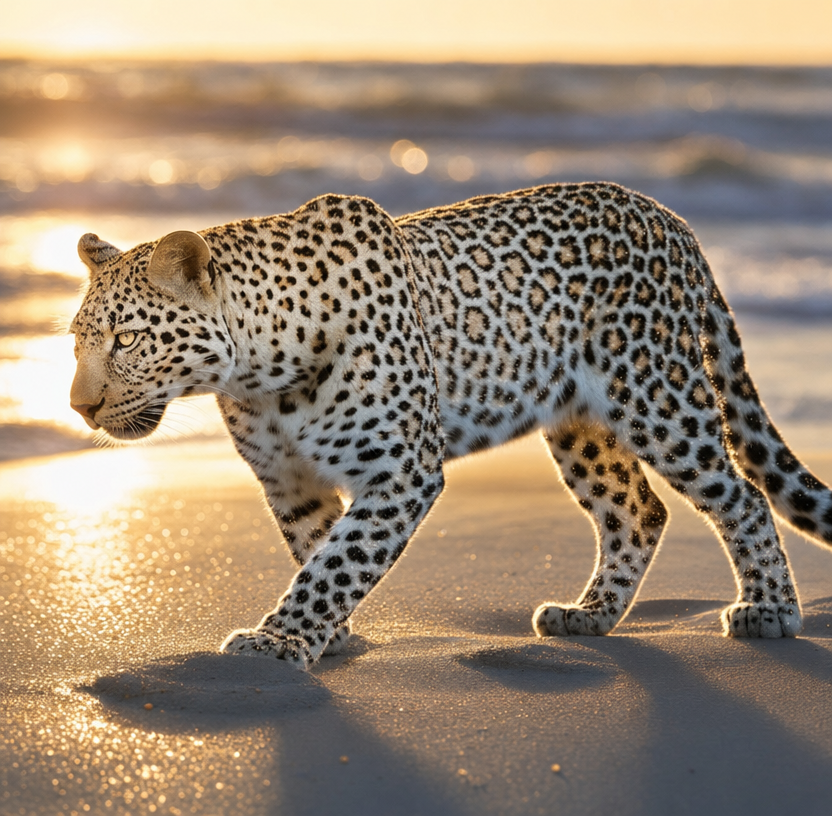
“Leopard walking across smooth wet sand at the shoreline” gives the image a clear candid-action path, while “cinematic framing” keeps the animal as the visual anchor. The serene warmth comes specifically from “late afternoon golden light” and “warm rim light traces the leopard’s profile”; “slightly cooler sea haze” and “gentle, out-of-focus waves” create the gray-blue background separation. “Shallow depth of field” isolates the leopard, and “crisp fur texture” plus “wet sand reflects subtle highlights around its paws” preserve detail where the eye lands.
FAQ
→How do I make the leopard feel more dramatic and dominant?
Replace “serene and cinematic atmosphere” with “tense, powerful wildlife atmosphere,” change “gentle, out-of-focus waves” to “wind-driven whitecaps,” and add “low-angle perspective with the leopard filling most of the frame.” Keep “warm rim light” if you want the profile to remain clearly outlined.
→How do I make the shoreline and reflection more central than the leopard’s fur?
Replace “crisp fur texture is sharply defined” with “wide environmental composition with the leopard smaller in frame,” and change “shallow depth of field” to “moderate depth of field keeping the reflective beach and horizon readable.” Expand “wet sand reflects subtle highlights around its paws” to “a broad mirror-like reflection of the leopard across the wet sand.”
→How do I build a series of variations from this prompt?
Keep “photorealistic wildlife photo,” “leopard walking,” and “smooth wet sand at the shoreline” fixed, then swap “late afternoon golden light” for “cool blue dawn,” “overcast silver daylight,” or “deep sunset magenta light.” For consistent alternates, also replace “slightly cooler sea haze” with a matching background treatment such as “pale blue morning mist” or “violet dusk haze.”