Why this works
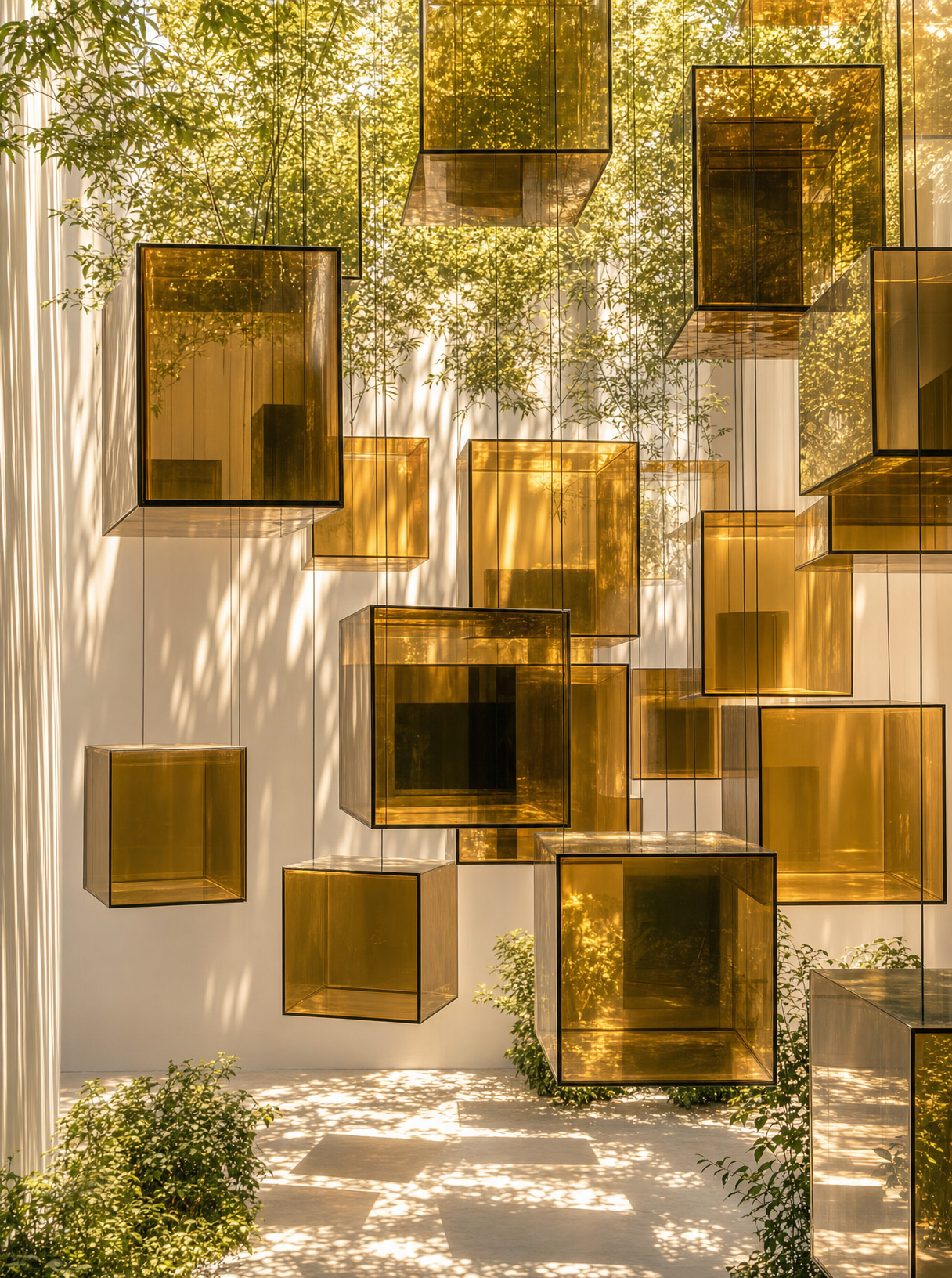
The phrase “suspended translucent amber-gold glass cubes of varying sizes” establishes the installation’s geometric subject, while “airy layered composition with noticeable depth between the tiers” gives the wide architectural framing a readable sense of scale. “Soft late-afternoon natural light streams through nearby foliage” directly produces the warm dappled shadows and connects the dominant beige floor-and-wall palette with the surrounding green. “Ultra-detailed glass surface reflections and refractions” and “subtle glow within the cubes” supply the focal detail, while “pristine white walls,” “pale, matte floor,” and “modern calm meditative atmosphere” keep the image quiet rather than visually crowded.
FAQ
→How do I make the glass cubes feel more dramatic and less meditative?
Replace “modern calm meditative atmosphere” with “tense, theatrical, high-contrast atmosphere,” and change “soft late-afternoon natural light” to “hard directional sunset light with deep angular shadows.” Keep “ultra-detailed glass surface reflections and refractions,” but add “strong caustic light patterns” to make the glass effects more forceful.
→How do I make one cube the clear visual centerpiece?
Replace “cubes of varying sizes, arranged in an airy layered composition” with “one oversized suspended amber-gold glass cube centered in the foreground, with smaller cubes receding behind it.” Change “wide interior framing” to “centered medium-wide framing with the largest cube dominant,” and add “selective focus on the foreground cube” instead of “sharp focus” across the entire installation.
→How do I turn this into a series with different architectural settings?
Keep “suspended translucent amber-gold glass cubes” and “ultra-detailed glass surface reflections and refractions” unchanged as the visual identity, then replace “white walls and a pale matte floor in a clean contemporary architectural space” with setting variants such as “brutalist concrete gallery with tall clerestory windows,” “dark wood library with narrow skylights,” or “coastal pavilion with open glass walls.” Adjust “nearby foliage filtering light” to match each location, such as “dusty skylight beams,” “filtered light through trees,” or “bright ocean-reflected daylight.”
Learn the technique behind this
- Why can't AI spell, and how do I get readable text in an image? — Older diffusion models had no character-level representation of text, so they produced letterform-shaped texture instead of words.
- Do negative prompts work, and what should go in one? — Negative prompts work on models that support a separate negative conditioning channel — mainly Stable Diffusion and FLUX-family models.
- Which aspect ratio should I use, and how does it change the image? — Aspect ratio determines what the model composes, not how it's cropped afterwards.
Related prompts

Young woman with two cats
Blonde woman hugging beige pillow on off-white bed
Morning Tea at the Writing Desk
Modern bedroom with indigo abstract mural wall