Why this works
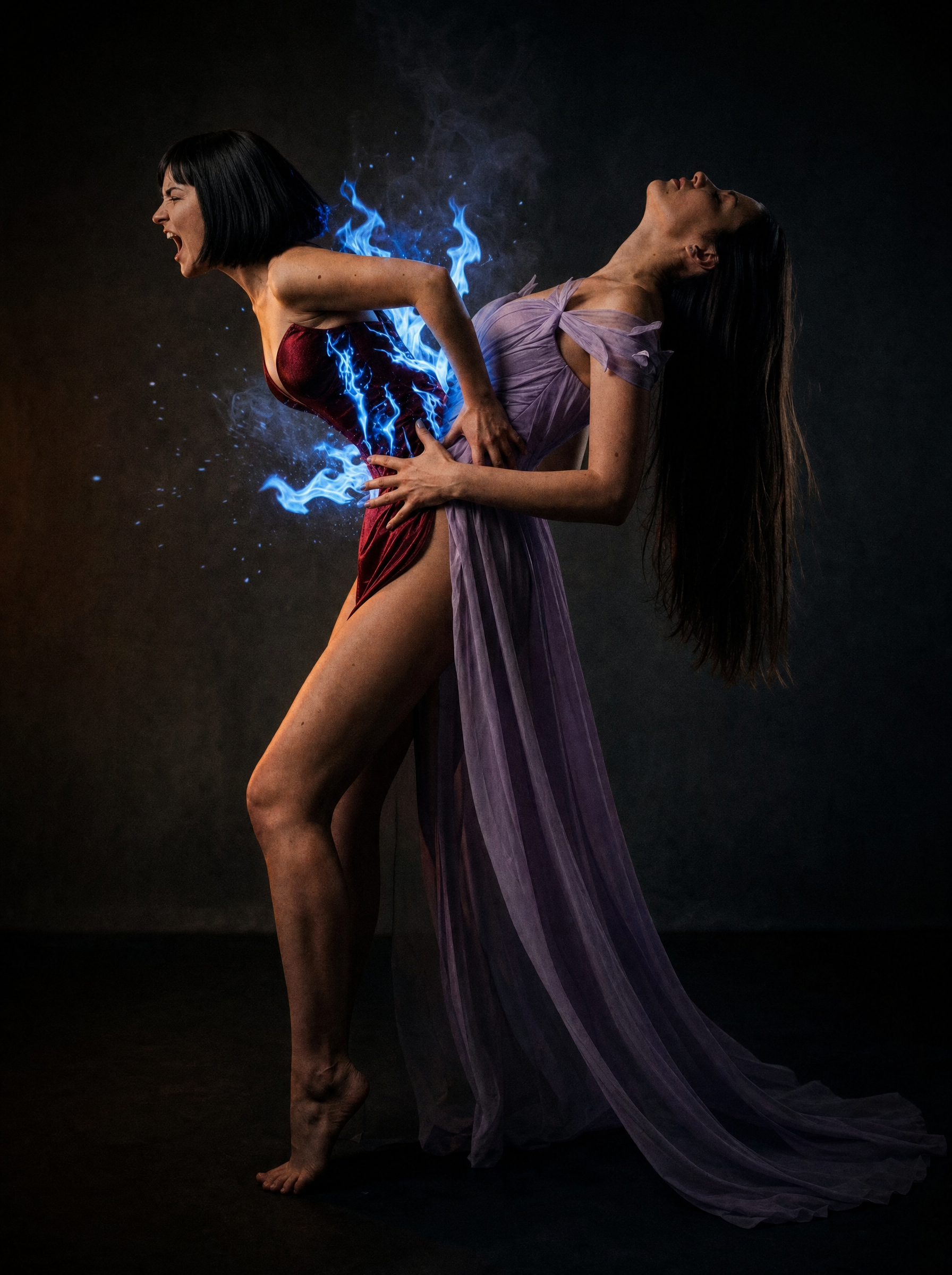
The back-to-back pose and “full-body composition, straight-on” give the image a formal, readable vertical structure, while the forward lean and backward arch create opposing motion. “Bright blue flames” against the “deep red satin bodysuit” and “flowing lavender chiffon gown” establishes the dominant blue-purple-red harmony, with “blue-orange color accents” adding ember contrast. The mood comes specifically from “high-contrast dramatic lighting,” “drifting ash and pale smoke,” and the “dark seamless studio background,” while “sharp realistic skin texture” and “subtle film-grain realism” keep the surreal fire grounded in fashion-photography detail.
FAQ
→How do I make the flames and forward woman more visually dominant?
Replace “two women posed back-to-back” with “the forward-leaning woman centered as the dominant primary subject, the second woman receding behind her,” and change “bright blue flames burst upward from her torso” to “towering electric-blue flames fill the upper half of the frame.” Keep “full-body composition,” but add “flames reaching above her head” to increase vertical prominence.
→How do I shift this from intense and fiery to a colder, dreamlike mood?
Replace “fiery atmosphere with blue-orange color accents” with “an icy, dreamlike atmosphere with blue-white and lavender accents,” and change “embers glow in the air” to “translucent frost particles drift through the air.” Replace “high-contrast dramatic lighting” with “soft diffused moonlike lighting” and “pale smoke swirling around her legs” with “cool mist pooling around their feet.”
→How do I create a series of related variations without losing the editorial identity?
Keep “photorealistic cinematic studio fashion editorial,” “dark seamless studio background,” “full-body composition,” and “subtle film-grain realism” unchanged. Vary one load-bearing element per version: replace “deep red satin bodysuit” with “cobalt velvet jumpsuit,” “flowing lavender chiffon gown” with “metallic silver pleated dress,” or “blue flames” with “golden sparks,” while preserving the back-to-back dance stance and dramatic studio lighting.
Learn the technique behind this
- Why can't AI spell, and how do I get readable text in an image? — Older diffusion models had no character-level representation of text, so they produced letterform-shaped texture instead of words.
- Why does the model ignore parts of my prompt? — Ignored instructions are almost always conflicts, counts, or spatial relationships — three things current models handle badly — rather than the model failing to read you.
- How should a prompt be structured, and does word order matter? — A prompt that behaves predictably names one subject first, then what it is doing, then where, then the light, then the lens or medium, then the style.
Related prompts
Teal fashion editorial in monster-filled lift
Cobalt Boots in Sleek Studio Edit
Silhouette Influencer by Sunlit Window
Sunlit editorial on striped beach towel