Why this works
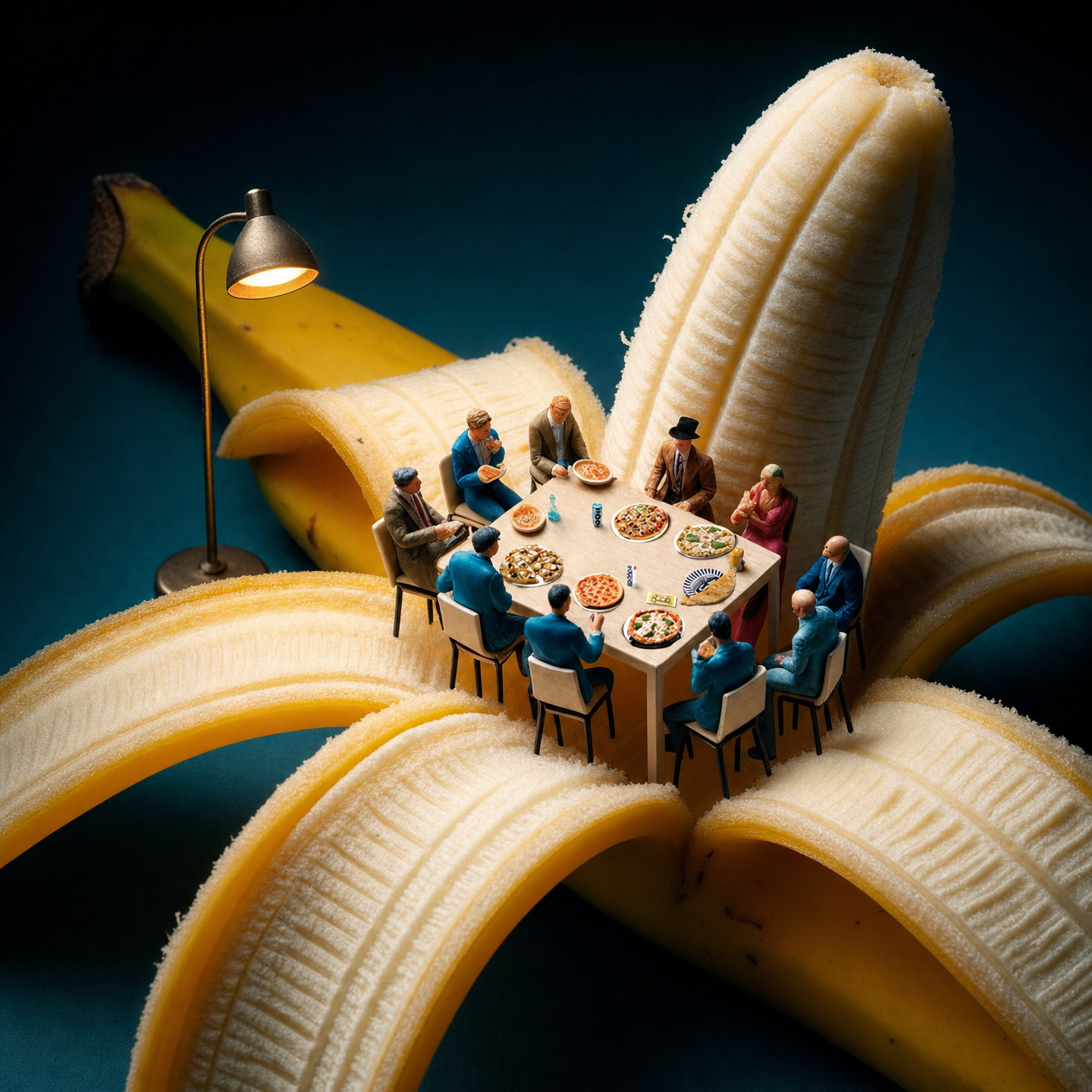
The phrase “tiny people dining around a pizza table on a peeled banana” supplies the surreal scale joke, while “banana peel edges framing the scene” makes the overhead-flatlay composition read as an intentional enclosure. “Small warm desk lamp” and “warm amber lamp glow” add a playful focal accent against the “deep teal to black gradient background,” producing the image’s yellow-brown and blue-teal color contrast. “Shallow depth of field that keeps the diners and pizza sharp” concentrates attention on the miniature meal, with “lamp and peel edges fall softly out of focus” creating the staged diorama effect.
FAQ
→How do I make the diners and pizza feel more central and prominent?
Replace “banana peel edges framing the scene” with “banana peel forming a narrow circular border around the diners,” and change “shallow depth of field that keeps the diners and pizza sharp” to “tight macro focus centered on the diners and pizza, with all framing elements strongly blurred.”
→How do I make the scene moodier and less playful?
Replace “whimsical but realistic” and “small warm desk lamp” with “quietly ominous miniature realism” and “single dim amber bulb casting long shadows.” Change “dramatic studio lighting” to “low-key chiaroscuro lighting” while keeping the “deep teal to black gradient background” for the darker blue-teal atmosphere.
→How do I build a series of variations from this prompt without losing its visual identity?
Keep “photorealistic miniature diorama,” “banana peel edges framing the scene,” “dramatic studio lighting,” and “shallow depth of field” unchanged. Swap only “tiny people dining around a pizza table” for subjects such as “tiny chefs preparing sushi,” “tiny astronauts sharing noodles,” or “tiny campers roasting marshmallows,” and replace “on a peeled banana” with a new food platform such as “on a halved orange” or “inside an avocado shell.”
Learn the technique behind this
- Why can't AI spell, and how do I get readable text in an image? — Older diffusion models had no character-level representation of text, so they produced letterform-shaped texture instead of words.
- How should a prompt be structured, and does word order matter? — A prompt that behaves predictably names one subject first, then what it is doing, then where, then the light, then the lens or medium, then the style.
- Why does the model ignore parts of my prompt? — Ignored instructions are almost always conflicts, counts, or spatial relationships — three things current models handle badly — rather than the model failing to read you.
Related prompts
Blueberries Bursting Into Vanilla Cream
Chocolate Filled Cookie Splitting Midair With Dark Drip
Partially Peeled Banana on Blue
Banana slices in cool milk splash background