Why this works
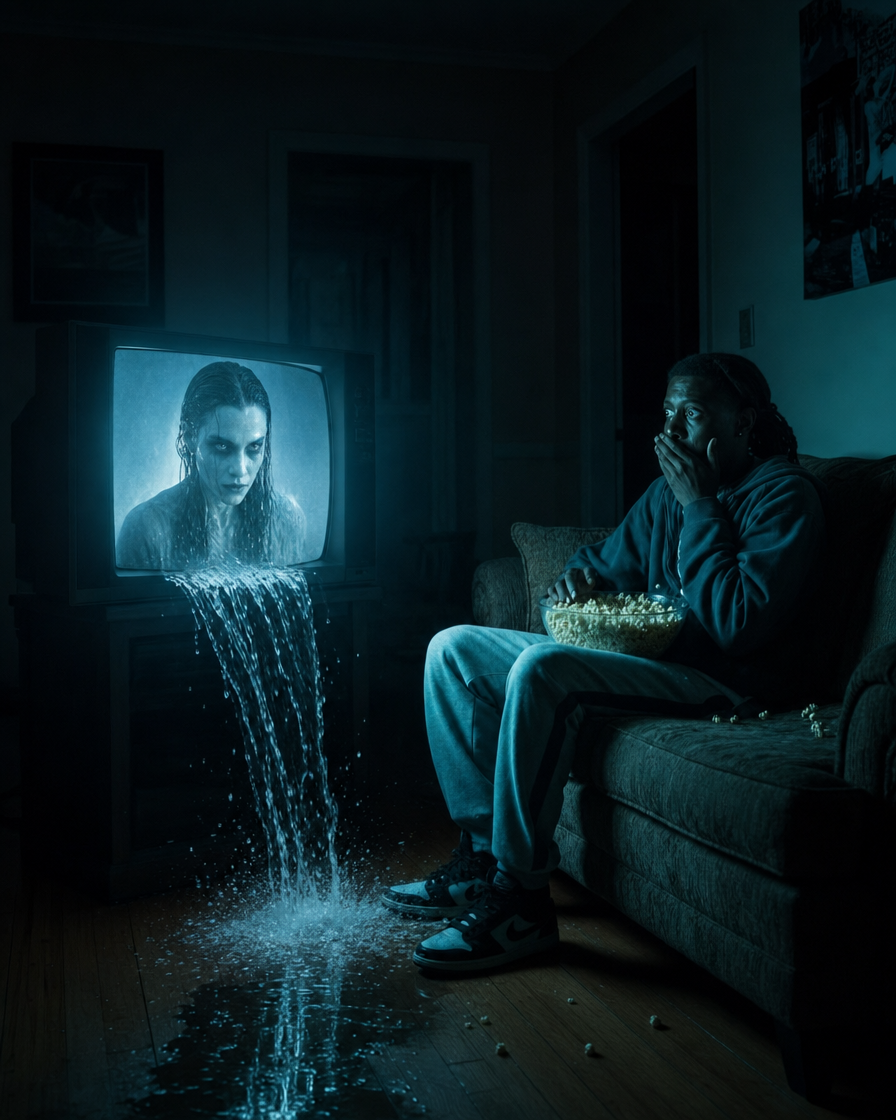
“Dramatic wide framing” keeps the terrified person, bulky CRT, and water spill readable together, while “emphasizing the TV and splash area” creates a clear visual path from the ghostly face to the floor. The cold “icy-blue glow” and “moody teal-blue lighting” establish the blue-gray palette and eerie tone; “deep shadows” and “high-contrast splashes” keep the living room threatening rather than merely dim. “Water spills onto the wooden floor” plus “wet reflections near the couch” supplies the strongest motion cue, while “realistic textures on the sofa fabric and floorboards” anchors the supernatural event in a tactile, photorealistic setting.
FAQ
→How do I make the ghostly woman more central and frightening?
Replace “dramatic wide framing from the living-room side” with “medium close-up centered on the CRT screen and ghostly woman,” and change “her expression tense and watching” to “her face filling the screen, eyes fixed directly on the viewer, mouth slightly open.” Keep “water spills onto the wooden floor” in the lower foreground so the spill remains a secondary threat.
→How do I change this from cold suspense to warmer, more violent horror?
Replace “moody teal-blue lighting” and “cold icy-blue glow” with “flickering blood-red and dirty amber light from the CRT.” Change “deep shadows” to “harsh black shadows with red spill across the walls,” and replace “high-contrast splashes” with “violent, chaotic water bursts catching red highlights.”
→How do I build a series of variations without losing the core image?
Keep “terrified person,” “old, bulky CRT television,” and “water spills onto the wooden floor” unchanged, then swap the setting phrase “dark living room” for locations such as “abandoned motel room,” “flooded basement,” or “empty suburban nursery.” For each variation, replace the on-screen figure phrase “ghostly pale woman with slick dark hair” with a setting-specific apparition, such as “drowned child in a school uniform” or “faceless elderly man in a rain-soaked coat.”
Learn the technique behind this
- Why can't AI spell, and how do I get readable text in an image? — Older diffusion models had no character-level representation of text, so they produced letterform-shaped texture instead of words.
- Which aspect ratio should I use, and how does it change the image? — Aspect ratio determines what the model composes, not how it's cropped afterwards.
- How should a prompt be structured, and does word order matter? — A prompt that behaves predictably names one subject first, then what it is doing, then where, then the light, then the lens or medium, then the style.
Related prompts
Young woman with two cats
Blonde woman hugging beige pillow on off-white bed
Cozy Winter Living Room in Sage

Morning Tea at the Writing Desk