Why this works
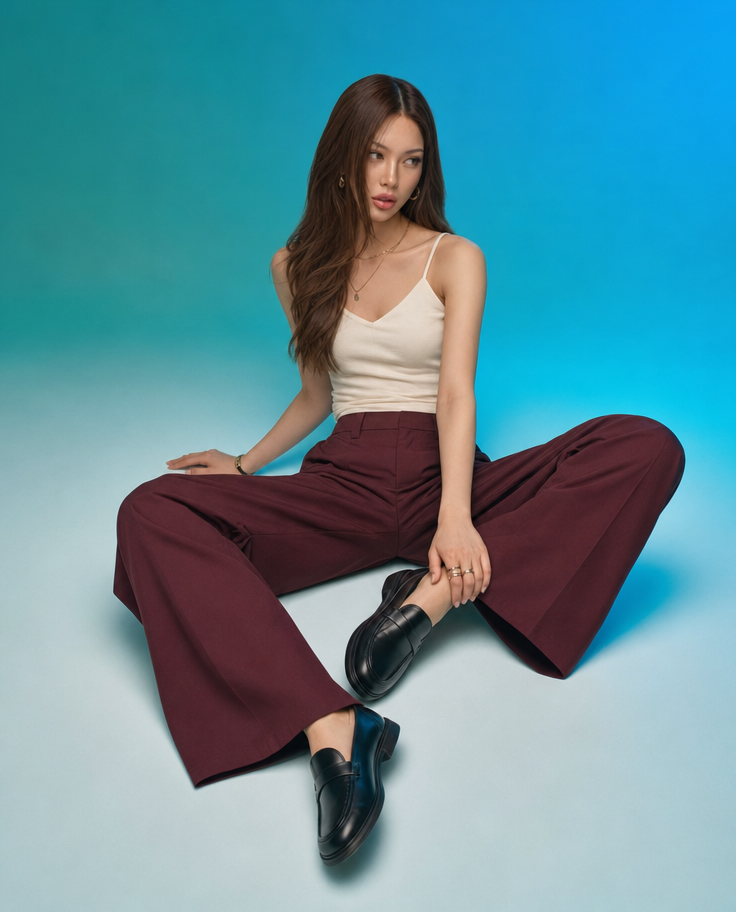
The centered studio portrait framing makes the seated model the immediate focal point, while “against a smooth teal-to-azure gradient backdrop” gives the image its cool blue field and clean editorial separation. “Clean softbox lighting with crisp skin texture and fabric detail” preserves the ribbing, hair, and leather surfaces, and “shallow depth of field” keeps attention on the subject rather than the studio background. The cream camisole and burgundy trousers provide controlled contrast against the blue backdrop, while “relaxed, edgy pose” supplies the cool, stylish attitude without disrupting the composed layout.
FAQ
→How do I make the portrait feel warmer and more inviting?
Replace “smooth teal-to-azure gradient backdrop” with “warm terracotta-to-amber gradient backdrop,” change “clean softbox lighting” to “warm diffused window light,” and swap “cool relaxed stylish mood” for “soft, welcoming, sunlit mood.” Keep the cream camisole, burgundy trousers, and centered framing to retain the fashion-editorial structure.
→How do I make the trousers and lower-body styling more prominent?
Replace “studio portrait framing” with “three-quarter seated fashion framing from mid-thigh upward,” change “shallow depth of field” to “moderate depth of field with trousers and loafers sharply defined,” and add “legs angled toward camera, trousers and black leather loafers prominent in the foreground.” Keep “no sneakers visible” if the footwear must remain controlled.
→How do I build a series of variations from this prompt without losing its visual identity?
Keep “contemporary editorial studio fashion portrait,” “centered” composition, “clean softbox lighting,” and “photorealistic” unchanged, then vary one controlled block at a time. Replace the backdrop phrase with options such as “soft lilac-to-gray gradient,” “deep cobalt studio wall,” or “warm beige seamless paper,” and rotate the outfit phrase with alternatives such as “fitted black knit top and high-waisted ivory trousers” while preserving the same seated pose and shallow depth of field.
Learn the technique behind this
- Why can't AI spell, and how do I get readable text in an image? — Older diffusion models had no character-level representation of text, so they produced letterform-shaped texture instead of words.
- How should a prompt be structured, and does word order matter? — A prompt that behaves predictably names one subject first, then what it is doing, then where, then the light, then the lens or medium, then the style.
- Which aspect ratio should I use, and how does it change the image? — Aspect ratio determines what the model composes, not how it's cropped afterwards.
Related prompts
Cobalt Boots in Sleek Studio Edit
Teal fashion editorial in monster-filled lift
Sunlit editorial on striped beach towel
Silhouette Influencer by Sunlit Window