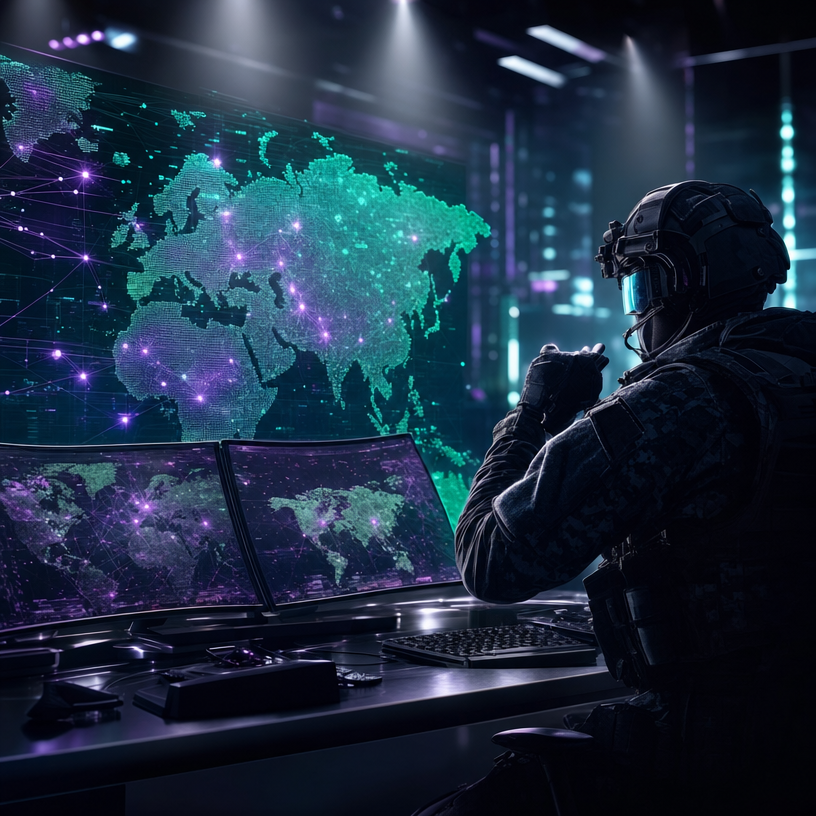
Why this works
The tense strategic mood is anchored by “colder top-lit cinematic lighting with sharper highlights, deeper shadows” and “subtle haze,” while the “teal and violet screen glow” supplies the blue-purple-teal color harmony visible across the monitors and hologram. “35mm eye-level framing” establishes an immersive control-room viewpoint, and “shallow depth of field focused on the workstation and analyst” makes the seated operator the compositional anchor within the rule-of-thirds layout. The “large holographic-style digital world map,” cables, and status indicators add layered scale and surveillance detail without pulling focus from the analyst.
FAQ
→How do I make the holographic world map the main focal point?
Replace “shallow depth of field focused on the workstation and analyst” with “deep focus with the holographic world map in razor-sharp detail,” and change “facing multiple curved monitors and a large holographic-style digital world map” to “centered beneath a towering holographic world map dominating the background.” Keep “teal/violet screen glow” to preserve the colored projection as the visual anchor.
→How do I shift this from tense and militarized to a calmer analytical mood?
Replace “tense, strategic atmosphere” with “quiet, methodical research atmosphere,” and change “sharper highlights, deeper shadows” to “soft, evenly diffused overhead lighting with gentle shadows.” You can also replace “tactical soldier/intelligence analyst” with “calm civilian data analyst” while retaining the “ultra-realistic textures” and “35mm eye-level framing.”
→How do I create a series of matching control-room variations?
Keep the fixed phrases “35mm eye-level framing,” “cinematic color grading,” “teal and violet screen glow,” and “rule-of-thirds,” then swap only the setting details: replace “large holographic-style digital world map” with “live orbital traffic model,” “subterranean infrastructure map,” or “real-time maritime network.” Vary the subject action with replacements such as “typing rapidly,” “studying a floating alert window,” or “speaking into a secure headset” while preserving “shallow depth of field focused on the workstation and analyst.”
Learn the technique behind this
- Why can't AI spell, and how do I get readable text in an image? — Older diffusion models had no character-level representation of text, so they produced letterform-shaped texture instead of words.
- How do I keep one consistent style across a whole set of images? — Style consistency is more achievable than character consistency because style lives in describable attributes.
- How should a prompt be structured, and does word order matter? — A prompt that behaves predictably names one subject first, then what it is doing, then where, then the light, then the lens or medium, then the style.
Related prompts
Open-Frame Futuristic PC With Blue LEDs

Magenta-Cyan Hands Nearly Touch

Magenta-Cyan Holographic Control Room

Blue holographic cube on server room pedestal