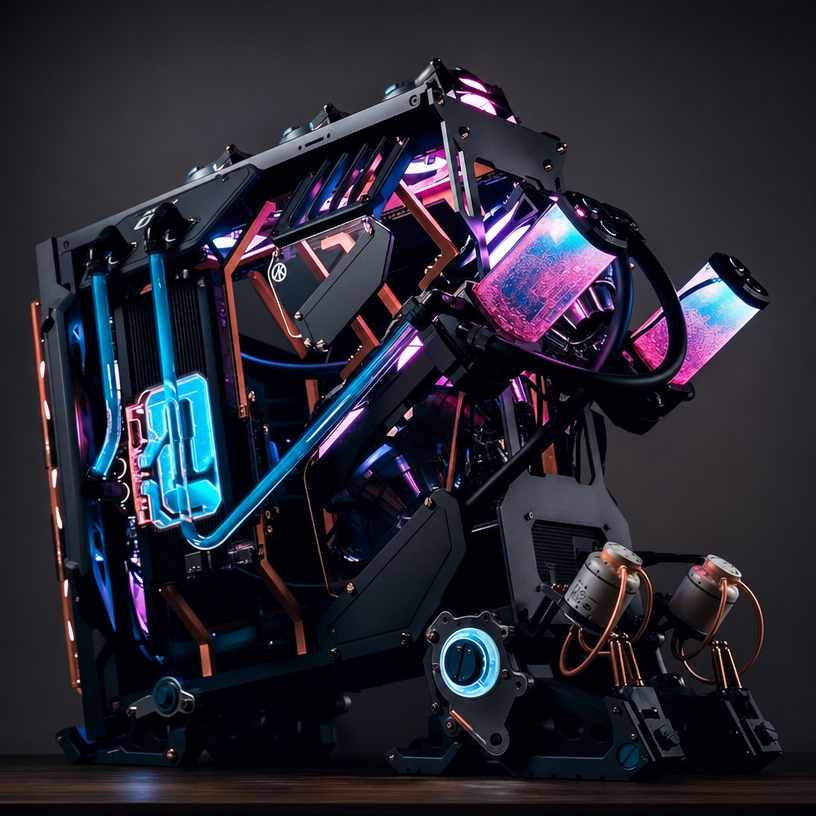
Why this works
“Product-photography framing” and the “centered” composition make the open-frame tower read as a deliberate hero object, while “ultra-sharp focus on exposed components” directs attention to the modular hardware and mechanical detail. The black metallic chassis with copper accents supplies grounded contrast, and the replacement of neon green with “cool blue and magenta LED accents” produces the image’s blue, pink, and purple color harmony. “Dark, moody studio product background” paired with “dramatic studio lighting with high contrast” establishes the premium, futuristic showroom mood without competing with the tower.
FAQ
→How do I make the internal hardware more prominent than the outer chassis?
Replace “product-photography framing, ultra-sharp focus on exposed components” with “three-quarter close-up macro product framing, internal motherboard, GPU, cooling loops, and cable runs dominating the composition, razor-sharp focus on internal hardware.” Keep “open-frame” and “exposing intricate internal components” so the chassis remains visibly secondary.
→How do I change the dark premium mood into a brighter engineering showcase?
Replace “dark, moody studio product background” with “bright white technical studio backdrop with subtle soft-gray gradients,” and replace “dramatic studio lighting with high contrast” with “clean high-key studio lighting with controlled reflections and soft shadows.” Retain “black and metallic with copper accents” to preserve material definition against the lighter background.
→How do I create a series of variations without losing this design identity?
Keep the fixed phrases “custom futuristic open-frame PC tower,” “extreme modular build,” “photorealistic CGI render,” and “premium tech showcase,” then vary one controlled slot at a time: replace “black and metallic with copper accents” with “brushed titanium with red accents” for a new material version, or replace “cool blue and magenta LED accents” with “amber and cyan LED accents” for a new lighting palette. Preserve “centered” and “product-photography framing” across the set so the changes remain comparable.
Learn the technique behind this
- Why can't AI spell, and how do I get readable text in an image? — Older diffusion models had no character-level representation of text, so they produced letterform-shaped texture instead of words.
- How should a prompt be structured, and does word order matter? — A prompt that behaves predictably names one subject first, then what it is doing, then where, then the light, then the lens or medium, then the style.
- Do negative prompts work, and what should go in one? — Negative prompts work on models that support a separate negative conditioning channel — mainly Stable Diffusion and FLUX-family models.
Related prompts

Magenta-Cyan Holographic Control Room

Blue holographic cube on server room pedestal

DJ in neon haze at low angle
Glowing Fiber-Optic Cables With Purple Data Lines