Why this works
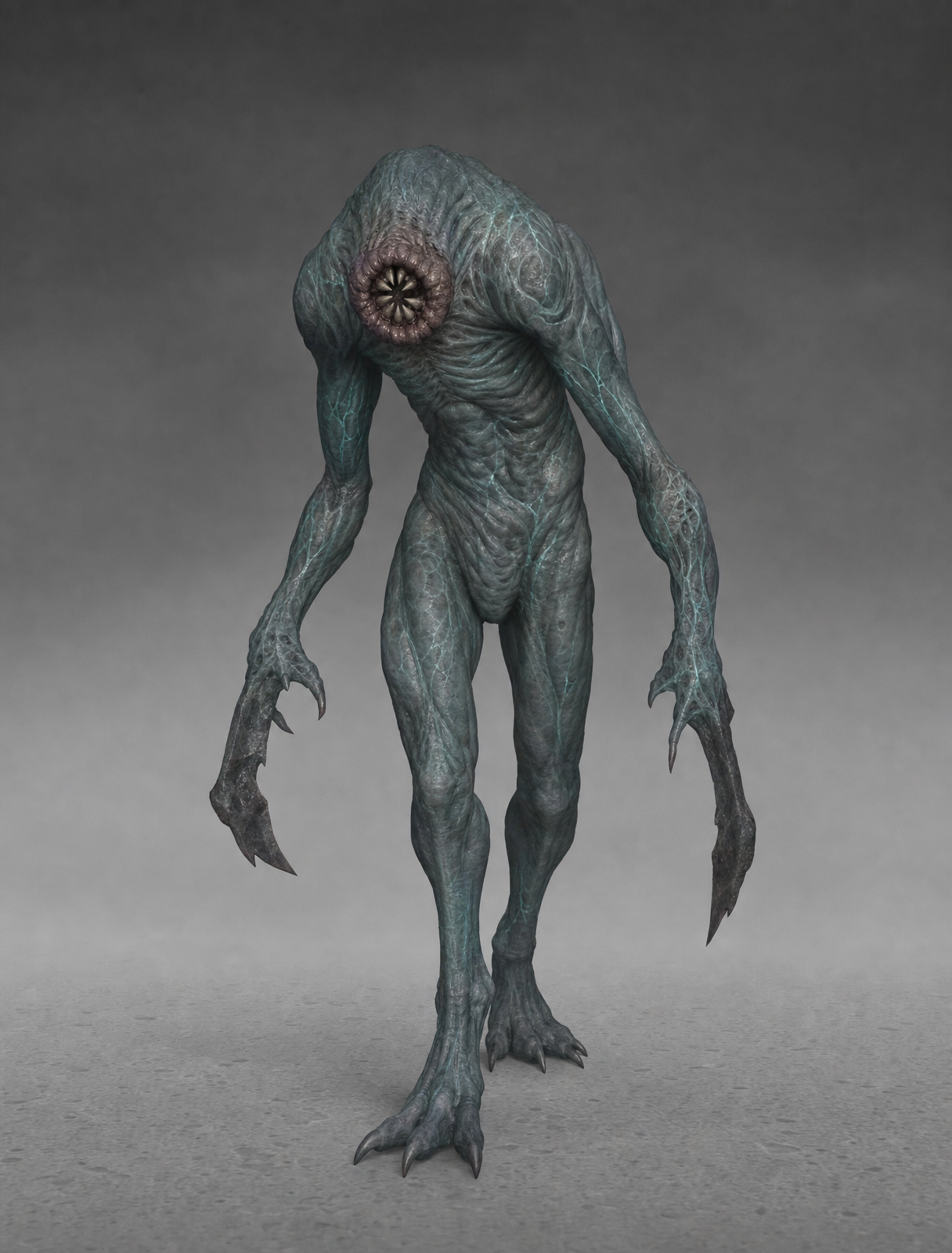
The phrase “full-body photorealistic alien humanoid” establishes a portrait-oriented figure study, while “straight-on studio framing” keeps the elongated limbs and chest-mounted mouth immediately legible. “Wrinkled teal-gray skin,” “faint bioluminescent vein patterns,” and the dominant black-and-teal palette create restrained color harmony without losing the creature’s anatomical detail. The eerie, menacing tone comes from “grotesque, slightly twisted elongated limbs,” “circular tooth-lined mouth,” and “slender, menacing stance,” reinforced by “dramatic soft lighting with gentle rim light outlining the silhouette.” “Sharp focus,” “ultra-high detail,” and “realistic skin texture” make the skin folds, teeth, and veins carry the image rather than atmospheric blur.
FAQ
→How do I make the chest-mouth more prominent and central?
Replace “the circular tooth-lined mouth is positioned at the upper chest/neck area” with “a large circular tooth-lined mouth dominates the center of the torso, facing directly toward the viewer.” Add “chest and mouth emphasized as the primary focal point” after “sharp focus,” while keeping “full-body” if the complete silhouette still matters.
→How do I change the image from eerie studio horror to a more threatening action pose?
Replace “slender, menacing stance” with “predatory crouched stance, shoulders hunched and elongated arms raised defensively.” Replace “cool neutral light-gray studio background with a subtle floor shadow” with “dark industrial corridor with wet reflective flooring,” and change “dramatic soft lighting with gentle rim light” to “hard directional overhead light with sharp cast shadows.”
→How do I build a consistent series with different alien subjects?
Keep the fixed phrases “full-body photorealistic,” “straight-on studio framing,” “cool neutral light-gray studio background,” “subtle floor shadow,” “gentle rim light outlining the silhouette,” and “sharp focus.” Swap only the subject block, replacing “grotesque alien humanoid creature” and its anatomical details with a new creature, such as “tall translucent insectoid alien with folded blade-like wings and six jointed arms,” while preserving “teal-gray skin tone” or assigning a controlled color variation for each entry.
Learn the technique behind this
- Why can't AI spell, and how do I get readable text in an image? — Older diffusion models had no character-level representation of text, so they produced letterform-shaped texture instead of words.
- How should a prompt be structured, and does word order matter? — A prompt that behaves predictably names one subject first, then what it is doing, then where, then the light, then the lens or medium, then the style.
- How do I keep the same character across multiple images? — Text prompts alone won't hold a face across images — a description defines a type, not a person.
Related prompts
Surprised Man Holding Mini Cartoon Self
Charcoal-blazer woman with art monsters
Laid-back 3D Caricature Portrait with Streetwear Style
Muscular Figure With Icy Thorn Crown