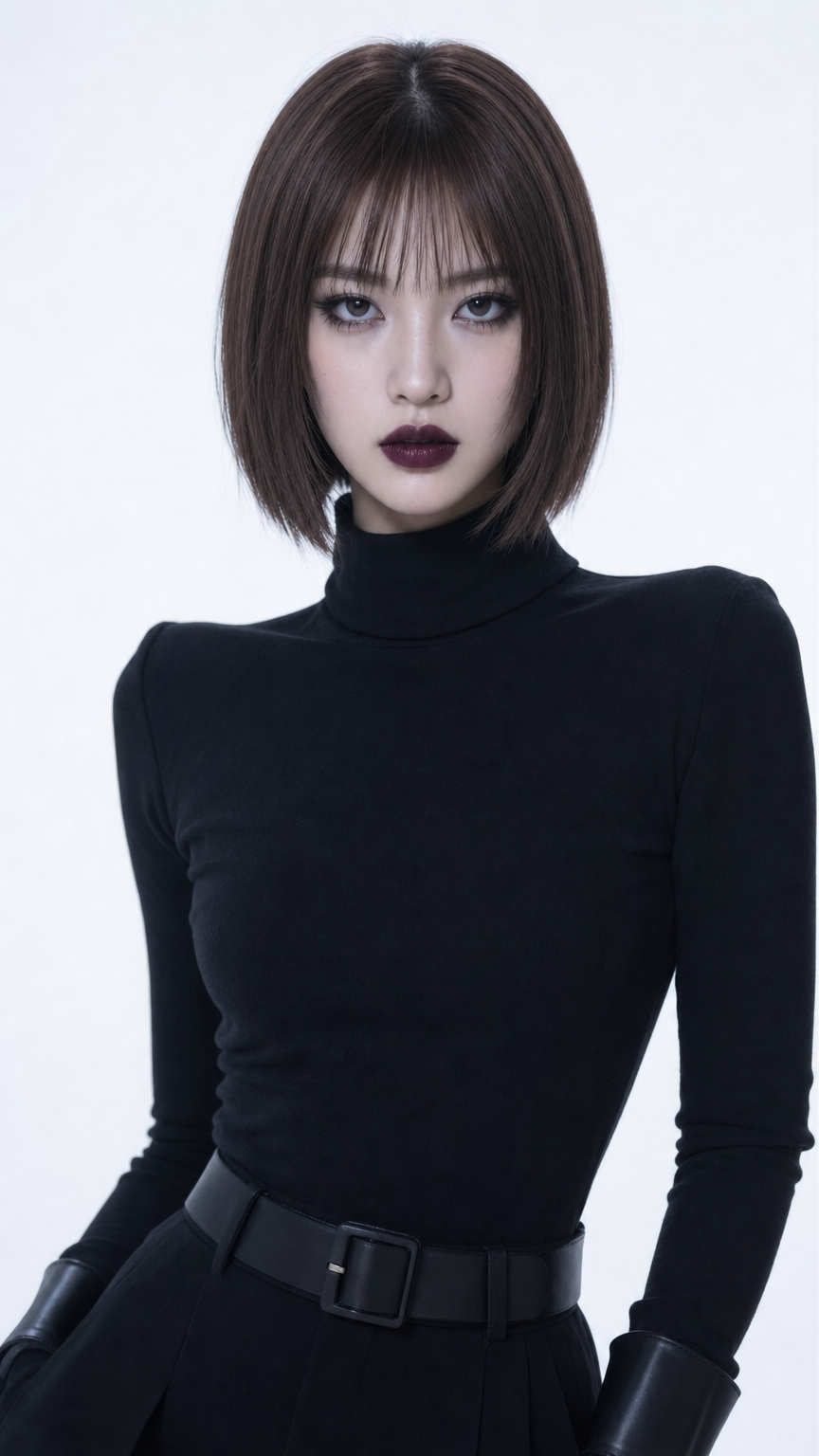
Why this works
The full-body portrait framing keeps the brunette model and deep teal dress readable as the primary vertical subject, while the “soft blurred reflected silhouette behind her” adds depth without competing for focus. “Soft diffused lighting,” “shallow depth of field,” and “soft-focus” directly produce the gentle dreamy mood, while “cool teal with subtle warm amber highlights” explains the restrained color relationship, including the image’s gray field and orange accents. The “minimal studio background” and “editorial fashion photography” language provide the clean, controlled space and polished magazine composition.
FAQ
→How do I make the reflected silhouette more central and visually prominent?
Replace “soft blurred reflected silhouette behind her” with “large, clearly visible reflected silhouette occupying the background beside and behind her, slightly blurred but recognizable,” and change “shallow depth of field” to “moderate depth of field” so the reflection retains more definition.
→How do I shift this from dreamy elegance to a sharper, more dramatic editorial mood?
Replace “soft diffused lighting” and “dreamy elegant atmosphere” with “hard directional side-lighting, crisp shadows, and a high-contrast editorial mood.” Keep “cool teal with subtle warm amber highlights,” or replace it with “deep teal, charcoal gray, and controlled amber highlights” for a stronger version of the existing palette.
→How do I build a series of variations while keeping the same fashion identity?
Keep “editorial fashion photography,” “minimalist,” “deep teal dress,” and “cool teal with subtle warm amber highlights” fixed, then vary the setting phrase from “minimal studio background” to “brutalist concrete studio,” “amber-lit hotel corridor,” or “misty glasshouse interior.” Change “soft blurred reflected silhouette” to a matching recurring motif such as “blurred reflection in smoked glass” or “elongated shadow on the studio wall.”
Learn the technique behind this
- Why can't AI spell, and how do I get readable text in an image? — Older diffusion models had no character-level representation of text, so they produced letterform-shaped texture instead of words.
- How should a prompt be structured, and does word order matter? — A prompt that behaves predictably names one subject first, then what it is doing, then where, then the light, then the lens or medium, then the style.
- Why does the model ignore parts of my prompt? — Ignored instructions are almost always conflicts, counts, or spatial relationships — three things current models handle badly — rather than the model failing to read you.
Related prompts
Cobalt Boots in Sleek Studio Edit

Teal fashion editorial in monster-filled lift

Sunlit editorial on striped beach towel

Silhouette Influencer by Sunlit Window