Why this works
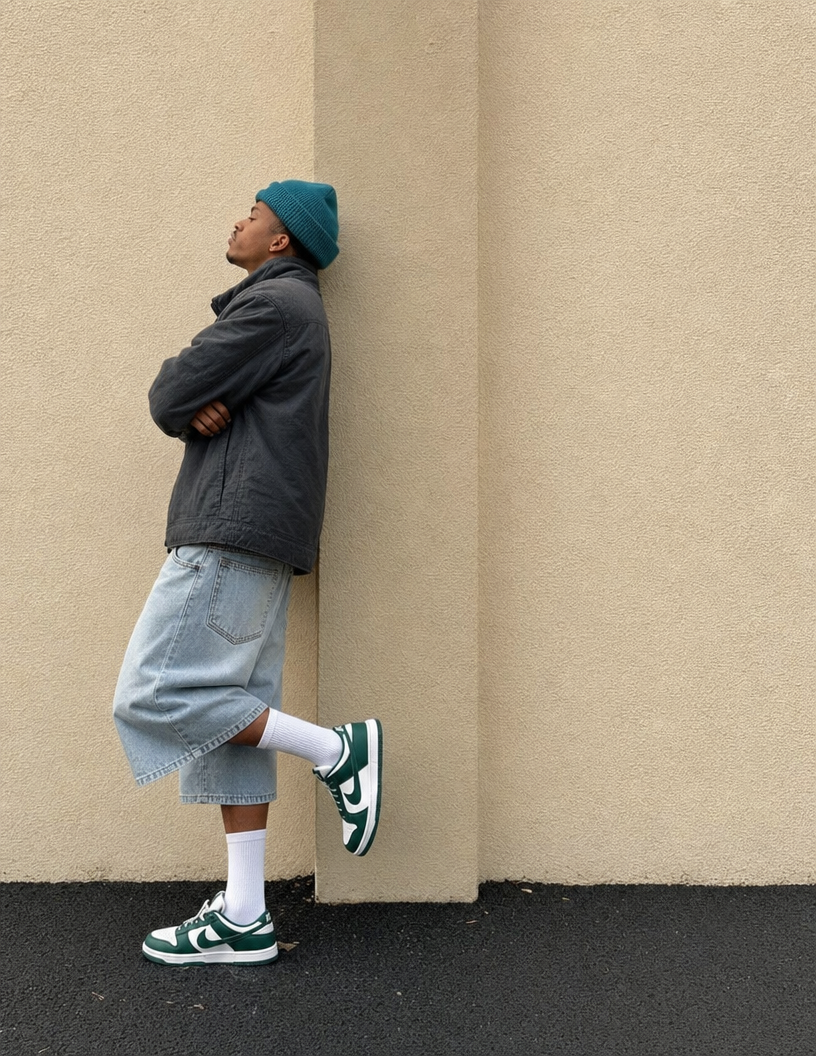
The phrase “split-scene editorial street-style composition” establishes the full-body, back-to-back structure, while “street-photography framing with sharp focus on the real subject” makes the photographed man the visual anchor. “Plain warm beige concrete wall” and “clean minimalist background” leave negative space around the figures, allowing the teal beanie, blue-gray clothing, and green sneaker details to form a restrained color harmony against the neutral wall. “High-contrast editorial lighting” separates the real subject from the backdrop, while “bold, graffiti-like lines” and “sharp photorealistic detail” create the deliberate tension between illustration and photography that gives the image its playful fashion-editorial tone.
FAQ
→How do I make the illustrated counterpart more prominent than the real subject?
Replace “sharp focus on the real subject” with “equal sharp focus and visual prominence on both figures,” and change “blending with the stylized illustrated figure” to “the graffiti-style illustrated counterpart in the foreground, larger and more visually dominant.” Add “oversized illustrated figure with bold saturated outlines” to increase its scale and graphic weight.
→How do I shift this from playful street style to a darker, more dramatic editorial mood?
Replace “playful fashion-forward mood” with “moody, gritty, high-fashion editorial mood,” and change “high-contrast editorial lighting” to “hard directional side-lighting with deep shadows and a narrow pool of light.” Swap “plain warm beige concrete wall” for “weathered charcoal concrete wall with subtle urban grime,” while keeping the teal beanie and green sneaker accents as controlled color highlights.
→How do I build a series of variations while keeping the same visual concept?
Keep “split-scene editorial street-style composition,” “posed back-to-back,” and “photorealistic street photography mixed with graffiti-style illustration” unchanged, then replace the outfit and wall descriptors for each version. For example, substitute “teal knit beanie, charcoal zip-up jacket, and light-wash jeans” with “red varsity jacket, black cargo pants, and red high-top sneakers,” and replace “plain warm beige concrete wall” with “pale blue tiled underpass wall.”
Learn the technique behind this
- Why can't AI spell, and how do I get readable text in an image? — Older diffusion models had no character-level representation of text, so they produced letterform-shaped texture instead of words.
- How should a prompt be structured, and does word order matter? — A prompt that behaves predictably names one subject first, then what it is doing, then where, then the light, then the lens or medium, then the style.
- Do negative prompts work, and what should go in one? — Negative prompts work on models that support a separate negative conditioning channel — mainly Stable Diffusion and FLUX-family models.
Related prompts
Cobalt Boots in Sleek Studio Edit
Teal fashion editorial in monster-filled lift
Sunlit editorial on striped beach towel
Silhouette Influencer by Sunlit Window