Why this works
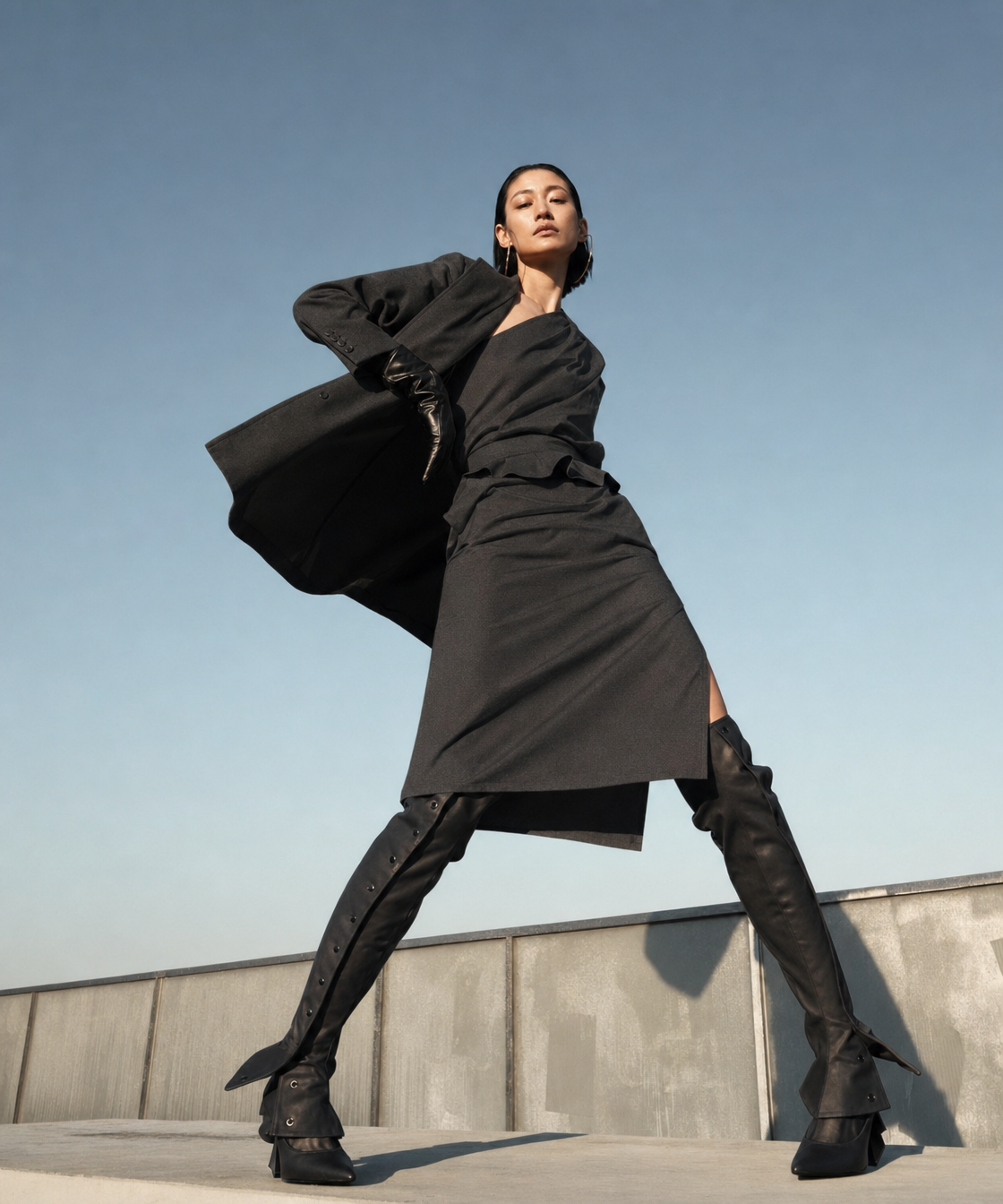
The phrase “low-angle viewpoint looking up” makes the full-body model feel commanding, while “strong geometric rooftop lines” gives the portrait a directional frame and reinforces her “bold, confident” stance. “Deep charcoal,” “matte black,” and “cooler pale blue/grey” create a restrained gray and sky-blue palette, with “vivid contrast between the model’s dark outfit and the sky” keeping the silhouette legible. “Crisp late-afternoon daylight with slightly longer shadows” supplies the dramatic edge, and “sharp focus and crisp detail” preserves the coat, satin-like gloves, and realistic textures as editorial focal points.
FAQ
→How do I make the model feel even more imposing and central?
Keep “low-angle viewpoint looking up,” but replace “portrait-full-body” with “full-body vertical composition with the model occupying most of the frame.” Change “strong geometric rooftop lines emphasizing” to “converging rooftop lines directing the eye toward the model,” and add “minimal empty sky around her silhouette.”
→How do I shift this from cool, commanding drama to a warmer, softer editorial mood?
Replace “cooler pale blue/grey tone” and “cool sky tones for vivid contrast” with “warm peach and amber sunset tones.” Change “crisp late-afternoon daylight with slightly longer shadows” to “soft golden-hour backlight with gentle shadow detail,” and replace “vivid contrast” with “subtle tonal harmony between the charcoal outfit and warm sky.”
→How do I build a coordinated series of variations from this rooftop image?
Preserve “photorealistic high-fashion editorial photography,” “low-angle viewpoint,” “clean, sharp magazine-style composition,” and the charcoal coat, then swap only the setting phrase “outdoors on a rooftop with strong geometric rooftop lines.” Use alternatives such as “concrete parking deck with repeating ramps,” “glass-and-steel rooftop terrace,” or “brutalist rooftop beside a water tower,” while changing the accent palette to “charcoal, muted green, and overcast gray” or “black, cream, and late-sunset orange.”
Learn the technique behind this
- Why can't AI spell, and how do I get readable text in an image? — Older diffusion models had no character-level representation of text, so they produced letterform-shaped texture instead of words.
- How should a prompt be structured, and does word order matter? — A prompt that behaves predictably names one subject first, then what it is doing, then where, then the light, then the lens or medium, then the style.
- Do negative prompts work, and what should go in one? — Negative prompts work on models that support a separate negative conditioning channel — mainly Stable Diffusion and FLUX-family models.
Related prompts
Teal fashion editorial in monster-filled lift
Cobalt Boots in Sleek Studio Edit
Silhouette Influencer by Sunlit Window
Sunlit editorial on striped beach towel