Why this works
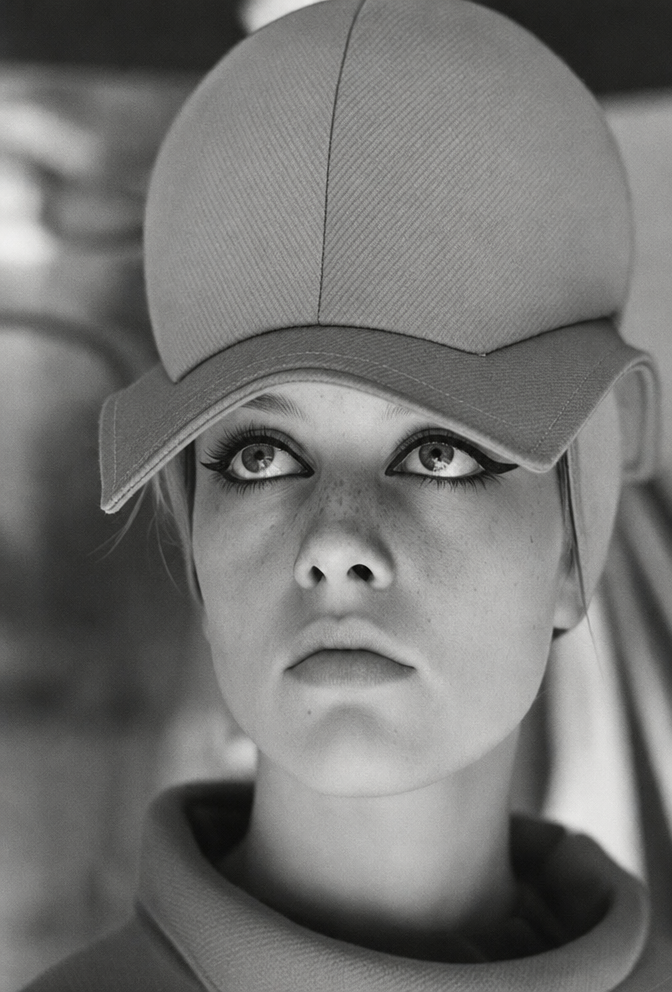
The close-up editorial portrait framing and “crisp facial detail” make the model’s face and oversized sculptural cap the dominant forms, while the “curved brim” creates a strong graphic contour near the gaze. “Black-and-white” paired with “high-contrast studio lighting” reduces the image to hard tonal structure, giving the eyeliner and cap more visual force than a colored palette would. “Soft blurred background” isolates the subject, and “vintage avant-garde fashion photography” with “surreal expressive mood” pushes the restrained pose toward an unusual, editorial character.
FAQ
→How do I make the sculptural cap more prominent than the model’s face?
Replace “close-up editorial portrait framing” with “three-quarter fashion portrait framing from chest up,” and expand “oversized sculptural cap with a curved brim” to “monumental sculptural cap dominating the upper frame, exaggerated curved brim casting a graphic shadow across the face.” Keep “crisp facial detail” if you still want the model recognizable, or replace it with “sharp detail on the cap’s molded surface” to shift priority upward.
→How do I change the surreal dramatic mood into a softer, more delicate editorial tone?
Replace “high-contrast studio lighting” with “large diffused window light with gentle frontal fill,” and change “surreal expressive mood” to “quiet, romantic, contemplative mood.” Swap “heavy graphic eyeliner” for “fine softly smudged eyeliner” while retaining “black-and-white” for a restrained tonal palette.
→How do I build a series of variations without losing this portrait’s identity?
Keep the fixed anchors “black-and-white editorial fashion portrait,” “young model,” “oversized sculptural cap,” and “close-up editorial portrait framing.” Vary one controlled slot at a time: replace “curved brim” with “angular brim,” “folded brim,” or “translucent brim”; replace “soft blurred background” with “blurred geometric studio panels” or “blurred vintage dressing room”; and alternate “upward gaze” with “direct gaze” or “downcast gaze.”
Learn the technique behind this
- Why can't AI spell, and how do I get readable text in an image? — Older diffusion models had no character-level representation of text, so they produced letterform-shaped texture instead of words.
- How should a prompt be structured, and does word order matter? — A prompt that behaves predictably names one subject first, then what it is doing, then where, then the light, then the lens or medium, then the style.
- Why does the model ignore parts of my prompt? — Ignored instructions are almost always conflicts, counts, or spatial relationships — three things current models handle badly — rather than the model failing to read you.
Related prompts
Teal fashion editorial in monster-filled lift
Cobalt Boots in Sleek Studio Edit
Silhouette Influencer by Sunlit Window
Sunlit editorial on striped beach towel