Why this works
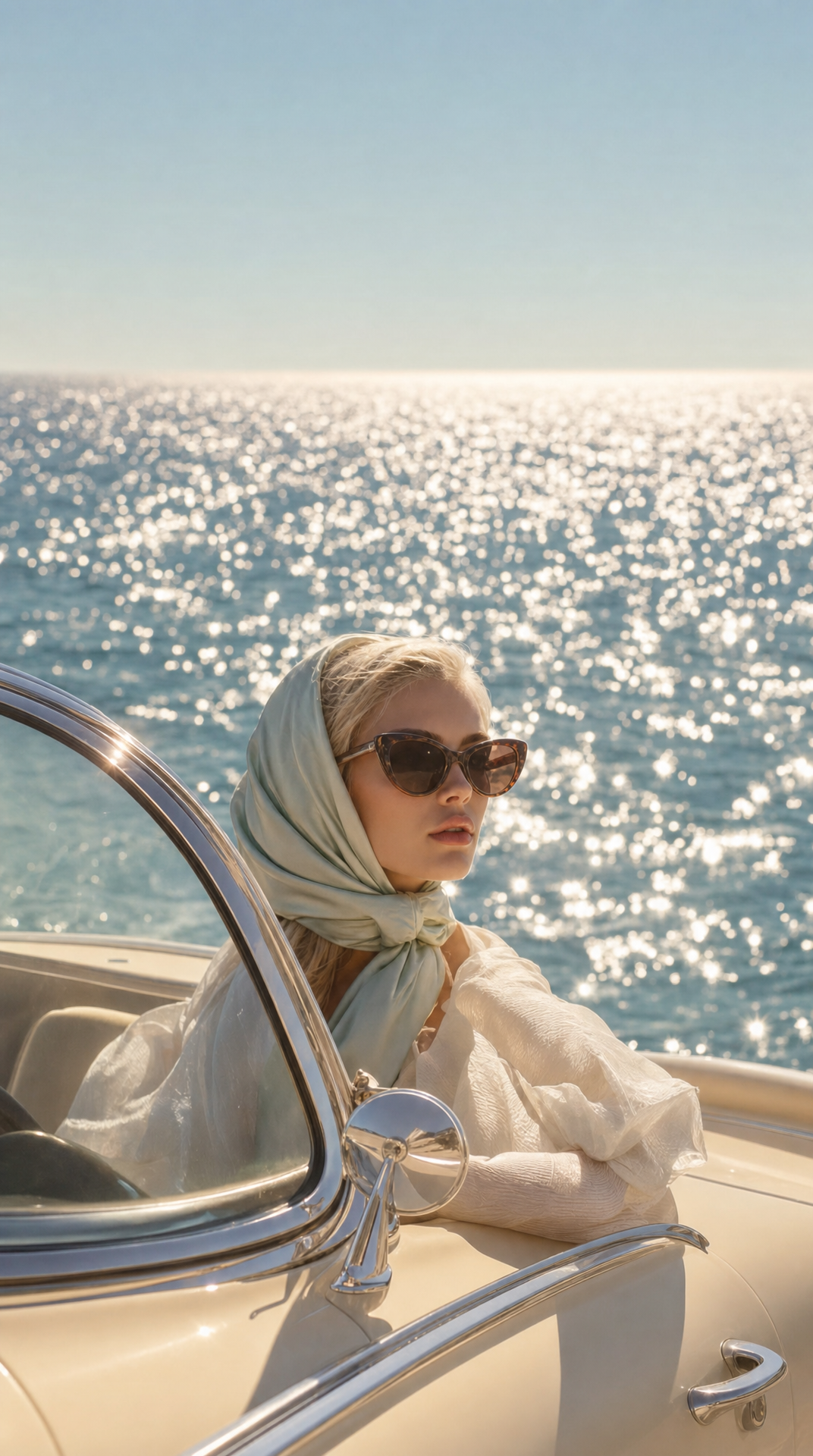
The “editorial portrait framing” and “portrait-closeup” keep the woman, oversized cat-eye sunglasses, and pale sage silk headscarf visually dominant, while the cream convertible and sparkling sea remain a clean coastal context rather than competing subjects. “Soft late-afternoon sunlight creating crisp but less harsh geometric shadows” supplies definition without losing the serene mood, and the beige, white, and gray palette reinforces the prompt’s “minimalist” and “clean tailored styling.” “Subtle metallic highlights on the side mirror” add a controlled reflective accent, while “crisp magazine polish” directs the image toward a precise, high-fashion finish instead of a casual beach snapshot.
FAQ
→How do I make the convertible and ocean more prominent instead of keeping this as a close portrait?
Replace “portrait-closeup” and “Editorial portrait framing” with “three-quarter environmental fashion portrait” and add “full cream convertible visible in the foreground, expansive sparkling sea and horizon occupying the background.” Keep “crisp magazine polish” so the wider composition still reads as a fashion editorial.
→How do I shift the mood from serene glamour to a darker, more dramatic editorial tone?
Replace “soft late-afternoon sunlight” and “crisp but less harsh geometric shadows” with “low sunset backlight, deep directional shadows, and controlled high-contrast rim light.” Change “Serene glamorous mood” to “mysterious nocturnal glamour,” and replace the beige-and-white emphasis with “charcoal, black, and muted silver accents.”
→How do I build a coordinated series of variations from this prompt?
Keep “Minimalist high-fashion editorial photography,” “clean tailored styling,” and “crisp magazine polish” unchanged, then swap one controlled variable per image: replace “cream convertible” with “ivory yacht,” “vintage white scooter,” or “architectural seaside villa,” and replace “pale sage silk headscarf” with “powder-blue scarf,” “ivory satin turban,” or “black silk ribbon.” Preserve “soft late-afternoon sunlight” and “portrait framing” to hold the series together.
Learn the technique behind this
- Why can't AI spell, and how do I get readable text in an image? — Older diffusion models had no character-level representation of text, so they produced letterform-shaped texture instead of words.
- Why does AI get hands and faces wrong, and how do I fix it? — Hands fail because they're small in frame, extremely variable in pose, and self-occluding — the model has less usable signal per pixel than for any other body part.
- How do I keep the same character across multiple images? — Text prompts alone won't hold a face across images — a description defines a type, not a person.
Related prompts
Cobalt Boots in Sleek Studio Edit
Teal fashion editorial in monster-filled lift
Sunlit editorial on striped beach towel
Silhouette Influencer by Sunlit Window