Why this works
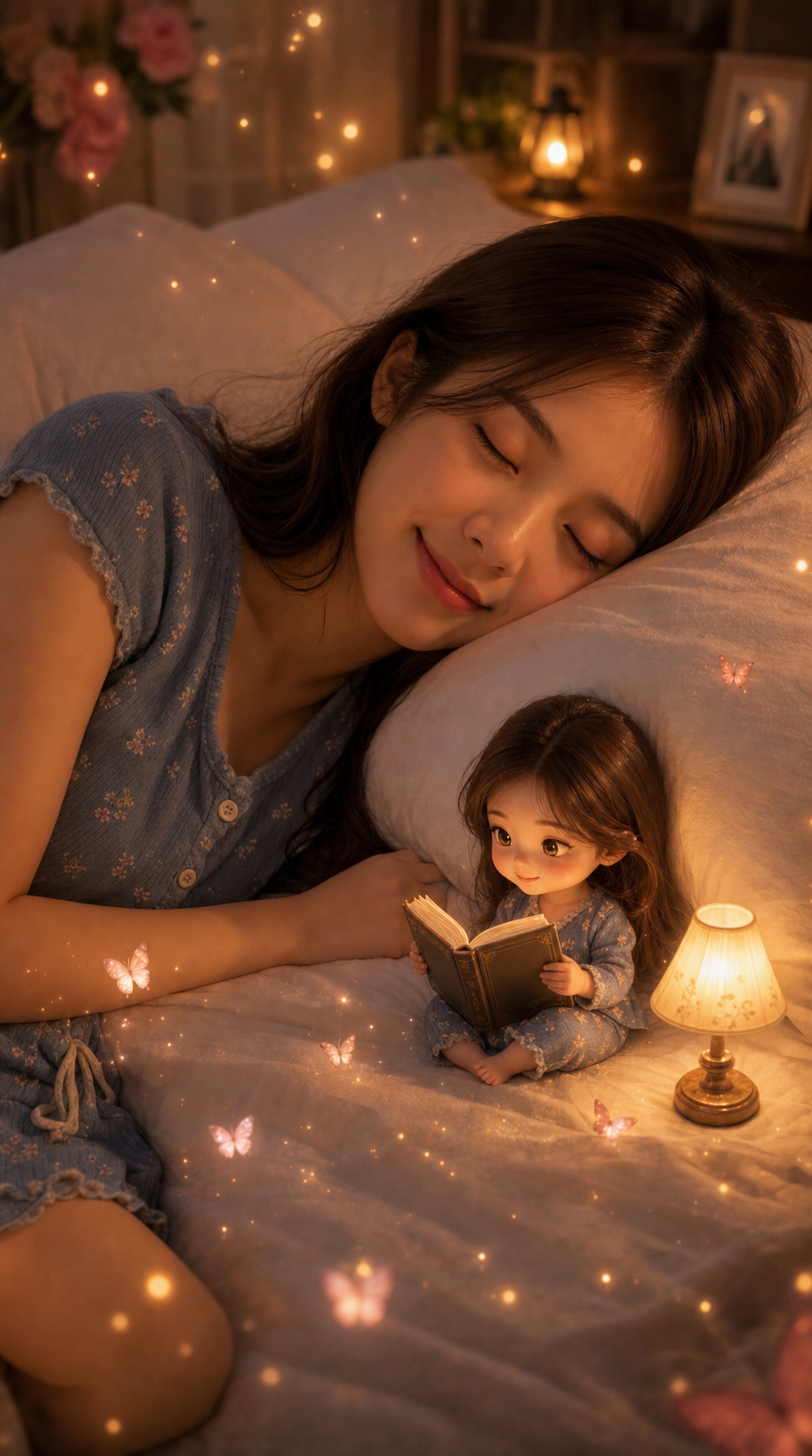
The phrase “close framing on the pillow area” makes the sleeping woman and miniature reader share the visual focus, while “vertical composition” supports the portrait orientation and preserves the intimate bedroom context. “Warm, cozy bedroom,” “cinematic warm light,” and the “softly glowing bedside lamp” establish the gold-and-beige palette and peaceful mood; the woman’s “blue knit pajama shorts” provide the main cool color contrast. “Shallow depth of field” and “dreamy bokeh” separate the tiny book and faces from the background, while “floating sparkles,” “glowing dust motes,” butterflies, and petals supply the magical realism without overpowering the central pillow scene.
FAQ
→How do I make the tiny chibi reader more prominent than the sleeping woman?
Replace “close framing on the pillow area” with “macro close-up centered on the tiny chibi reader,” and add “the miniature figure occupies the foreground at sharp focus, with the sleeping woman softly blurred behind.” Keep “shallow depth of field,” but specify that focus falls on “the fairy tale book, chibi face, and glowing bedside lamp.”
→How do I make this scene feel moonlit and slightly mysterious instead of warm and cozy?
Replace “warm, cozy bedroom” with “quiet bedroom washed in cool blue moonlight,” and change “cinematic warm light with soft glowing lamp illumination” to “soft silver moonlight with a small pool of amber light from the bedside lamp.” Replace “warm light” around the butterflies and petals with “cool moonlit haze,” while retaining “dreamy bokeh” for the gentle atmosphere.
→How do I build a series of similar images with different miniature dream companions?
Keep the fixed structure, including “a young woman sleeping peacefully,” “close framing on the pillow area,” “vertical composition,” and “shallow depth of field.” Replace “a tiny chibi version of herself” and “lovingly reading a miniature fairy tale book” with a consistent slot such as “a tiny chibi version of herself accompanied by a miniature [companion] performing [quiet action],” for example “a tiny chibi version of herself with a miniature fox arranging glowing paper stars,” then vary only the companion, prop, and small environmental accents.
Learn the technique behind this
- Why can't AI spell, and how do I get readable text in an image? — Older diffusion models had no character-level representation of text, so they produced letterform-shaped texture instead of words.
- How should a prompt be structured, and does word order matter? — A prompt that behaves predictably names one subject first, then what it is doing, then where, then the light, then the lens or medium, then the style.
- Which aspect ratio should I use, and how does it change the image? — Aspect ratio determines what the model composes, not how it's cropped afterwards.
Related prompts
Young woman with two cats
Blonde woman hugging beige pillow on off-white bed
Black tower fan on gray rug by window
Cozy Winter Living Room in Sage