Why this works
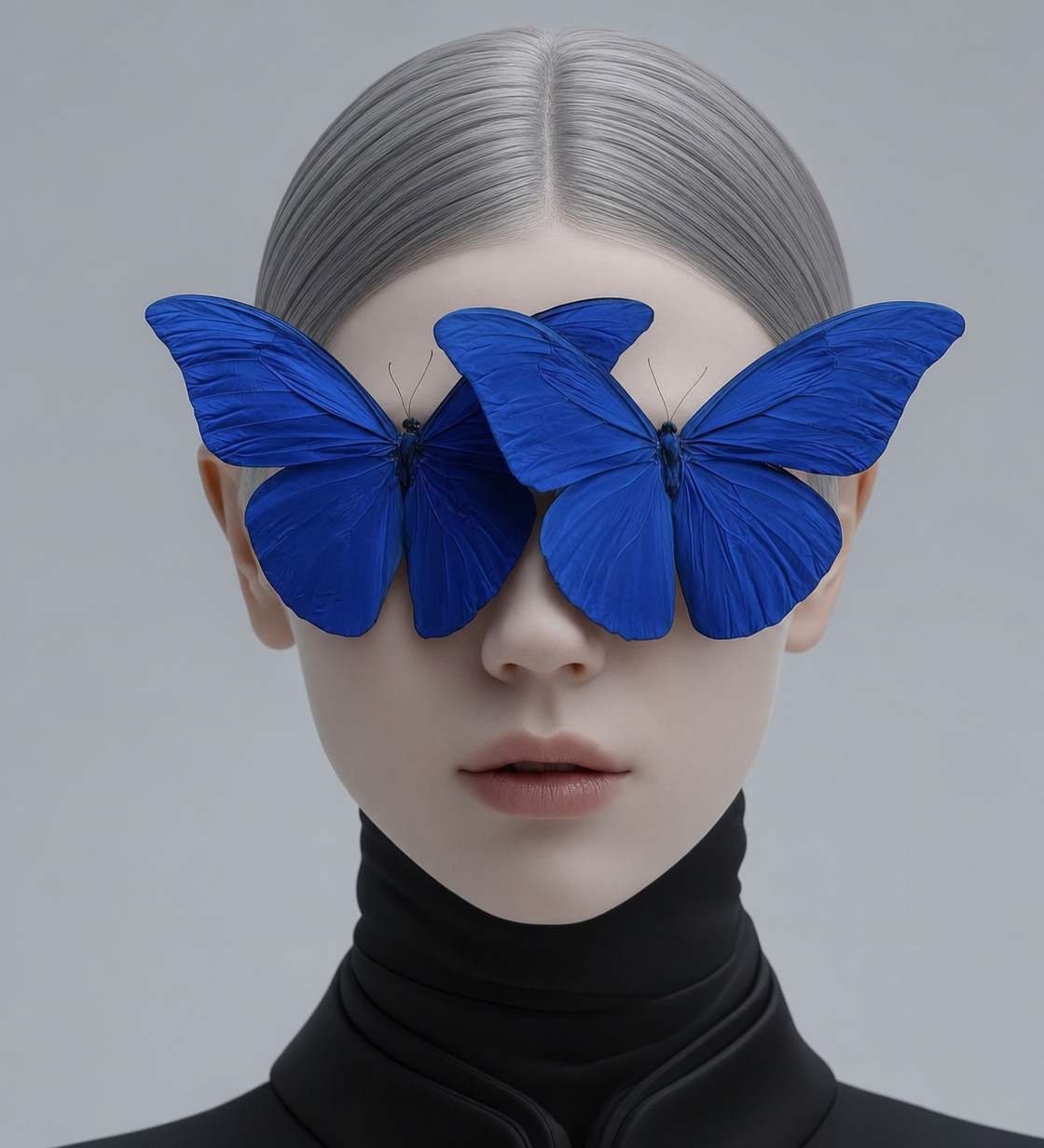
The phrase “centered frontal composition” and the close-up portrait framing make the face and eye-covering butterflies the immediate focal point, while “two vivid cobalt blue butterflies” supplies the strongest color contrast against the pale skin and soft gray background. “Sleek silver-gray hair slicked back,” “minimal matte black high-neck garment,” and “smooth porcelain skin” remove visual clutter, creating the controlled, futuristic mood. “Crisp editorial lighting with gentle rim highlights” preserves facial and butterfly detail while separating the silhouette from the cool-toned studio backdrop.
FAQ
→How do I make the butterflies feel larger and more dominant in the portrait?
Replace “two vivid cobalt blue butterflies covering the eyes” with “two oversized vivid cobalt blue butterflies spanning the upper face and extending toward the temples,” and change “portrait-closeup” to “extreme close-up portrait.” Keep “centered frontal composition” so the enlarged forms remain symmetrical.
→How do I shift this from ethereal and futuristic to darker and more dramatic?
Replace “soft cool-toned gray background” with “deep charcoal-black studio background,” and change “crisp editorial lighting with gentle rim highlights” to “hard directional side-lighting with narrow blue highlights and deep sculptural shadows.” Replace “minimal, ethereal, futuristic” with “dark surreal, severe, nocturnal fashion editorial.”
→How do I build a coordinated series while keeping this image’s visual identity?
Keep “centered frontal composition,” “smooth porcelain skin,” “sleek silver-gray hair slicked back,” and “minimal matte black high-neck garment” unchanged. Create variations by replacing only “two vivid cobalt blue butterflies covering the eyes” with matched surreal motifs such as “two translucent amber moths covering the eyes,” “small mirrored chrome discs over the eyes,” or “delicate white orchids obscuring the eyes,” while preserving “soft cool-toned gray background” and “gentle rim highlights.”
Learn the technique behind this
- Why can't AI spell, and how do I get readable text in an image? — Older diffusion models had no character-level representation of text, so they produced letterform-shaped texture instead of words.
- How should a prompt be structured, and does word order matter? — A prompt that behaves predictably names one subject first, then what it is doing, then where, then the light, then the lens or medium, then the style.
- Why does the model ignore parts of my prompt? — Ignored instructions are almost always conflicts, counts, or spatial relationships — three things current models handle badly — rather than the model failing to read you.
Related prompts
Teal fashion editorial in monster-filled lift
Cobalt Boots in Sleek Studio Edit

Silhouette Influencer by Sunlit Window

Sunlit editorial on striped beach towel