Why this works
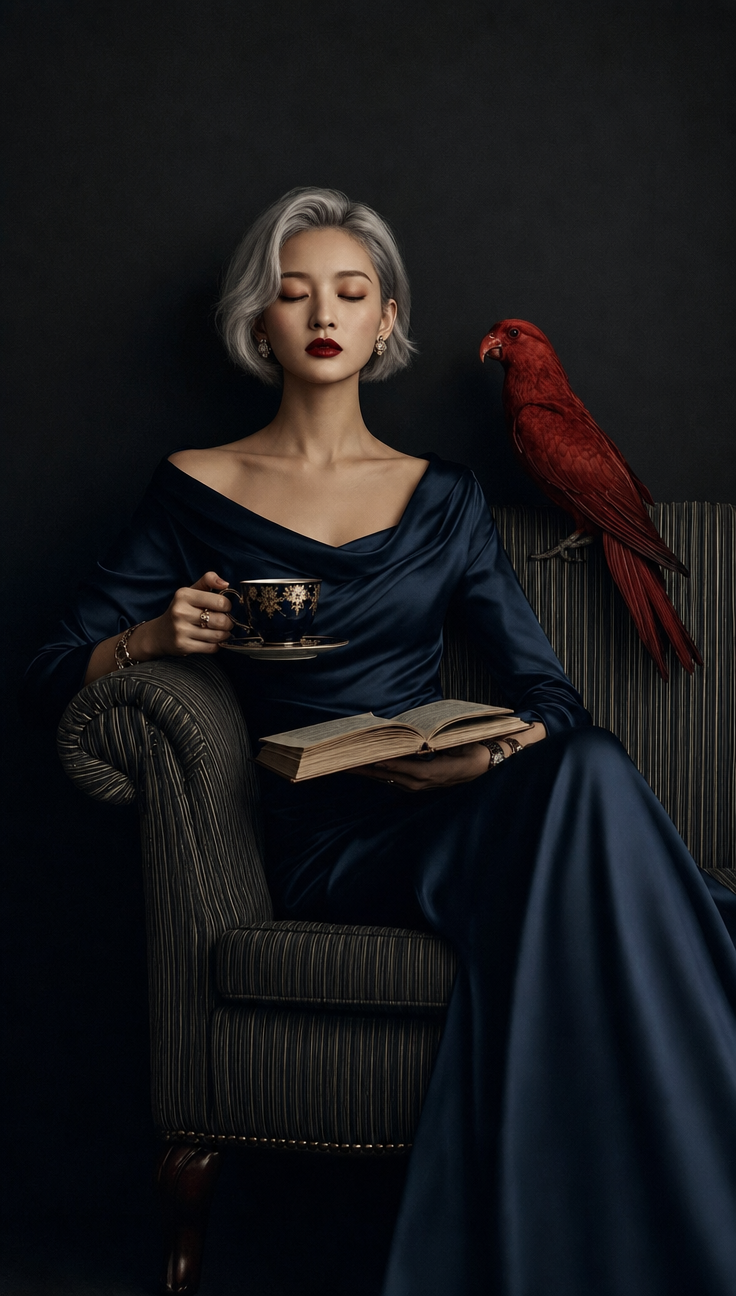
The contrast between the “deep navy satin dress,” “dark charcoal studio backdrop,” and “red parrot” gives the full-body portrait a controlled blue-red-black palette, while “subtle teal highlights” add separation without breaking its restrained luxury. “Moody, low-key cinematic studio lighting” and the “serene, mysterious closed-eye expression” establish the quiet tone, and “shallow depth of field” keeps attention on the woman, teacup, book, and parrot against the studio. The “striped vintage armchair” supplies graphic structure beneath the seated figure, while “luxurious fabric textures,” “high-detail skin and feathers,” and “photorealistic editorial framing” make satin, plumage, and skin carry the image’s tactile richness.
FAQ
→How do I make the red parrot more central and visually prominent?
Replace “red parrot perched beside her” with “large red parrot perched prominently on her shoulder, facing the camera, occupying the upper-right focal area.” Change “shallow depth of field” to “moderate depth of field keeping both the woman’s face and parrot’s feathers sharply focused,” so the bird does not disappear into the portrait blur.
→How do I shift this from mysterious and subdued to warmer, more inviting fashion editorial?
Replace “dark charcoal studio backdrop” with “warm espresso-brown studio backdrop,” and replace “moody, low-key cinematic lighting” with “soft golden key light with gentle fill and warm rim light.” Change “serene mysterious closed-eye expression” to “serene, welcoming expression with a subtle smile,” while keeping the “deep navy satin dress” and “red parrot” for contrast.
→How do I build a coordinated series of variations from this portrait?
Keep the fixed anchors “short silver bob,” “deep navy satin dress,” “red parrot,” and “striped vintage armchair,” then swap one controlled block per image. Replace “dark studio” with settings such as “ornate library,” “rain-streaked conservatory,” or “Art Deco salon,” and change the prop phrase “a teacup and an open book” to “a crystal glass and a folded letter” or “a fan and a closed journal,” while preserving “photorealistic editorial fashion portrait” and “cinematic composition” for visual consistency.
Learn the technique behind this
- Why can't AI spell, and how do I get readable text in an image? — Older diffusion models had no character-level representation of text, so they produced letterform-shaped texture instead of words.
- How should a prompt be structured, and does word order matter? — A prompt that behaves predictably names one subject first, then what it is doing, then where, then the light, then the lens or medium, then the style.
- Which aspect ratio should I use, and how does it change the image? — Aspect ratio determines what the model composes, not how it's cropped afterwards.
Related prompts
Teal fashion editorial in monster-filled lift
Cobalt Boots in Sleek Studio Edit
Silhouette Influencer by Sunlit Window
Sunlit editorial on striped beach towel