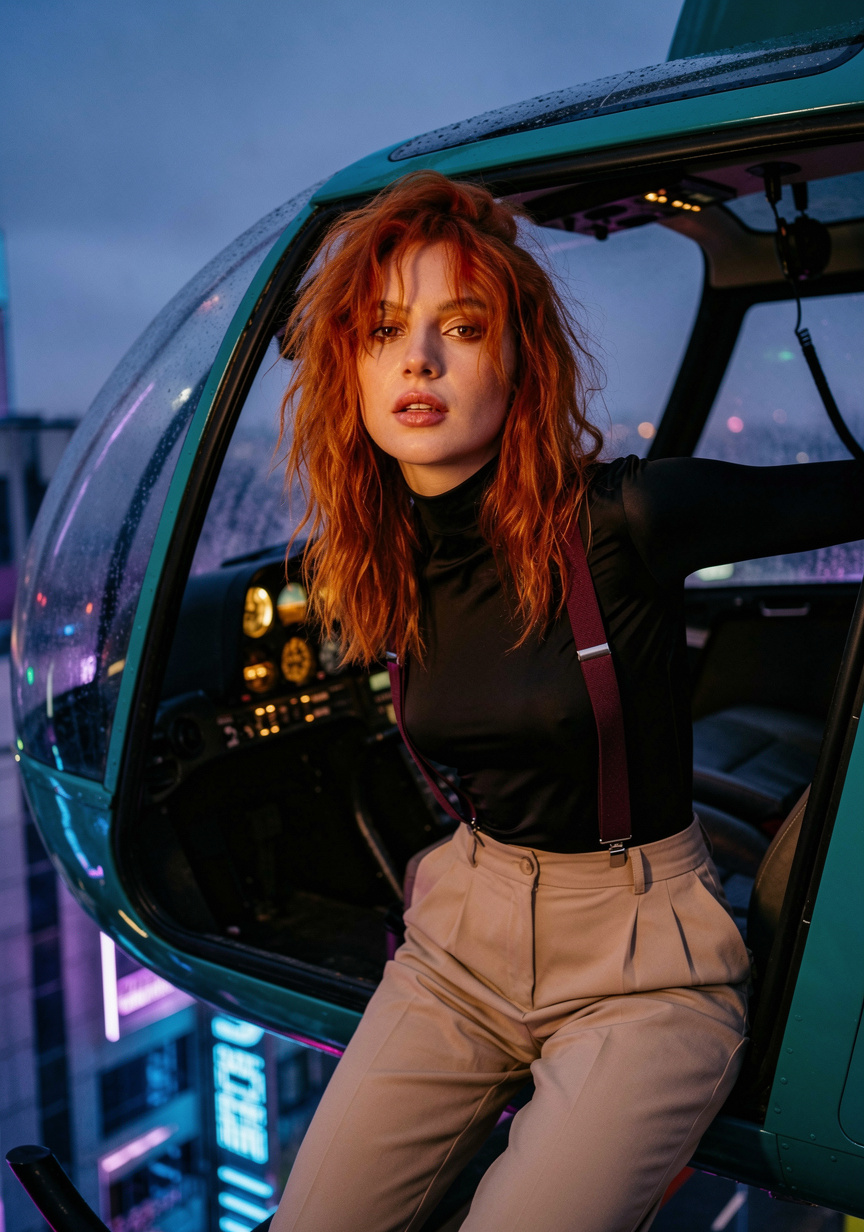
Same prompt, generated with each model separately — click one to see how it holds up.
Why this works
The phrase “red-haired woman seated in the open doorway of a teal helicopter” establishes a strong subject-and-frame relationship, while “one arm resting on the frame” gives the pose a relaxed, editorial asymmetry. “Deep indigo evening sky,” “cool-toned rim lighting with a subtle magenta edge,” and “warm highlights on the subject” create a cool-versus-warm color structure around the black, tan, and burgundy wardrobe. “Distant city lights glowing far below” supplies urban scale, and “shallow depth of field” keeps attention on the “confident direct gaze” and “ultra-detailed realistic skin texture” rather than the background.
FAQ
→How do I make the woman’s face and gaze more central and prominent?
Replace “seated in the open doorway” with “tight head-and-shoulders portrait filling the frame,” and change “confident direct gaze” to “intense unwavering eye contact centered in the composition.” Keep “shallow depth of field,” but add “background reduced to soft circular city-light bokeh” so the helicopter and skyline recede.
→How do I change the dramatic twilight mood into a brighter, more optimistic fashion image?
Replace “at twilight” and “deep indigo evening sky” with “late golden hour under a clear peach-and-cobalt sky.” Swap “cool-toned rim lighting with a subtle magenta edge” for “warm directional sunlight with soft champagne highlights,” while keeping “glossy high-fashion magazine aesthetic” for the editorial finish.
→How do I build a series of variations without losing the original visual identity?
Keep the fixed phrases “red-haired woman,” “black fitted bodysuit and tan high-waisted trousers with burgundy suspenders,” “teal helicopter,” and “glossy high-fashion magazine aesthetic.” For each variation, replace only “open doorway” and the pose with options such as “standing beside the helicopter skid,” “leaning against the cabin,” or “looking over her shoulder from the cockpit,” then vary the setting with “coastal cliffs,” “desert airstrip,” or “snow-covered mountain valley.”
Learn the technique behind this
- Why can't AI spell, and how do I get readable text in an image? — Older diffusion models had no character-level representation of text, so they produced letterform-shaped texture instead of words.
- How should a prompt be structured, and does word order matter? — A prompt that behaves predictably names one subject first, then what it is doing, then where, then the light, then the lens or medium, then the style.
- Why does AI get hands and faces wrong, and how do I fix it? — Hands fail because they're small in frame, extremely variable in pose, and self-occluding — the model has less usable signal per pixel than for any other body part.
Related prompts
Teal fashion editorial in monster-filled lift
Cobalt Boots in Sleek Studio Edit
Silhouette Influencer by Sunlit Window
Sunlit editorial on striped beach towel