Why this works
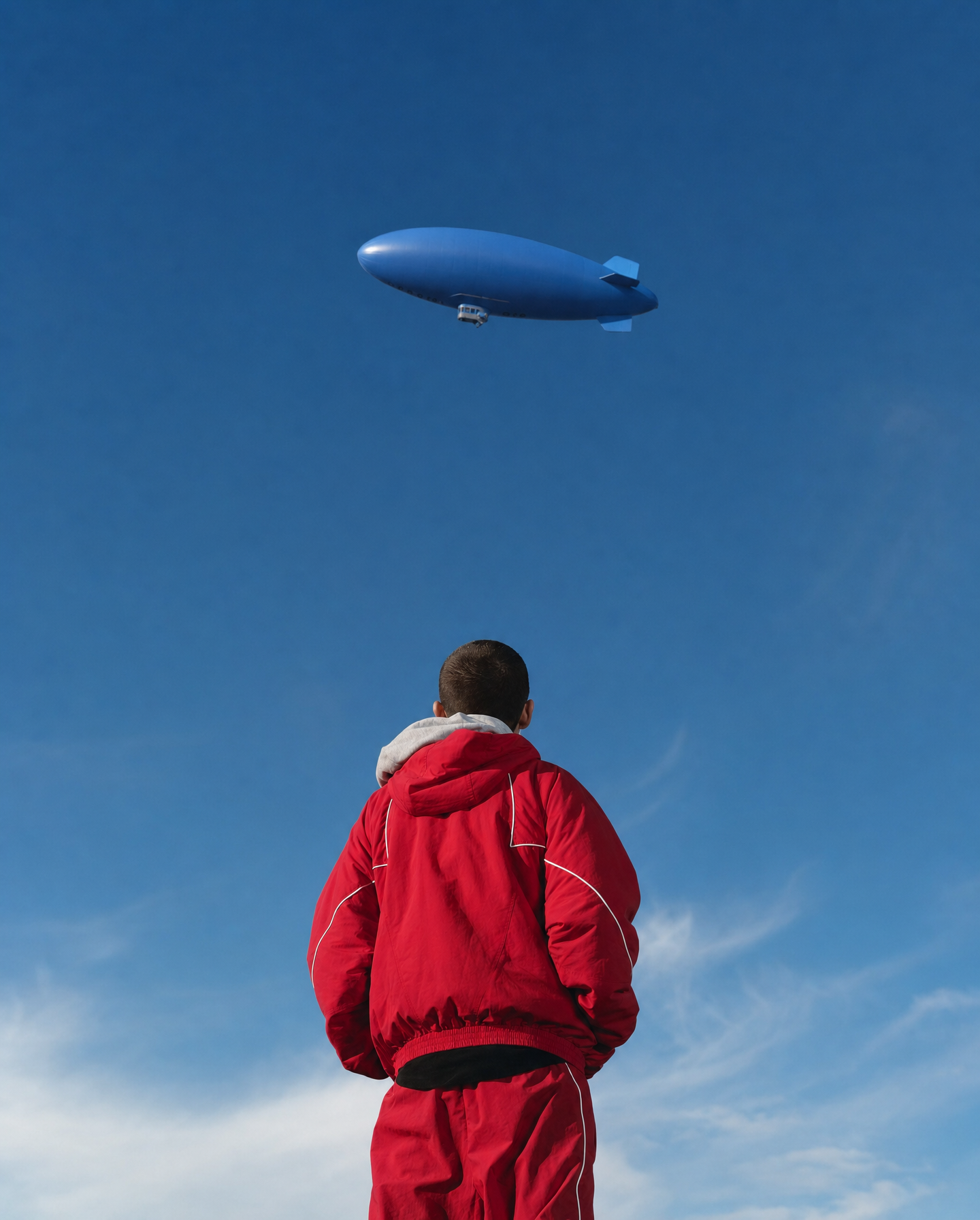
The low-angle shot and “person seen from the rear” make the upward gaze and the distant blue blimp the organizing axis, while the “minimal composition” leaves the clear sky doing most of the framing. “Red tracksuit with white piping” supplies the dominant red-and-white graphic block, set against the “deep blue sky” and “blue blimp” for the prompt’s explicit complementary contrast. “Crisp daylight,” “sharp focus,” and “realistic skin/fabric texture” keep the surreal scale relationship grounded in a convincing editorial photograph rather than an illustration.
FAQ
→How do I make the blimp more prominent and turn it into the main subject?
Replace “a blue blimp high above” with “a massive blue blimp occupying the upper half of the frame, clearly readable with visible gondola and panel detail,” and change “low-angle shot with minimal composition” to “extreme low-angle shot with the blimp dominating the composition.” Keep “person seen from the rear” but reduce the figure to “small full-body silhouette in the lower foreground.”
→How do I shift this from crisp editorial surrealism to a darker, more dramatic mood?
Replace “clear deep blue sky” with “storm-dark indigo sky with heavy layered clouds,” and “crisp daylight” with “hard directional sunset light with long shadows and red rim light.” Change “subtle surreal minimalism” to “ominous cinematic surrealism,” while retaining “red tracksuit with white piping” so the figure stays sharply separated from the darker background.
→How do I build a consistent series of variations from this image?
Keep the fixed structure “person seen from the rear,” “red tracksuit with white piping,” “low-angle shot,” “portrait-full-body,” and “cinematic editorial fashion photography.” For each variation, replace only “blue blimp high above” with a controlled object list such as “silver zeppelin,” “floating red weather balloon,” or “enormous white moon,” and swap “clear deep blue sky” for matching settings such as “pale overcast sky,” “violet twilight sky,” or “golden sunset sky.”
Learn the technique behind this
- Why can't AI spell, and how do I get readable text in an image? — Older diffusion models had no character-level representation of text, so they produced letterform-shaped texture instead of words.
- How should a prompt be structured, and does word order matter? — A prompt that behaves predictably names one subject first, then what it is doing, then where, then the light, then the lens or medium, then the style.
- Do negative prompts work, and what should go in one? — Negative prompts work on models that support a separate negative conditioning channel — mainly Stable Diffusion and FLUX-family models.
Related prompts
Teal fashion editorial in monster-filled lift
Cobalt Boots in Sleek Studio Edit
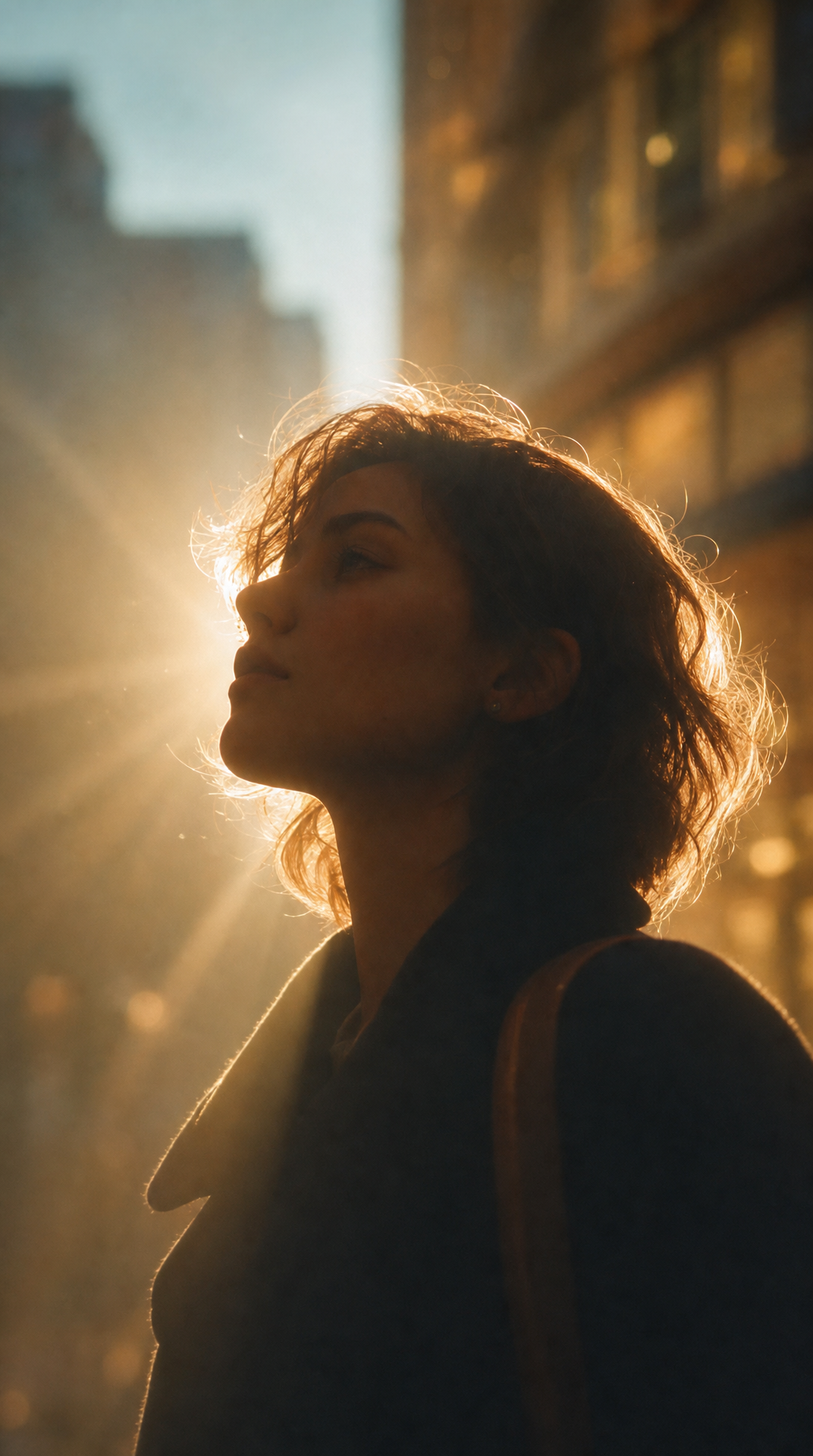
Silhouette Influencer by Sunlit Window

Sunlit editorial on striped beach towel