Why this works
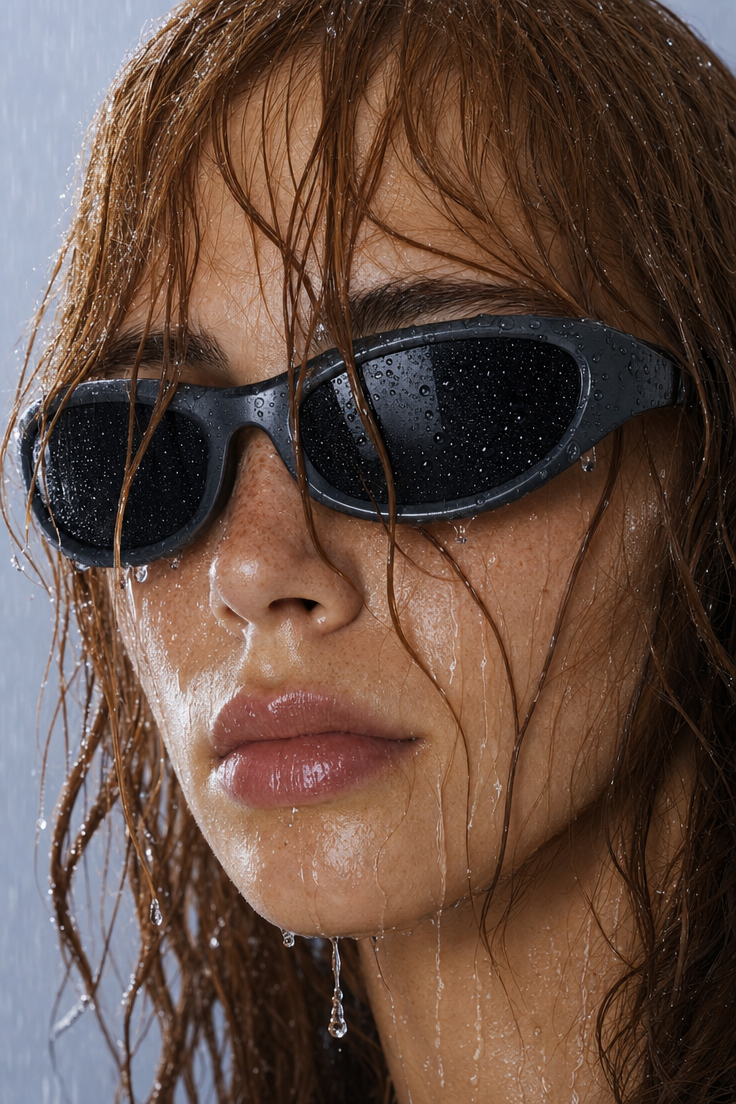
The close-up framing and “crisp focus on her face and sunglasses” make the portrait feel immediate, while “shallow depth of field” suppresses the slate blue-gray background into a clean editorial field. “Soft overcast daylight with cool, fresh color grading” establishes the cool, glossy tone, and “high micro-detail on water bead texture” gives the black-and-gray palette tactile contrast through sharp droplets and rim highlights. The “slightly oversized” gunmetal sunglasses and “light auburn” hair provide graphic shape and a restrained warm accent without breaking the severe, modern composition.
FAQ
→How do I make her eyes and expression more central instead of the sunglasses?
Replace “non-mirrored gunmetal-gray sunglasses with a slightly oversized frame” with “no sunglasses, direct eye contact, sharply defined irises,” and change “crisp focus on her face and sunglasses” to “razor focus on her eyes and relaxed intense expression.” Keep “close-up portrait framing” and “shallow depth of field” so the face remains dominant.
→How do I shift this from cool, severe editorial imagery to a warmer cinematic mood?
Replace “soft overcast daylight with cool, fresh color grading” and “cool tonality” with “warm late-afternoon sidelight, amber highlights, and muted copper color grading.” Change “slate blue-gray background” to “deep terracotta studio background,” while retaining “rain-soaked, glossy skin” and “visible water droplets” for the reflective texture.
→How do I build a matching series with different weather or styling while preserving this composition?
Keep “close-up portrait framing,” “shallow depth of field,” and “crisp focus on her face and sunglasses” unchanged, then swap “rain-soaked, glossy skin” and “visible water droplets” for a defined condition such as “windblown skin with fine salt crystals” or “frosted skin with tiny ice particles.” Replace “light auburn wet hair, clinging to her face” with a series-specific styling phrase such as “short platinum hair swept sharply to one side,” and assign each variation a new background color while preserving the same gunmetal accessory.
Learn the technique behind this
- Why can't AI spell, and how do I get readable text in an image? — Older diffusion models had no character-level representation of text, so they produced letterform-shaped texture instead of words.
- Why does AI get hands and faces wrong, and how do I fix it? — Hands fail because they're small in frame, extremely variable in pose, and self-occluding — the model has less usable signal per pixel than for any other body part.
- How do I keep the same character across multiple images? — Text prompts alone won't hold a face across images — a description defines a type, not a person.
Related prompts

Teal fashion editorial in monster-filled lift
Cobalt Boots in Sleek Studio Edit
Silhouette Influencer by Sunlit Window
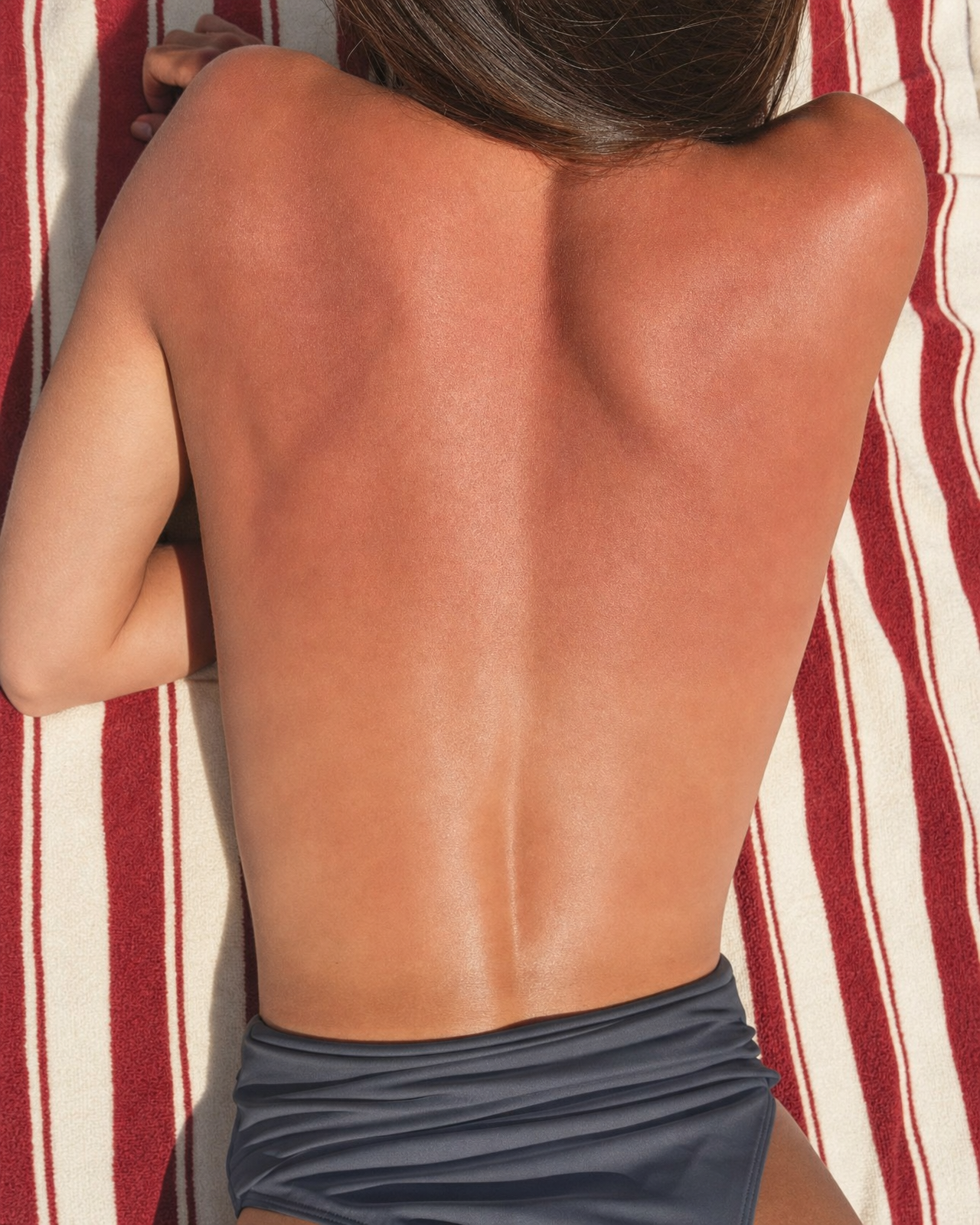
Sunlit editorial on striped beach towel