Why this works
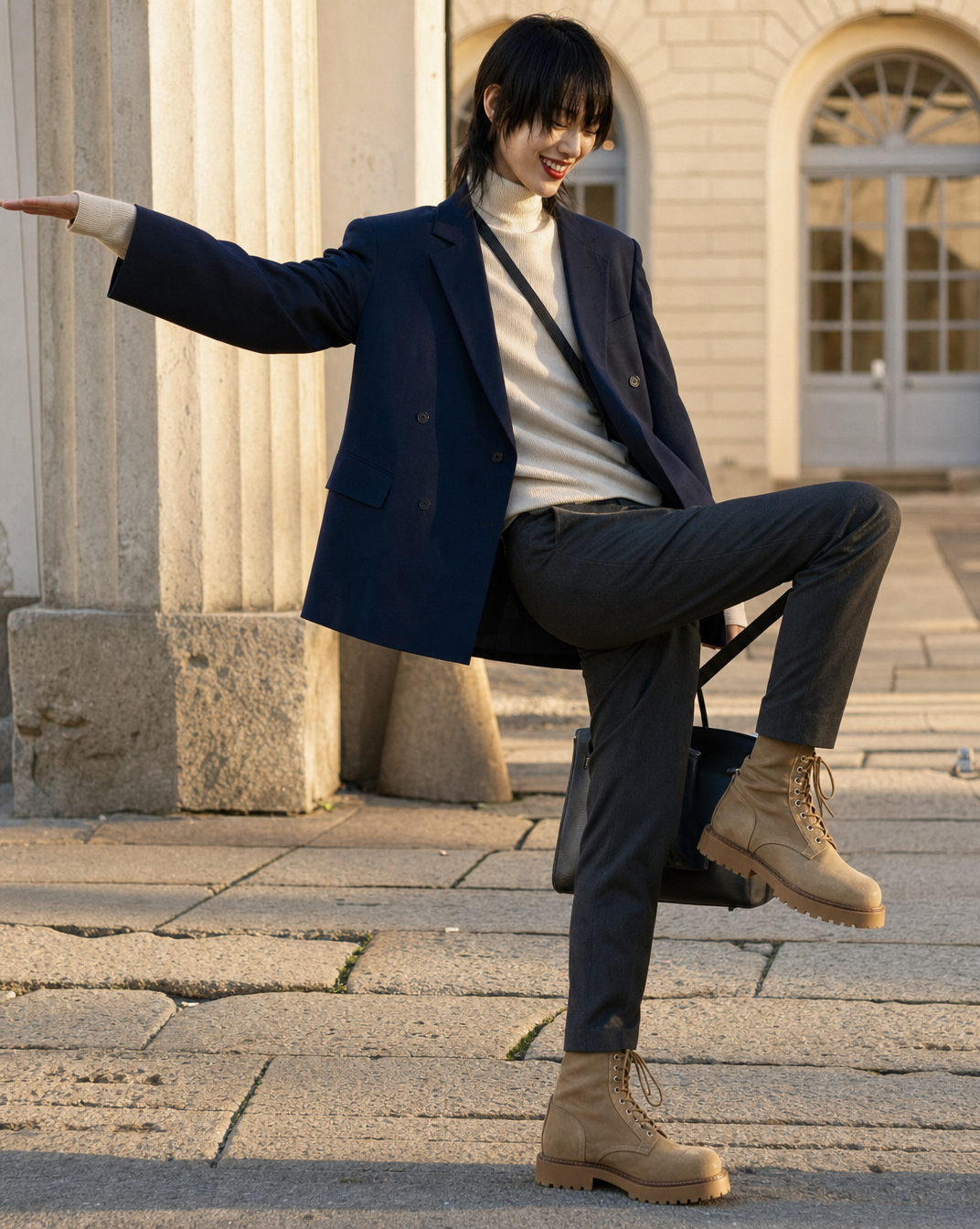
The phrase “dynamic and one-legged with arms outstretched” supplies the image’s playful, confident gesture, while “candid editorial fashion photography” keeps the pose from feeling like a rigid studio setup. “Portrait-full-body,” “urban pavement,” and “in front of a classical stone building” establish a clear full-length vertical composition with architectural context rather than a headshot. The navy blazer, cream turtleneck, charcoal trousers, and tan boots create a restrained navy-beige-gray harmony, while “natural late-afternoon sunlight” adds warmth without breaking the muted earth-toned palette. “Shallow depth of field” separates the subject from the building, and “high-detail facial and fabric textures” preserves the editorial emphasis on clothing and expression.
FAQ
→How do I make the image feel more cinematic and less casually playful?
Replace “candid, playful confidence” with “composed, cinematic confidence,” and change “captured with candid energy and a slight motion feel” to “静? deliberate fashion pose with controlled stillness and dramatic presence.” Keep “natural late-afternoon sunlight,” or replace it with “low golden-hour backlight with long architectural shadows” for stronger visual drama.
→How do I make the person more prominent than the building?
Replace “portrait-full-body” with “full-body subject-dominant portrait, subject filling 80 percent of the frame,” and change “in front of a classical stone building” to “classical stone building softly blurred in the distant background.” Keep “shallow depth of field,” and add “low camera angle, strong foreground separation” to give the figure more visual authority.
→How do I create a series of variations while keeping the same fashion identity?
Keep “navy blazer over a cream turtleneck, charcoal slim-fit trousers, and tan leather lace-up boots with chunky soles” unchanged as the wardrobe anchor. Make controlled swaps to “classical stone building on urban pavement,” such as “modern glass arcade,” “painted brick side street,” or “museum steps,” and vary “one-legged with arms outstretched” to “mid-stride glance,” “hands in blazer pockets,” or “turning pose with one boot lifted.”
Learn the technique behind this
- Why can't AI spell, and how do I get readable text in an image? — Older diffusion models had no character-level representation of text, so they produced letterform-shaped texture instead of words.
- How should a prompt be structured, and does word order matter? — A prompt that behaves predictably names one subject first, then what it is doing, then where, then the light, then the lens or medium, then the style.
- Do negative prompts work, and what should go in one? — Negative prompts work on models that support a separate negative conditioning channel — mainly Stable Diffusion and FLUX-family models.
Related prompts
Teal fashion editorial in monster-filled lift
Cobalt Boots in Sleek Studio Edit
Silhouette Influencer by Sunlit Window
Sunlit editorial on striped beach towel