Why this works
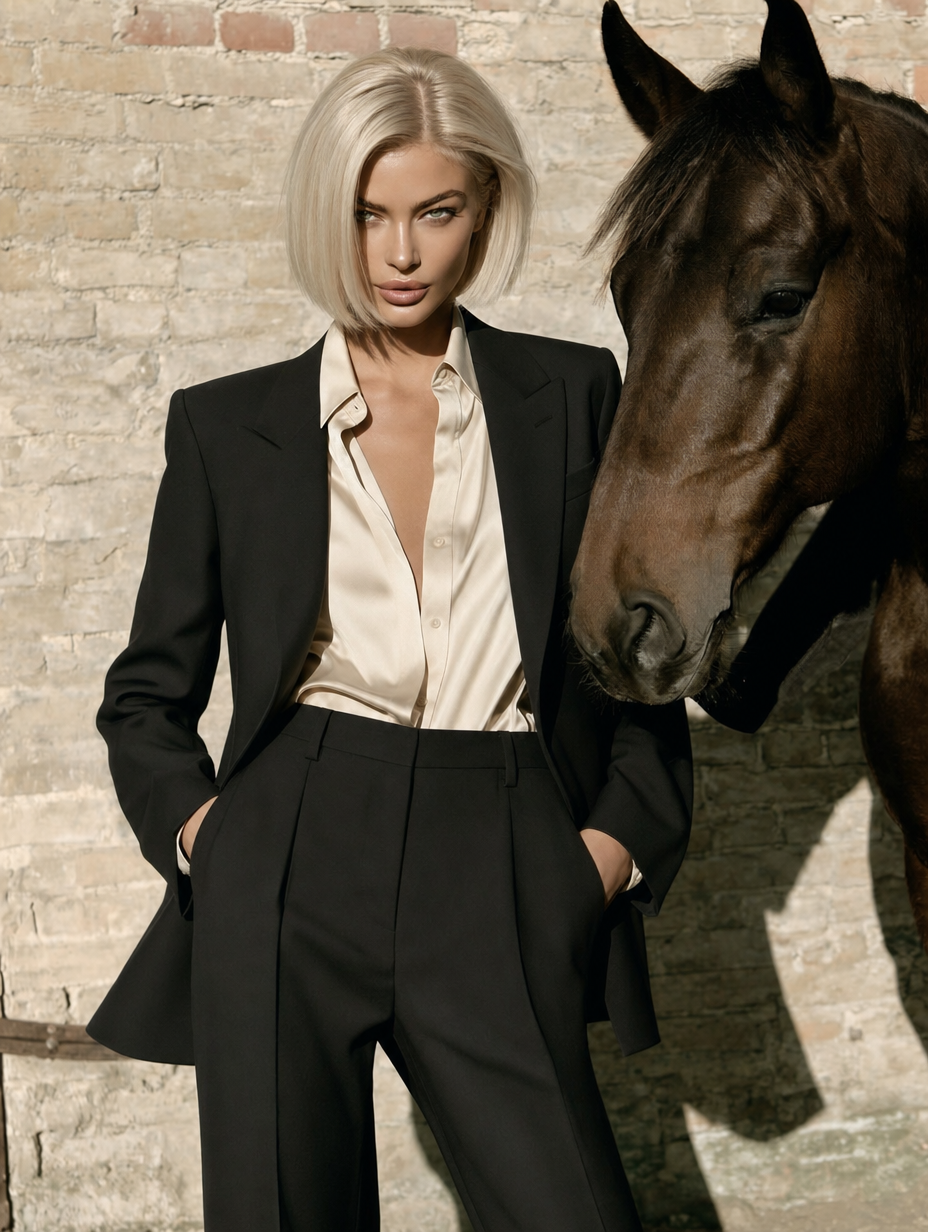
The “woman posing beside a dark brown horse” establishes a strong human-animal scale relationship, while “portrait-full-body” and “elegant composition” preserve both figures as the central read. The “tailored black blazer and cream satin blouse” create a restrained black-and-cream wardrobe contrast against the beige-dominant image, and “dramatic natural side light” adds sculpted definition to the fabric, hair, and horse. “85mm lens perspective” with “shallow depth of field” keeps the editorial portrait feeling compressed and polished, while “textured brick wall background” supplies tactile context without competing with the subjects.
FAQ
→How do I make the horse more prominent than the woman?
Replace “A fashionable woman posing beside a dark brown horse” with “a woman standing slightly behind a large dark brown horse, the horse’s head and shoulders dominating the foreground.” Change “portrait-full-body” to “environmental portrait with the horse in the primary foreground,” and replace “shallow depth of field” with “moderate depth of field” so the horse remains sharply legible.
→How do I shift the mood from moody luxury to bright daytime editorial?
Replace “moody cinematic look” and “luxurious, elegant, moody” with “bright, airy high-fashion editorial” and “fresh, optimistic, refined.” Change “dramatic natural side light” to “soft diffused morning light,” and replace “high-contrast color grading” with “low-contrast warm pastel color grading.”
→How do I create a coordinated series with different outfits and settings?
Keep the fixed anchors “photorealistic editorial fashion photography,” “85mm lens perspective,” “refined posture,” and “realistic skin texture,” then swap “tailored black blazer and a cream satin blouse” for variations such as “structured ivory suit with a silk burgundy camisole.” Replace “textured brick wall background” with settings such as “pale limestone courtyard,” “dark stable interior,” or “windswept coastal field,” while retaining “dramatic natural side light” to unify the series.
Learn the technique behind this
- Why can't AI spell, and how do I get readable text in an image? — Older diffusion models had no character-level representation of text, so they produced letterform-shaped texture instead of words.
- Which aspect ratio should I use, and how does it change the image? — Aspect ratio determines what the model composes, not how it's cropped afterwards.
- How should a prompt be structured, and does word order matter? — A prompt that behaves predictably names one subject first, then what it is doing, then where, then the light, then the lens or medium, then the style.
Related prompts
Teal fashion editorial in monster-filled lift
Cobalt Boots in Sleek Studio Edit
Silhouette Influencer by Sunlit Window
Sunlit editorial on striped beach towel